Project Contest to launch the p2p lending service in France

Beginning 2010, Friendsclear will launch Friendsclear Pro – the first real P2P lending service in France.

For this occasion, Friendsclear organizes a project contest:

– everybody can submit a professional project

– the public can vote for the best project

– the project which gets the most support will win 10k€

The author lives in France and reports as a guest blogger on french p2p lending trends for P2P-Banking.com.

A P2P Lending Service in a Cooperative Banking World

The main specificity of the French banking landscape is the important credit union culture. France has a strong history in cooperative banking, which gave birth to today’s important French banks as Credit Mutuel for example.

Will this history have an impact on the P2P lending development in France?

It’s interesting to notice, that the first P2P lending service in France, FriendsClear, just inked a partnership with one of these cooperative banks: Credit Agricole, a former farmer cooperative which evolved into one of the main modern global banking players.

At the end of this year, thanks to this partnership and the bank license, FriendsClearwill be able to open a genuine crowdfunding P2P service for very small businesses. I will come back in a later post on the details of this partnership and how the service will be provided; I just wanted to underline the specificity of the French Banking landscape and the credit union culture for P2P lending.

For FriendsClear’s Founder, Jean-Christophe Capelli, it makes no doubt that it has a strong positive impact. “I see a very bright future for P2P lending around the world, but especially in France, where we have a cooperative banking culture” he declares, and French banks seem intrigued even interested in this new practice. “It reminds them of their origin, when farmers got together to help one of them buy a plough or a youngster to settle. With P2P lending we are in very similar model, which has probably been neglected over time. It reminds them of their values of solidarity.”

Thus, about the actual #bankbloggerfight between James Gardner and Chris Skinner to know whether P2P lending is disruptive for the banking industry, Jean-Christophe sees it very differently in France: “it is reflecting their own image, where they have arrived, and whether they are still relying on their founding values. In this case, the disruption will much more be on the image they want to send out, on their marketing, and further on their DNA.”

Having contacted several French banks to build this partnership, Jean-Christophe noticed a strong interest in P2P lending: “the innovation manager of a big bank, showed me the strategic road map for 2012 and they targeted a strong presence in P2P lending”.

FriendsClear doesn’t fear competition, though, quite the contrary, they’re looking for it: “the most important part in our business today, is to spread the word. You don’t wake up in the morning, thinking, I’m going to take a P2P credit. The way to approach finance should evolve, and we need to get away from the idea that the best way to manage money is to take a revolving card. If there were a couple of other serious P2P services, we could reach a far more important part of the French population and let the usage evolve more quickly”.

For the moment, the only competitors to FriendsClear would be banks. But they are actually not targeting the same population, and that is probably why banks will want to get into P2P lending to access this new fringe of the market: “if the Credit Agricole has been so keen on working with us, it’s because they realized that, with their current offer, the very small businesses were not addressed. With P2P lending, they see a way of enlarging their offer to this population.”

Even if France is very late in providing a genuine P2P service, the specificity of the French culture could accelerate the market penetration.

The author lives in France and reports as a guest blogger on french p2p lending trends for P2P-Banking.com. Also posted in ekwiti

Review of peer to peer lending developments in 2008

As the end of 2008 approaches here is a look back on the highlights of peer to peer lending news in 2008:

Babyloan microfinance

Launched in summer French Babyloan.org has about 1750 lenders financing peer to peer micro-loans to entrepreneurs in developing countries. I signed up yesterday when I found the service (thanks to Jean Christophe Capelli for the pointer) and helped to fund 5 loans to borrowers in Benin, Cambodia and Tajikistan. One of them is Kheav Sitha who runs a small restaurant stand at her house in Phnom Penh, Cambodia. She wants to borrow 140 Euro for 6 months.

Signing up went smoothly. I liked the user interface for selecting the loans. It features summaries of the loan detail that are shown with AJAX on the right side of the screen while moving the mouse over photos of the borrowers seeking loans on the left side. The website is in French and English, but on some points the English translation seemed to be missing. Funds are transferred in via credit card payment – I have not yet found out how they can be transferred out after the loan term ends if they are not re-lend.

Like other platforms Babyloan partners with local microfinance institutions (MFIs). The MFIs screen the borrowers and handle the payout to the borrowers – in the case of Babyloan the payout has actually taken place BEFORE the loan is placed on the platform – and the MFI takes the sum to refinance the loan.
Unlike at MyC4 lenders do not receive interest. While Kiva asks for voluntary donations to fund its operations, at Babyloan a fee of 1 Euro per 100 Euro funded is compulsory . (Minimum a lender can lend is 20 Euro).

Babyloan is backed by Acted (a NGO), Bred (a regional bank in France) and Credit Cooperatif.

The following presentation explains what Babyloan does for MFIs:

Veecus launches peer to peer microfinance

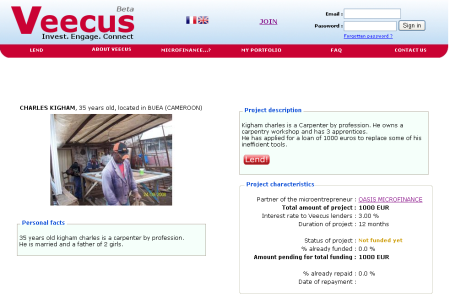
veecus logoThis week the new social lending service Veecus.com launched. Veecus is a peer-to-peer microfinance network. It allows microentrepreneurs from all over the world to access funds to develop their projects. Lenders can select projects, invest and take part in economic development.

Microfinance institutions (MFIs) supply the loan listings and set the interest rates. Currently there are two MFIs active (VSSU and Oasis Microfinance), which list loans in India and Cameroon offering 3% interest rates.

Lenders can bid in multiples of 20 Euro. Currently uploading money is done via Paypal. Credit card payments will become available next week.

Veecus is run by a french limited company, run and owned by the co-founders Clément Carjat and Baptiste Fabre. Veecus will make money from a “volume-based fee paid by microfinance institutions once they
have received funds for microentrepreneurs projects.” as well as a 1 Euro one-time signup-fee from each lender.

The site is available in english and french language (the company blog is in french only). If you have tried Veecus please share your experiences with the community in our Forum.

The concept has similarities to Kiva and MyC4.

veecus loan listing

Image: One of the current project loan listings.