State of Selected P2P Lending Companies

More than 2 years have passed, since P2P-Banking.com published the first overview table of p2p lending companies. At that time the focus was to create a comprehensive list and to get a perspective on the loan volumes.

Today I want to look at a smaller selection of p2p lending companies and do a rating on more factors than just loan volume. While I describe below what factors led to my rating, please note that the rating represents my personal opinion.

The table lists the companies in alphabetical order and gives:

New loan volume per month

This amount is in most cases retrieved from the last month(s) figures from the company websites (if they have statistic sections), and then converted into US$ at today’s currency exchange rates. In other cases it is a rough estimate by me based on volume figures published in media in the recent past. For CommunityLend I failed to find a per month figure (the total figure from launch to mid-February is here).

Brand/Press

Extend and tone of press coverage in the past months. Since a large share of new users is introduced to p2p lending services via media, positive media coverage is extremely important. Continued positive media coverage has helped some companies to associate positive values to their brand.

Growth/Marketing

This column especially rates if the new loan volume is growing continuously month after month. Furthermore it puts the absolute volume into perspective to the size of the market. It is obvious that absolute numbers in a country with a small population (e.g. Canada) will be much lower than those in a country with a large population (e.g. US). Furthermore it takes into account if the (online) marketing measures of the the company succeed in winning new borrowers and lenders (though in most markets lenders do not need to be actively acquired).

Sustainability

Sustainability rates a mix of several factors:

  1. ROIs for lenders / default rates
    Most p2p lending companies that failed in the past, did so as a result of high default rates which led to negative lender ROIs and caused massive lender churn
  2. Ability of company to raise new funding
    Most p2p lending companies still have to bridge a considerable time-span at their current growth rate before they become cash flow positive. The ability to raise more funding to finance continued operation is essential for their success
  3. Business model

User satisfaction

This rates the publicly voiced user opinion. Major factor are the comments in forums. To a lesser degree I took the user experience published in blog articles into account. The problem with lender experiences published in blogs often is that the writer is casting a positive image, since he earns commissions for newly referred customers through the affiliate program of the p2p lending site. Also these review are often written at the start of the lending activity at which point the lender’s ROI is naturally unharmed by the experience of defaults.
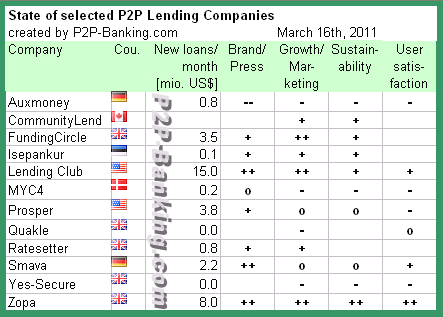

Empty fields: I had not enough information to rate these. E.g. with some of the new UK p2p lending companies I felt I had too few indicators to reach an opinion on the sustainability.

Availability of information also influenced the selection of companies. Due to language barriers including more services (e.g. the Japanese p2p lending companies) was not feasible for me.


Kiva to reach 25 million US$ loan volume

Kiva.org, which allows everybody to help funding microloans to entrepreneurs in developing countries, will achieve the milestone of 25 million US$ loan volumn within the next two days.

Launched 2005 the amazing growth curve can be seen on this Kiva stats page. The growth accelerated in 2007 driven by major media coverage. Up to now more then 260,000 individual lenders have funded more than 37,000 loans in 42 countries.
The current default rate is only 0.11%. While Kiva lenders do not receive interest, borrowers pay interest to the local Kiva Field partners (microfinance institutions).

Kiva, founded by Matt and Jessica Flannery (picture), is  a non-profit which currently has 16 employees paid by optional 10% lenders can donate on top of loans. Apart from them many volunteers aid the Kiva cause.

A February 2006 survey showed that Kiva donors were evenly distributed between 25 and 60. Slightly over half were males, and 65% made more than $50,000 a year. But a $25 cap on individual donations is causing the demographics to spread; more older, younger, and less-well-off people are signing up. Kiva has about 15,000 to 20,000 visitors a day coming to the site now.

While lenders may withdraw funds via Paypal upon repayment, 90% decide to reinvest the money into new loans.

(Picture courtesy Kiva.org)

Lending Club hits 10 million US$ loan volume

P2P Lending service Lendingclub.com, which launched last May, today surpasses 10 million US$ in loans. While the total amount is still much lower then the loan volume of competitor Prosper.com (currently over 120 million US$ loan volume) the growth acceleration of Lendingclub is really impressive.

Rob Garcia, Director Web production at Lending Club, told P2P-Banking.com:

This milestone confirms the validity of our approach to person-to-person lending, but more importantly, our value proposition to our borrowers and lenders.  Borrowers are realizing 20-30% better rates than going through the banks, while our lenders enjoy 12% average returns.  We are working to take this concept to a larger audience, so $10M is just a mile marker in our marathon.

The growth can be seen in this chart. For Prosper loan volume compare chart on this page. So basically in February Lending Club has originiated close to the amount Prosper did, when taking into account only those loans that would fit the minimum criteria of Lending Club's 640 FICO score and <30% DTI.

The statistic information at Lendingclub.com shows that over 1200 loans have been issued. So far few loans are late, but since most of the loans are very young, it is to early to tell which level of defaults will have to be expected. The statistic page also shows that Lendingclub declined over 80 million US$ in loan applications.

If you sign up via this link, you get a 25 US$ bonus by Lending Club (and I am paid a referral fee).

Finding the best MyC4 loans

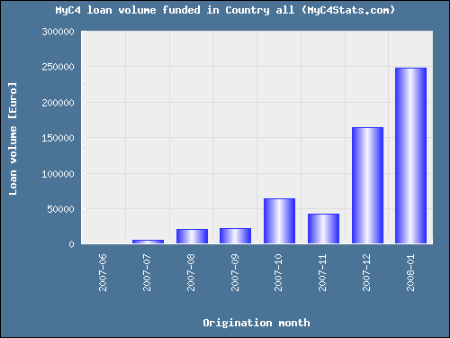
MyC4.com accelerated growth during the past month. This is shown by stats on MyC4Stats.com (provided by Wiseclerk.com) showing the loan volume by origination month. Compared to earlier months the loan volume rose sharply in December and January. In December 150,000 Euro loans and in January 250,000 Euro loans were disbursed to African entrepreneurs.

myc4 loan volume by month
(Source: MyC4Stats.com)

The new MyC4Stats page offers reports helping lenders to find open MyC4 loan listings with the best rates. At MyC4 – unlike at Prosper – every lender funds a loan at his individual interest rate. In fact 50 different lenders funding one specific loan may each earn different, self-set interest rates. While MyC4 sets a maximum for the weighted average interest rate for each loan, it is still possible for an individual lender to bid higher and earn more after funding.

Example: A 2500 Euro loan to Clementine Gbrou, who exports grains to Europe the maximum weighted Wanted interest rate was 12% (lender interest, not borrower). This loan closed with a weighted average interest rate of 11,64% (lender interest). The individual lenders in this loan earn DIFFERENT selfselected interest rate between 3% and 13.5%. Several lenders thus achieved above average rates.

How to find the best loans?

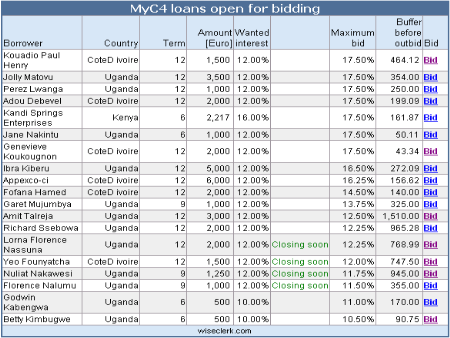
To select the loans with the best rates for bidding in the listing phase a quick overview of available listings sorted by the maximum possible interest rates that can be bid, is important. Several tables on MyC4Stats help lenders on this. Sample screenshot:

Myc4 bidding tool
(Source: MyC4Stats.com)

The report presents the listings sorted by maximum interest rate (column Maximum bid) that can be bid and states the Euro amount above this rate that serves as a buffer before being outbid. The buffer is caused by the rule that new bids must always be place at least 0.5% lower then the current high bid.

First anniversary of Boober

A year ago Boober.nl launched as first peer to peer lending service in the Netherlands. While Boober faced some hardship (especially on regulation issues) the first year of Boober can be called a success for the company. So far Boober has funded over 2 million Euro in loans in the Netherlands. Compare this to the 1 million Euro Smava.de has loaned in the much larger German market in the last 10 months.

But not all lenders are satisfied with the results. The PIVN an association of lenders, on Jan. 14th called for an investment stop. The main cause are fee changes. Richard van den Toorn, Secretary of PIVN, told P2P-Banking.com:

It's not going very well with Boober, although they claim otherwise. The
PIVN (association of investors) has indeed given an advice not to invest
in new loans until some of her demands have been met. Reason for giving
such an advice is that Boober changed their payment-policy for the
investors radically, without consulting the PIVN first. It's so much the
height of their fee …, but that they are making sure the
benefits are going to Boober first, leaving the investors [lenders] with the risk of
remaining payments from the borrower. Continue reading