International P2P Lending Services – Loan Volumes November 2014

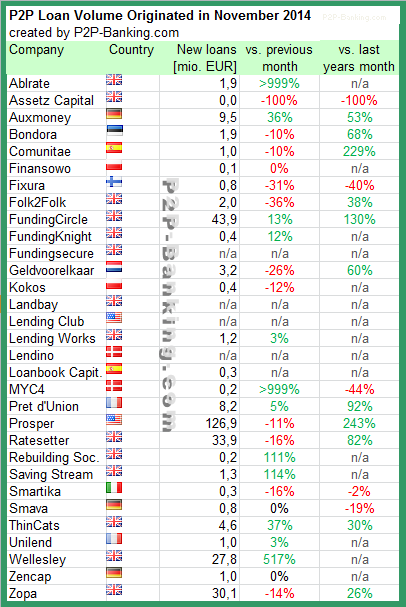
November was a month of mixed results for the listed p2p lending services. Some grew, some had a small decline in newly originated loan volume this month. Ratesetter crossed a total volume of 400 million GBP originated since inception. Ablrate profited from the deal with the first institutional investor, which boosted volume. I added one more service.  I do monitor development of p2p lending figures for many markets. Since I already have most of the data on file I can publish statistics on the monthly loan originations for selected p2p lending services.


Table: P2P Lending Volumes in November 2014. Source: own research
Note that volumes have been converted from local currency to Euro for the sake of comparison. Some figures are estimates/approximations.

Notice to p2p lending services not listed:
If you want to be included in this chart in future, please email the following figures on the first working day of a month: total loan volume originated since inception, loan volume originated in previous month, number of loans originated in previous month, average nominal interest rate of loans originated in previous month.

Lending Club Valuation at IPO 4.33B Max.

For the coming Lending Club IPO a recent SEC filing reveals details on the valuation of the company.

LendingClub Corporation is offering 50,000,000 shares of its common stock and the selling stockholders are offering 7,700,000 shares of common stock. We will not receive any proceeds from the sale of shares by the selling stockholders. This is our initial public offering and no public market currently exists for our shares of common stock. We anticipate that the initial public offering price will be between $10.00 and $12.00 per share.

After the IPO there will be 361,111,491 shares of common stock outstanding at Lending Club so at 12 US$ per share this will result in a 4.33 US$ billion valuation. Read more details on Lend Academy.

Growth of Bondora Resale Market

This post is based on the findings, which German investor ‘Bandit55555’ posted in his own blog p2p-anlage.de. ‘Bandit55555’ is the investor at Bondora with the highest ROI (at least that I am aware of): He calculates his XIRR ROI to be 35.4%, while Bondora displays 57.5% for his portfolio. He achieves that by very diligently using the public download data supplied by Bondora as a basis for his investing and trading. In fact he even developed his own scoring system based on the data.

The secondary market of p2p lending marketplace Bondora was introduced in March 2013. Right now more than 24,400 loan parts are on sale. Using the data Bondora makes publicly available for download the following charts were created.


Number of loans sold on Bondora’s secondary market. Source p2p-anlage.de, reproduced here with permission. Continue reading

P2P Lending in Poland and a Portrait of Kokos.pl

This is a guest post by Krystyna Mitręga-Niestrój, University of Economics in Katowice, Poland

P2P lending develops quickly in the world in recent years. The platform Kokos.pl was the beginner at social lending in Poland in February 2008. The following portals began to operate shortly thereafter: Finansowo.pl, Monetto.pl (both in March 2008, however Monetto is not operating any more) and Smava.pl (equivalent to German Smava.de platform). During the first four years of the Polish p2p lending market the value of loans was estimated at PLN 130 million (approx. USD 43 million). It consisted only a small number comparing to the value of consumer loans granted by banks – more than PLN 127 billion (approx. USD 42 billion), as of February 2012. Almost half of this amount (PLN 61 million, approx. USD 20 million) was borrowed through the platform Kokos.pl, which so far has more than 180 thousand users. After five years (situation at the beginning of 2013) from launching the first p2p platform approx. half a million the Polish residents borrowed approx. PLN 250 million (USD 58.5 million) (5 lat pożyczek społecznościowych, 2013). The owners of the p2p platforms earn money mainly on fees charged for transactions. It should be noted, that the information about the p2p lending market in Poland is limited and current, comprehensive data are lacking.

The most important players on the Polish social lending market are: Kokos.pl (with almost 80% share in invested funds through p2p lending platforms), Finansowo, Sekrata, Pożycz, SzybkoiPewnie, Bilonko, Zakra (Zestaw Narzędzi Pożyczkodawcy, 2013). The situation on p2p lending market in Poland is dynamic, however there is more positive tendencies associated with entering of the new players on the market, than the bankruptcies of the p2p platforms. The two examples of the latter are the collapse of Monetto.pl and Ducatto.pl. The Polish peer-to-peer lending market seems to be interesting for foreign p2p platforms (for instance the entrance of Swedish TrustBuddy in 2013).
Taking under consideration the information from the largest p2p platform Kokos.pl (the data include the 5 years period, from the launching of the platform) we can state that the statistical investor and borrower came from Masovian Voivodeship (is the largest, the most populous and the wealthiest voivodeship in Poland), are on average 34 and 33 years old. The statistical borrower borrows on average PLN 2,026 (USD 1.500) for 11 instalments. The average salary is equal to PLN 2,723 (approx. USD 2000).

At the beginning when first p2p lending platforms have launched a great part of Polish society was skeptical about such form of investing and borrowing. The threat of fraud and bankruptcies of p2p platforms hampered the development. However, thanks to changes and refining methods of verification the p2p platforms have became safer. The popularity of social lending is growing steadily in Poland. This trend is, among others, influenced by more attractive offer and promotions of p2p lending platforms. Continue reading

Interview with Matthew Powell, CFO of Lending Works

What is Lending Works about?

Lending Works is an online marketplace lending platform for unsecured personal loans. We offer extremely competitive lender returns and fixed rate, flexible loans up to £25,000 over 1 to 5 years.

What are the three main advantages for investors?

  1. Lender protection – our unique Lending Works Shield consists of a reserve fund to cover loan arrears and insurance to protect against the primary reasons for borrower defaults, including loss of employment, fraud and cybercrime. No other peer-to-peer lender offers this. In addition, our underwriting processes are extremely robust, resulting in a 0.00% arrears and default rate since launch
  2. Great returns – our lender returns are extremely competitive and are protected by the Lending Works Shield, so the rate you see is the rate you get
  3. Flexibility – lenders can access their funds early using our Quick Withdraw facility, or can automatically reinvest monthly repayments using Auto Lend

What are the three main advantages for borrowers?

  1. Low cost loans – our loans are offered at market leading rates. By directly connecting our customers and cutting out the bank, we’re able to cut down the cost of a loan significantly
  2. Simplicity – by utilising the latest technology and being an exclusively online platform, we’re able to pay out funds within one working day of completing the simple online application process
  3. Flexibility – borrowers can make overpayments or settle their loans early at any time, without charge

What ROI can investors expect?

Lenders can expect returns of around 4.1% over 3 years, up to 6.0% over 5 years. These rates are protected by the Lending Works Shield so there shouldn’t be a need for lenders to factor in bad debts.

How did you start Lending Works? Is the company funded with venture capital?

We started building Lending Works in 2012 and launched the platform in 2014. The idea was to create a simple and safe platform to enable ordinary consumers to get a fair deal. We tried to make lending and borrowing through Lending Works as simple as possible – most of our customers do not have the time or desire to actively monitor and manage their account. That’s why we opted to steer away from an auction-based or “market” model and introduced features like Auto Lend to automate the reinvestment process.

The company is funded primarily by angel investors. We’ve raised around £4m in funding to date which has enabled us to navigate the launch period successfully. We’re now focused on driving exponential growth through innovative partnerships and new loan origination channels.

Is the technical platform self-developed?

The technical platform is completely bespoke and was initially built by an external digital services agency. Since launch we’ve brought all development activity in-house which allows us to innovate quickly and to regularly release updates. We hired our first Head of Technology, Michael Raasch, in September. Michael has over 25 years’ experience working for large investment banks and has been fundamental in preparing our platform for large scale. Continue reading