Fynanz – p2p loans to students

Fynanz.com, currently launching for borrowers in New York and Florida, offers peer to peer lending to students.

Fynanz 

The service differs from other p2p lending service in many points.

  1. The private student loans, also known as "alternative student loans", Fynanz offers have variable interest rates. Other p2p lending services so far operate only with fixed interest rates. At Fynanz interest rates are based on the LIBOR index, adjusted quarterly, plus a margin which is set by lenders. Suggested margins are 3 to 7.5% for a typical overall interest rate of 6 to 11% before fees.
    This is higher then federal student loans, but Fynanz still sees a large market, since federal student loans have borrowing limits and may not cover the entire costs of education.
  2. Very long loan terms of 10 to 20 years. Again unsual, but lenders may offer to sell loans after one year at a discount to Fynanz. There also seems to be the option to transfer a loan to a different lender (allowing the sale to a different lender).
  3. Students can select to defer interest payments while in school and for a 6 month grace period after leaving school.
  4. Loan amounts range from 2,500 to 20,000 US$ per loans. Borrowers may take out up to four loans per year to a total maximum of 160,000 US$. That is an unprecedented amount in p2p lending.
  5. The fees are pretty high in my opinion. Borrowers pay 2.9, 4.9 or 6.9% (depending on FACS) of the loan amount origination fee. Addionaly borrowers pay 1% guarantee fee into the guarantee fund until they have repaid 10% of the loan amount. Lenders pay a 1% servicing fee (not while loan is in deferment)
  6. Guarantee for lenders. Not only in case of identity theft, but also in cases of defaults Fynanz protects 50 to 100% (depending on FACS grade) of the loan amount.
  7. Fynanz applies it's own FACS grade (Fynanz Academic Credit Score) to rate borrowers. It not only relies on the credit history but also on academic charateristics.
  8. Pledge bids allow lenders to bid without having funds in account. Lenders must transfer money within 5 days of bidding.
  9. Fynanz has a "bid priority" that ranks four types of types of lenders in the following order: the highest priority lenders are friends and family of the borrower; then alumni of the borrower’s school; third are unaffiliated lenders; and fourth is Fynanz itself.

Hollowoak has some more interesting points from the lender agreement in his blog, which Chirag Chaman, Fynanz CEO commented on.

To browse listings go to the Fynanz listings page.
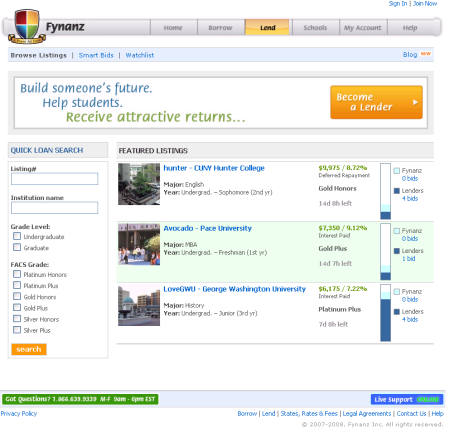
Further information ressources include Tom's review, the comprehensive FAQ and the new Fynanz blog answering questions.

Overall it will be interesting to see how Fynanz develops. If you use Fynanz as a lender or borrower please share you experiences in the forum.
Prosper seeks Hedge Funds as lenders

Prosper.com is actively promoting it's marketplace to hedge funds.

Prosper is America’s largest peer-to-peer marketplace with over 600,000 members,” stated Kirk Inglis, CFO of Prosper. “As credit markets experience unprecedented changes, institutional lenders, including hedge funds, are using Prosper to diversify portfolio returns without the lack of transparency and fees associated with structured consumer debt products.

(via ProsperousLand)

Another recent Prosper related topic was the concern raised by lenders that in select states Prosper stops any collection activities on small loans, if the borrower sends a Cease-and-Desist letter (the example given is a 2,500 US$ loan in Texas). The author of the blog post argues that the risks for lenders rise, if this example really shows overall practise.

Moreover, they won't pursue legal action to recover small loans. So all small loans are now risky since the borrower has an easy method to halt payment, collections and legal proceedings. Prosper simply seems unwilling to go after small borrowers.

Finally, even for larger loans, it seems unsafe to lend, since Prosper will only sue in select states. I don't recall Prosper saying anything about selective enforcement in my many lender agreements, but before I put another penny into Prosper, you can be damn sure I will ask them what states they will take legal action in and what the minimum loan amount is for which they will sue.


Review – Smava after year one – Lenders satisfied

German p2p lending service Smava.de launched one year ago. Since the launch of Smava 393 loans were funded for a total loan volume of about 1.7 million Euro (approx. 2.6 million US$).

Lender’s viewpoint

In a february survey 33% of lenders answered to be very satisfied with Smava and 63% were satisfied. 48% said their ROI met expectations while 19% said it exceeded expectations.

So far a 7% ROI is realistic. Only 3 loans have defaulted and 11 are (less then 30 days) late. In the past Smava cured the majority of late loans. The Anleger-Pool mechanism spreads the losses of a default across all loans of a credit grade. Therefore when 1 in 100 loans in credit grade X defaults, the lenders invested in the defaulted loan still receive 99% of the principal, while for lenders in the current loans returns are lowered by 1%.

Technically and on the process level Smava functions as promised.

Borrower’s viewpoint

Provided the borrower has a credit grade of at least ‘H’ (95% of the German population have credit grades between ‘A’ and ‘H’ so about 5% are excluded) and he has a sufficient income, chances for obtaining a loan through Smava are good. About two third of the listings were funded. The fee of 1% of the loan amount that Smava charges borrowers is low.

Marketplace development

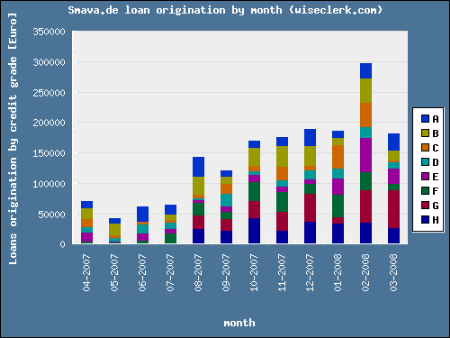
Smava’s growth has picked up in the last month (see chart).


(Source: smava loan stats, Wiseclerk.com, 03-21-08)

So far Smava has not reached a broad appeal. While press release state 25,000 registered users, only 650 have invested money and roughly 450 wrote a loan listing. Looking at the distribution of lenders by amount invested, the top 50 Smava lenders funded about 700,000 Euro (or about 40% of total loan volume). Currently lenders are limited to a maximum of 25,000 Euro investment.

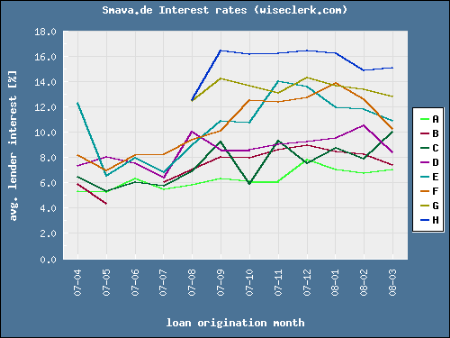
Attracting new borrowers has been the bottleneck for Smava’s growth so far. An increase of money supply by lenders with no matching demacnd increase led to slightly falling average interest rates in the last weeks (see chart). Before rates increased, especially for credit grade ‘F’ caused by sharpened risk awareness following several late payments.


(Source: smava loan statistic, Wiseclerk.com, 03-21-08)

Smava charges borrowers a fee of 1% of the loan amount. There are no fees for lenders. Total revenue of Smava in the first year therefore was 17,000 Euro (1% von 1.7 million Euro). Prosper, Lendingclub and Zopa have much bigger p2p lending volumes per year. Boober‘s loan volume in the Netherlands is about the same size as Smava’s but in a market with only one fifth the size (by inhabitants). First priority of Smava must be to accelerate growth.

Boober director Guus Drijver leaves company

Guus Drijver, director of Dutch p2p lending service Boober.nl, will leave the company on April 1st. The new director Ilse Smulders cited different opinions on how to further develop the company as cause for the departure.
According to unconfirmed blog sources, Boober failed to reach the forecast numbers in 2007.

Unrelated: Recently Boober searched to fill the position 'Financial Manager'.

Kiva to reach 25 million US$ loan volume

Kiva.org, which allows everybody to help funding microloans to entrepreneurs in developing countries, will achieve the milestone of 25 million US$ loan volumn within the next two days.

Launched 2005 the amazing growth curve can be seen on this Kiva stats page. The growth accelerated in 2007 driven by major media coverage. Up to now more then 260,000 individual lenders have funded more than 37,000 loans in 42 countries.
The current default rate is only 0.11%. While Kiva lenders do not receive interest, borrowers pay interest to the local Kiva Field partners (microfinance institutions).

Kiva, founded by Matt and Jessica Flannery (picture), is  a non-profit which currently has 16 employees paid by optional 10% lenders can donate on top of loans. Apart from them many volunteers aid the Kiva cause.

A February 2006 survey showed that Kiva donors were evenly distributed between 25 and 60. Slightly over half were males, and 65% made more than $50,000 a year. But a $25 cap on individual donations is causing the demographics to spread; more older, younger, and less-well-off people are signing up. Kiva has about 15,000 to 20,000 visitors a day coming to the site now.

While lenders may withdraw funds via Paypal upon repayment, 90% decide to reinvest the money into new loans.

(Picture courtesy Kiva.org)