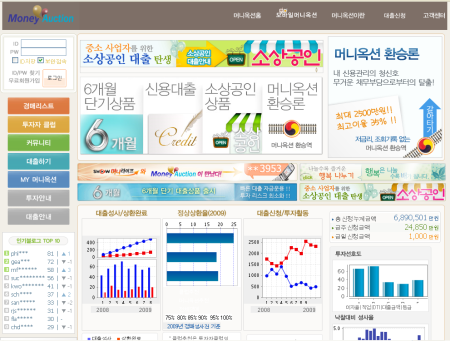
Moneyauction, a Korean p2p lending company, says it is “the No. 2 [website] in Korea’s non-bank area, but the number 1 website in the finance area”. And it has impressive figures to prove it. Between June 01th, 2007 and Sep. 15th the loan amount applied was 56.6 million US$.
Moneyauction partnered with telecommunication carrier Korea Telecom and offers a mobile service allowing borrowers to apply for and lenders to bid on loans via their cell phone.
In 3 months Moneyauction plans to launch a secondary market (called ‘Divided bond trading’). A spokesman told P2P-Banking.com that he expects this new feature to boost the transaction volume.
P2P lending services continue to grow. In some markets the speed of growth has even accelerated.
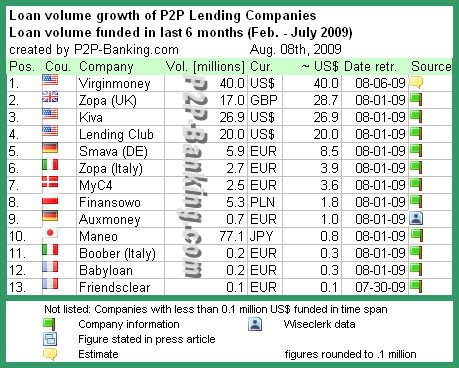
P2P-Banking.com has created the following overview table listing services in operation and ranked them by loan volume funded in the past 6 months. This image may be reprinted on other internet sites, provided it is not altered or resized and the following text (including the direct link to this article) is given as source directly below the image: Source: P2P-Banking.com
For some service like the Korean Moneyauction and Popfunding no figures were available. Also omitted are some services that did not reply to information requests.
Note that Prosper.com was closed for most of the observed time span and did not make the minimum cutoff for the table. Also note that Zopa Italy is currently closed.
Especially british Zopa and the German services show strong growth lately. Smava nearly doubled loan volume in July compared to June (chart), whereas Auxmoney tripled it (chart). At Smava currently even 25,000 Euro loans (approx. 35,750 US$) are funded with bids in only 4 minutes (!) bidding time (example loan).
On the other hand MYC4‘s growth slowed in the last months (chart) due to problems with the providers loan picks.
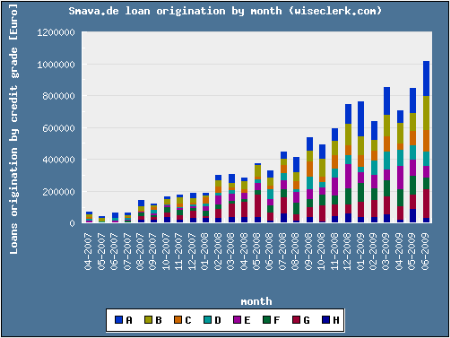
P2p lending site Smava.de for the first time reached more than 1 million Euro (approx. 1.4 million US$) loan volume funded in one month. One factor contributing to this is that Smava is in the top 10 rankings for German Google search results for the keywords kredit (engl. loan) and kredite (engl. loans) since the end of May. I find it interesting that there is not one single bank site in the top ten for these search results.
German p2p lending service Smava.de launched two year ago. Since the launch of Smava 1350 loans were funded for a total loan volume of about 7.9 million Euro (approx. 10.7 million US$).
Lender’s viewpoint
So far lenders on Smava did well. There are approx. 2500 lenders active on Smava. Despite the credit crisis, 99% of the lenders earned a profit in 2008 (total 210,861 Euro), while the 1% who did incur a loss, lost only 60 Euro.
So far ROI in the range from 5-10% have been realistic. As of today 75 loans have defaulted, which is (in percent) more then was originally predicted. The Anleger-Poolmechanism spreads the losses of a default across all loans of a credit grade, which prevents total losses of investments. Therefore when 3 in 100 loans in credit grade X default, the lenders invested in the defaulted loans still receive 97% of the principal, while for lenders in the current loans returns are lowered by 3%.
Technically and on the process level Smava functions as promised.
Borrower’s viewpoint
Provided the borrower has a credit grade of at least ‘H’ (95% of the German population have credit grades between ‘A’ and ‘H’ so about 5% are excluded) and he has a sufficient income, chances for obtaining a loan through Smava are good. About 60 percent of the listings were funded. In February 2009 Smava raised the fees for borrowers from 1% to 2-2.5%.
Marketplace development
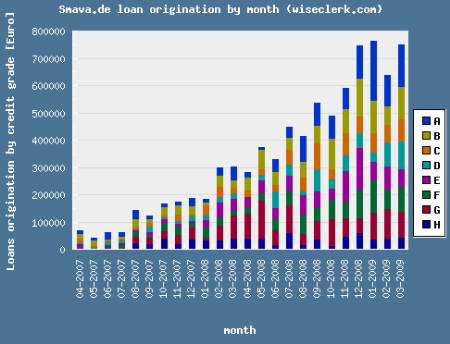
Smava shows continuous growth, with the volume of new loans per month approaching 1 million Euro (see chart)
Despite extensive and positive press coverage Smava is still a niche market with less than 5000 active users. Looking at the distribution of lenders by amount invested, the top 50 Smava lenders funded about 1,690,000 Euro (or about 21% of total loan volume). Currently lenders are limited to a maximum of 100,000 Euro investment.
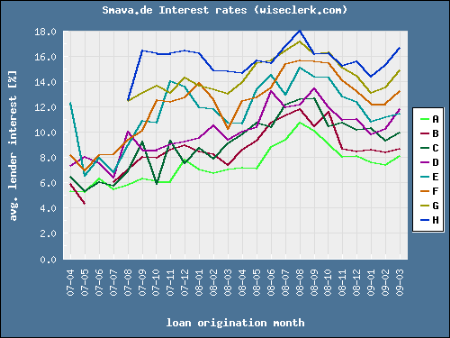
(Development of Smava average nominal interest rates for new loans; Source: smava loan statistic, Wiseclerk.com, 03-21-08)
I would estimate that the increased fees allow Smava to cover the variable costs. But to cover fixed operating expenses Smava needs to multiple its volume. First priority of Smava must be to accelerate growth.
Loanland launched last December as the first p2p lending company in the swedish market (see ‘Loanland launches peer to peer lending in Sweden‘). Since then about 5.7 million SEK (approx. 0.75 million US$) loan volume has been funded .
Ville Vesterinen has published more information about Loanland in the ArcticStartup blog:
The company is currently providing unsecured loans to the Swedish market. The Swedish market for unsecured loans to households amount to around 160 billion SEK (around 16 billion EUR or 20 billion USD) at present and with unsecured loans to SMEs the figure is about 500 billion SEK (around 50 billion EUR or 63 billion USD). The market has grown 15% annually during the last few years. … Loanland is using an open source platform that it has developed, automating most of the processes. The technology is based on Java, J2EE, MySQL, Tomcat, Spring and Hibernate. The platform and auction engine allows individual and automatic bidding, electronic signatures, integrated credit scoring and efficient payments.
The company … has already over 10 000 members and 5 000 registered borrowers and lenders. They have 6 million SEK (600K EUR or 750K USD) deposited out of which 95 percent is lend out as loans. Quite significant number considering that the startup operates currently only in Sweden.