Decision Trees – Using The Available Data to Identify Lending Opportunities on Bondora – Part 2

This is part 2 of a guest post by British Bondora investor ‘ParisinGOC’.

Read part 1 first.

Data Mining the Bondora data.

The initial process.

To help understand the specific data cleansing that the Bondora Data Set needed, I first made use of the RapidMiner metadata view – a summary of all the attributes presented to the software – showing Attribute name, type, statistics (dependant on type, includes the least occurring and most occurring values, the modal value and the average value), Range (min, max, quantity of each value for polynominal and text attributes) and, most critically, “Missings” and “Role”.

“Role” is the name given by RapidMiner to the special attributes that are needed to allow certain operations. In my case, the Decision Tree module needed to know which Attribute was the “Target”, that is the attribute that is the focus of the analysis and to which the Decision Tree has to relate the other attributes in its processing.  My “Target” was the “Default” attribute – a “Binominal” (called as such by RapidMiner and meaning an attribute with just 2 values) attribute – 1 if the loan had defaulted, 0 if not.

“Missings” is easy – this is the number of times this attribute has no valid value. For example, my import of the raw Bondora input data has 150 attributes.  Only half of these attributes have no missing values.  The remainder have between 13 and 19132 rows with missing values from a data set of 20767 rows.

To know whether these “missings” would impact my analysis, I needed to get to know the data in more detail.

I knew that Bondora had started to offer loans in Finland in summer 2013 with Spain following in October of that year and Slovakia in the first half of 2014.

I therefore decided not to bother with any loan issued prior to 2013. Continue reading

Decision Trees – Using The Available Data to Identify Lending Opportunities on Bondora – Part 1

This is a guest post by British Bondora investor ‘ParisinGOC’.

Introduction

Financial institutions across the world have many ways of assessing whether a loan is worth making.  A simple search on the web reveals that many use Data Mining.  More specifically, “Decision Trees” are a particular tool within Data Mining that has been analysed and I quickly found at least 2 papers (Mining Interesting Rules in Bank Loans Data and Assessing Loan Risks: A Data Mining Case Study) amongst many pointing in this direction.

Having had some experience of Data Mining in a financial environment, I believed I could use these same techniques in my own P2P lending which, after over 12 months activity, I felt could be improved.

In this document, I explore the use of the freely available Data Mining Software “RapidMiner” and its Decision Tree capabilities when applied to the data available to investors from Bondora, a peer-to-peer (P2P) lending site.

Bondora

Bondora is a P2P lending site based in Estonia that “unites investors and borrowers from all corners of the world”, allowing investors to invest funds to satisfy advertised borrowing needs.

Fundamentally, Bondora also provides comprehensive data to investors, allowing detailed data downloads of the individual loans held by the investor, as well as data on every application made to Bondora (originally known as Isepankur) since the first application on 21st February, 2009.

It is the complete Bondora data set that I have used as the raw data for analysis as it is the best data available to find out which potential borrowers are the right match to the potential lenders.  Only if enough lenders feel that a loan application is worth investing in will the loan be fulfilled.  Self-selection is taking place in both elements of the loan fulfilment and this data is the result of that interaction.

Also shown in this data are some elements of loan performance post-drawdown.  Crucially, it shows those loans that subsequently defaulted (failed to make any payments for a period in excess of 60 days).  Although Bondora will chase the debt on behalf of the investor and have a track record of some success, there is no guarantee that the investment, or any part of it, will be returned.

Decision Trees

www.investopedia.com/terms/d/decision-tree.asp states: A schematic tree-shaped diagram used to determine a course of action or show a statistical probability.

In this case, I am using the data provided by Bondora on all its previous applications to reveal how the resulting loans that share similar characteristics have performed.

Specifically, I am using this data to show the percentage of those previous loans that have defaulted and using this to indicate how a similar, new application may perform should the application succeed in attracting enough investors.

In other words, I am using past performance data to show how future investments may perform – I feel sure I have seen this phrase somewhere before! Continue reading

Growth of Bondora Resale Market

This post is based on the findings, which German investor ‘Bandit55555’ posted in his own blog p2p-anlage.de. ‘Bandit55555’ is the investor at Bondora with the highest ROI (at least that I am aware of): He calculates his XIRR ROI to be 35.4%, while Bondora displays 57.5% for his portfolio. He achieves that by very diligently using the public download data supplied by Bondora as a basis for his investing and trading. In fact he even developed his own scoring system based on the data.

The secondary market of p2p lending marketplace Bondora was introduced in March 2013. Right now more than 24,400 loan parts are on sale. Using the data Bondora makes publicly available for download the following charts were created.


Number of loans sold on Bondora’s secondary market. Source p2p-anlage.de, reproduced here with permission. Continue reading

Two Years Into P2P Lending Investment at Bondora – My Portfolio Review

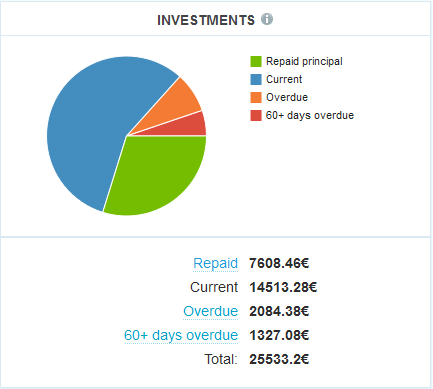
In October 2012 I started p2p lending at Bondora. Since then I periodically wrote on my experiences – you can read my last blog article here. Since the start I did deposit 14,000 Euro (approx. 17,800 US$). My portfolio is very much diversified. Most loan parts I hold are for loan terms between 36 and 60 months. Together the loans add up to 17,924 Euro outstanding principal. Loans in the value of 2,084 Euro are overdue, meaning they (partly) missed one or two repayments. 1,327 Euro principal is stuck in loans that are more than 60 days late. I already received 7,608 Euro in repaid principal back (which I reinvested).


Chart 1: Screenshot of loan status

At the moment I have 430 Euro in bids in open market listings and 394 Euro cash available. Continue reading

High Fluctuation of Discounts and Markups on the Secondary Market of Bondora

One advantage of Bondora is that this p2p lending market makes a lot of data available for download to investors. Recently Bondora added data on ‘Secondary market transaction history‘. In this article I will

  • analyse the data
  • use some examples to show how volatile the prices of traded loan parts can be
  • discuss some of the potential reasons for the inefficiency of the market
  • conclude with my opinion.

The basics of the Bondora secondary market

Bondora (at that time Isepankur) launched the secondary market in March 2013.

Sellers can list any current and overdue loan parts for sale as long they are not 60+ days overdue. Loan parts stay listed until they are sold or cancelled by seller for a maximum of 30 days. Loan parts are traded at principal value. Any unpaid accrued interest, overdue interest, overdue principal and unpaid late charges are disregarded for the sales prices and will – provided the borrower pays up anytime after the transaction – cause a windfall profit for the buyer. The seller can impose a discount or markup on the principal. The discount ca go as low as -99% whereas the possible markup was limited to 5% until July 24th, 2014 and increased to a maximum of 40% thereafter.

If a transaction occurs Bondora charges the seller and the buyer a 1.5% transaction fee each.

Using the data download

The download file I used had 159.7K data lines. This includes 66K cancelled listings and 35K failed listings. For the further analysis I used the 59.4K successful transactions.

On first look the market seems efficient: 8.3% of loan parts sold within 15 minutes. 20% sell within the first hour. But I felt the aggregate data might not tell the full story and I started to look how pricing (discount and markups) developed on individual loans.

First example is a 10,000 Euro A900 loan originated to an Estonian borrower on May 2013. This loan defaulted in October 2013 which ended the possibility to trade loan parts. In this short timespan 62 loan parts with a principal value of 1,748 Euro were traded (that’s out of 356 that were listed).

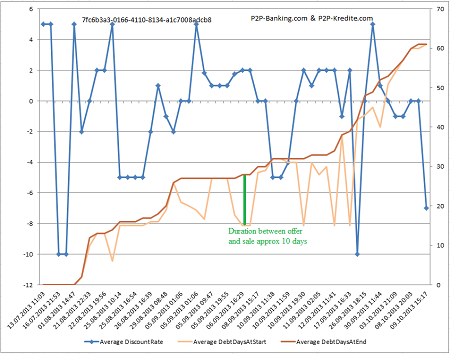
I took the transactions and spread them out over time on the x-axis and graphed the discount rate (blue line, left y-axis).


Chart 1: Example loan 1 (see larger image).

As you can see the price fluctuates widely from -10% discount to 5% markup, while the basic condition – the loan was overdue since begin of August did not change. I also added the orange line that shows how many days the loan was overdue when the seller listed it (DebtDaysAtStart) and the red line that shows how many days the loan was overdue when the transaction actually took place (DebtDaysAtEnd). At those times where the loan was overdue the distance between the two lines shows how long it took for a listed loan part before it sold (see green mark as example). Continue reading

Review of My Current Bondora Portfolio – First Experiences in Trading Bondora+ Loans

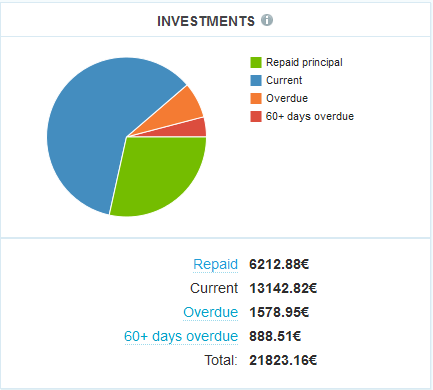
I started p2p lending at Bondora (formerly Isepankur) in the end of 2012. Since then I periodically wrote on my experiences – you can read my last report here. Since the start have deposited 13,000 Euro (approx. 17,600 US$). My portfolio is very diversified. Most loan parts I hold are for loan terms between 36 and 60 months. Together the loans add up to 15,610 Euro outstanding principal. Loans in the value of 1,579 Euro are overdue, meaning they (partly) missed one or two repayments. 888 Euro are in loans that are more than 60 days late. I already received 6,212 Euro in repaid principal back (which I reinvested).

Chart 1: Screenshot of loan status

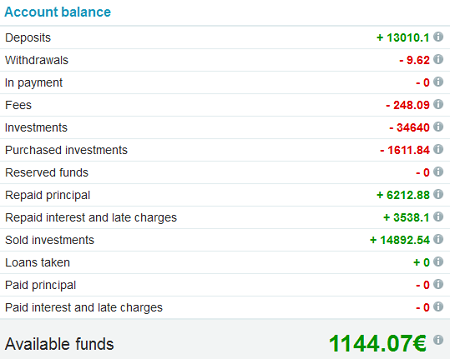
Right now I have a high amount of cash in the account – 1,144 Euro. I’ll explain what led to this situation later on.


Chart 2: Screenshot of account balance

Return on Invest

Currently Isepankur shows my ROI to be over 28.8% (sidenote: I and several others observed that trading had no impact on the ROI shown. Then our ROI suddenly jumped on June 19th; we assume Bondora changed the calculation then to account (better?) for capital gains; here is an example of a portfolio with very big impact of trading). In my own calculations, using XIRR in Excel, I currently get a 25.9% ROI. Even if I assume that 50% of my 60+days overdue will not be recovered (past recovery rates reported by Bondora have been high) my ROI still calculates to 23.2% . Continue reading