P2P Lending Experiences of a British Expat Living in the Eurozone

This is a guest post by British investor ‘JamesFrance‘.

Since retiring and leaving the UK to live in a warmer dryer part of Europe, I fortunately found myself able to live on less than my income, so had the problem of how to best manage these savings, which I wanted to protect from inflation and if possible achieve a positive return on by some type of short term investment. Unfortunately I never found a British savings account which would accept money from non residents, so I was obliged to accept a very low interest rate from my existing UK bank. I do have other long term investments so was prepared to take some risk to achieve a better return.

I had seen articles in the British press about Peer to Peer lending, which tended to refer to the big three, Zopa, Ratesetter and Funding Circle, none of which were prepared to allow a non resident to open an account, so I soon forgot about that as a possibility.   In August 2013 I read that another P2P business lending platform, Thincats, was joining the P2P finance association. I decided to look at their website and was surprised to learn that they could accept non resident investors.

Thincats is really for those with larger amounts to invest, having a minimum bid of 1000 GBP per loan, so it is difficult to achieve adequate diversification for relatively small sums without using their syndicates, which I didn’t find interesting, so I took the plunge and made 10 loans.   Needing 1000 GBP per loan meant that after that it took me some time to accumulate enough for my next bid, so I had the problem of uninvested money not earning until my next loan drew down.   I also found that some loans were repaid early which was reducing my returns because of the drawdown delays.   I think this would be an ideal platform for those with large amounts to invest, as they have a good flow of loans, there is plenty of information about the borrowing companies and once their new website is launched the process should be much easier.   A minimum 25 GBP fee for selling a loan on the secondary market makes it expensive to sell smaller amounts, which means that after several repayments a sale would not be economic.

By this time I was finding other possibilities with the help of websites such as P2P-Banking.com, where I read about isePankur in Estonia, which has an English language version and seemed ideal for any spare Euros languishing in my Euro account and only earning a secure 1% interest. isePankur now renamed Bondora, has been quite exciting to invest through as there have been many changes to the auto bidding system since I started there in September 2013, so just as I became used to the way my chioices were working out, it was all change so I had to start again to think of a good strategy.   They have been expanding rapidly and now issue personal loans in 4 European markets.   The defaut rates for their Spanish and Slovakian loans have been very high, so I have been avoiding those areas since that became apparent, which means time consuming manual investment because the auto bid system no longer allows choice of country.   I do not sell overdue loans on the secondary market, so my returns on the platform will be completely dependent on the eventual recovery of the defaulted loans, which will only become apparent after a few years.   The interest rates are high so I have accepted the level of risk involved. Continue reading

P2P Lending Marketplace Bondora Fuels European Expansion Plans

Bondora LogoP2P lending service Bondora, headquartered in Tallinn, announced that they raised 5M US$ Series A round led by Valinor Management to fuel further expansion plans for cross-border lending in Europe. Richard Fay and Ragnar Meitern also invested. Bondora was the first p2p lending service doing cross-border lending for retail investors. Bondora is currently facilitating loans to borrowers in Estonia, Spain, Finland and Slovakia from investors in all European countries. Bondora states that investments on the marketplace have consistently yielded premium returns to investors while simultaneously delivering competitive rates to borrowers through efficiency and lower interest rate spread.

Uniting European markets under the roof of a single platform creates a huge opportunity given the size of the population in the continent and the volume of outstanding debt. Thus, Eurozone countries alone account for 340 million people and EUR 1.1 trillion in outstanding consumer credit debt, a market equivalent to US. Lending to borrowers in markets that are independently relatively small (even Germany, the largest economy in Europe is only approximately twice the size of California in terms of GDP) allows earning premium returns due to lack of competition among traditional lenders.

Pärtel Tomberg, CEO and co-founder of Bondora, said he hoped the cash infusion from Valinor Management, the hedge fund run by David Gallo, will allow his company to build the more complex infrastructure needed to make more cross-border loans. ‘The goal is really to become a global market,’ Pärtel Tomberg said in an interview. ‘There are no precedents in the world on many of the things we want to do.’

The company also wants to attract institutional lenders from the US.

A possible mid-term competitor might be Lending Club. But Lending Club said in the investor conference call on Tuesday that they will focus on the US market and will not use the capital raised in their December IPO on international expansion plans in the near future. Renauld Laplanche is however monitoring international developments in the market: ‘We’ll see what model is really the winning model in any particular geography.’ Continue reading

Experiences with Setting up a Company in Estonia for the Purpose of Investing in Bondora P2P Lending

This is an interview with Austrian investor Bernd R. about the experiences he made when he created a company in Estonia to benefit from the advantages that investing as business on Bondora brings. Note that these are his personal experiences and should not be construed to be investment or tax advice. The circumstances for other investors will be different and investors should seek tax advice by qualified and certified tax advisors.

How did you get the idea to setup a company in Estonia for your Bondora investments?

I read a lot about Estonia – its business friendly environment, simple tax system, huge start-up culture and the efforts to make administration processes available online.

Setting up an investment vehicle in Estonia would allow me to combine an uncomplicated taxation system with the advantages of a legal entity and all that at low costs.

What are the main advantages when investing as a company rather than an individual on Bondora?

There are several advantages.

  • The corporate tax rate in Estonia is 0%. Only dividends are taxed with 20%. This means that your retained profits will generate additional profit. Double taxation agreements with your home country protect you from being taxed twice and usually limit the total taxation to the tax rate for dividends of your country of residence.
  • In Austria interest income of private loans is treated in a different way than regular interest income (e.g. from a bank saving account). Interest income of classic bank saving product are taxed with a 25% flat rate, “private loans” fall under progressive taxation. On-top income of a full-time employee is easily taxed with 43% till 50%. So depending on the individual situation the tax savings can be up to 25%.
  • Provisions for bad debts or write-offs reduce the taxation basis.
  • Profits and Losses of different activities can be consolidated, e.g. losses generated with stock trading can be consolidated with your Bondora interest earnings and reduce the taxation basis.

How does the tax situation improve in your specific case?

I reduced the tax rate by 25% compared to my individual tax rate.

In addition I will generate more profit in absolute numbers due to untaxed retained earnings invested and at the same time reduce the taxation basis with bad debt provisions. The impact of these 2 factors depend on the future default- and interest rate of my Bondora portfolio.

To setup the Estonian OÜ you used a company formation service. Did that require you to travel to Estonia?

No, it was not necessary. A power of attorney does the job. Continue reading

Review of My Bondora Loan Portfolio After Q4/2014

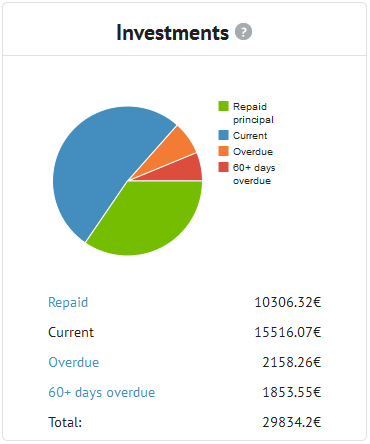
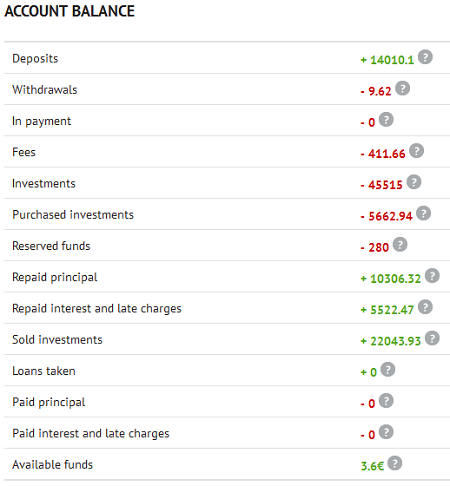
In October 2012 I started p2p lending at Bondora. Since then I periodically wrote on my experiences – you can read my last report here. Since the start I did deposit 14,000 Euro (approx. 17,000 US$). My portfolio is very diversified. Most loan parts I hold are for loan terms between 36 and 60 months. Together the loans add up to 19,528 Euro outstanding principal. Loans in the value of 2,158 Euro are overdue, meaning they (partly) missed one or two repayments. 1,853 Euro principal is stuck in loans that are more than 60 days late. I already received 10,316 Euro in repaid principal back – this figures includes loans Bondora cancelled before payout. I reinvested all repayments.


Chart 1: Screenshot of loan status

At the moment I have 280 Euro in bids in open market listings and 3 Euro cash available.


Chart 2: Screenshot of account balance

Return on Invest

Currently Isepankur shows my ROI to be over 27.56%. In my own calculations, using XIRR in Excel, assuming that 30% of my 60+days overdue and 15% of my overdue loans will not be recovered, my ROI calculations result in 25.0%. Continue reading

Bondora Ratings Create a Single Eurozone Lending Marketplace

This is a guest post by Pärtel Tomberg, CEO of Bondora.

This month we started the roll-out of Bondora Ratings, a loan application rating system based on the proprietary credit scoring model, with the aim to bring better predictability and consistency of the returns for investors active on Bondora platform.

Our initial aim for developing a credit scoring model was to bring the best banking practices to peer lending. Banks might have failed at providing people with affordable credits, but they have done a few things right, such as developing strong credit scoring models, that have helped them generate premium returns for their investors. With Bondora Ratings we are bringing credit scoring model to individual investors so they could maximize their returns in the same way banks do.

Being a platform that facilitates the exchange between lenders and borrowers, we believe it is our responsibility to bring the best practices, such as credit scoring, to peer lending; thus, making it an effective, efficient and mutually beneficial process for both parties. Eventually, Bondora Ratings will allow credible borrowers get a better rate for a loan, while investors will receive a predictable return level.

On top of bringing banking practices to peer lending, we saw a need for a simple, transparent and unified way to represent the risks and potential returns associated with a particular loan. Until recently, our investors used their own sophisticated models to evaluate the risks and plan their investments at Bondora. We have supported the initiative by offering a wide range of filters and providing extensive data export sets, and we will continue to support those investors in the future by providing a Trading API.

However, as the platform grows, we see an increasing inflow of investors that do not have a need or desire to engage into extensive number crunching. The historic performance of peer lending platforms, and Bondora in particular, indicates that peer lending provides premium returns compared to other assets classes and investors want a simple and easy way to earn those premium returns. Continue reading

Decision Trees – Using The Available Data to Identify Lending Opportunities on Bondora – Part 3

This is part 3 of a guest post by British Bondora investor ‘ParisinGOC’.

Read part 1 and part 2 first.

Investments Decisions using the Tree(s)

Using the Data

Using the output is as simple as looking at the visualisation to see how the Decision Tree splits down from the Root Node and comparing this with a Bondora loan application that I see as a potential target for investment. (Illustration 2 and Illustration 3) At the end of the set of branches that I follow dependant upon the data in the loan application, I end up at a “leaf node”- the end of the tree. (Illustration 4)  This node simply states how many previous loans match the one I am looking at, showing how many of the previous loans defaulted and how many have not.

I treat the Decision Tree as the first step in choosing whether to invest. If the performance record of previous loans like the one I am now considering suggest a default rate of 5% or less, I look further into the loan application. Continue reading