That’s the title of an email I’ve just received from PertuityDirect.com, a Virginia based p2p lending service in pre-launch stage. Pertuity Direct announces:
… If you have been keeping tabs on the space, you know that the social lending industry has been pretty interesting over the last two to three months. The guidance that regulators have given with regard to the segment, combined with the fact that consumer loans are still hard to come by, fits perfectly with what we are bringing to market. There is a real need for alternative sources of capital for consumers, as well as new and better investing options. Social lending is a great answer to the problem – and Pertuity Direct is poised to bring it to the mass market.
We are in final preparations to launch immediately after the New Year. All of the pieces are finally in place and we are revving up for Day 1.
We’re excited about 2009 and are looking forward to reaching out to you very shortly as we open for business. …
Since the Loanio delays I am a bit wary of launch dates, but ‘immediately after’ sounds confident – looking forward to the launch in January 2009 then.
Guest article by Peter Petrovics, co-founder of Noba
First of all, let me thank Wiseclerk for the opportunity to post this guest piece on his blog. I am excited to announce the January launch of the first Hungarian p2p lending service:
Also, as a regular reader of Wiseclerk’s posts, I am hoping to be able to draw on the wisdom of his readership in a particular legal problem we have run into while setting up our initiative.
My name is Peter Petrovics, and I have some modest experience working with online communities, while Charlie Szabo, my partner in Noba, is an accomplished former banker. We both have been deeply interested in the entire concept of p2p lending since we first heard of it. We started our project in our native Hungary last summer .
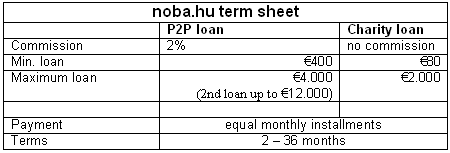
We opted on a dual system: one is dedicated to the P2P lending model, where we hope to see micro projects raising money through friends, family, social network and eventually anyone interested enough in the given venture.
The other section is dedicated to channel loans to the high number of people living in deep and prolonged poverty around the country. We call these “charity†loans, and this part of noba.hu is similar to Kiva.org with the difference that it is limited to Hungary. Applicants for these loans are assisted by a mentor, who is typically an NGO or social worker, in managing their loan applications and projects.
We hope, that noba.hu will not only allow a flow of funds, but will eventually create synergies between lenders and borrowers in terms of know-how, contacts, partnerships.
Both types of loans are intended to allow lenders to make real profit, hoping on the long run to attract a larger community of private and institutional lenders.
This is however the part where we run into a very tenacious obstacle: under Hungarian law, lending (on interest) is a privilege strictly reserved to banks – private individuals are allowed to give a single loan per year, the second loan would be considered as providing commercial banking services without legal authorization. This means that the people who are willing to participate in a P2P loan project as lenders are only allowed to lend the money with a 0% interest, unless these natural persons are founding registered financial institutions.
I would be grateful for any input regarding this problem. We have made some research, and found that similar regulatory restrictions have been overcome by other initiatives in the UK, the Netherlands and Germany, but I would be interested to hear any new ideas from you.
Does anybody have any idea if the whole issue could not be approached from an EU regulatory side? Could prove to be an easier path, than pursuing separate battles against the local legal systems.
Thank you for your attention, and looking forward to your comments.
Launched in summer French Babyloan.org has about 1750 lenders financing peer to peer micro-loans to entrepreneurs in developing countries. I signed up yesterday when I found the service (thanks to Jean Christophe Capelli for the pointer) and helped to fund 5 loans to borrowers in Benin, Cambodia and Tajikistan. One of them is Kheav Sitha who runs a small restaurant stand at her house in Phnom Penh, Cambodia. She wants to borrow 140 Euro for 6 months.
Signing up went smoothly. I liked the user interface for selecting the loans. It features summaries of the loan detail that are shown with AJAX on the right side of the screen while moving the mouse over photos of the borrowers seeking loans on the left side. The website is in French and English, but on some points the English translation seemed to be missing. Funds are transferred in via credit card payment – I have not yet found out how they can be transferred out after the loan term ends if they are not re-lend.
Like other platforms Babyloan partners with local microfinance institutions (MFIs). The MFIs screen the borrowers and handle the payout to the borrowers – in the case of Babyloan the payout has actually taken place BEFORE the loan is placed on the platform – and the MFI takes the sum to refinance the loan. Unlike at MyC4 lenders do not receive interest. While Kiva asks for voluntary donations to fund its operations, at Babyloan a fee of 1 Euro per 100 Euro funded is compulsory . (Minimum a lender can lend is 20 Euro).
Kiva announced a new policy regarding inactive accounts:
So, later this month, we’ll be rolling out a new policy where credit that has been inactive for 12 months will turn into a donation to Kiva. This way, the funds will be put to use helping Kiva fulfill our philanthropic mission, and affected lenders will receive something of value – a tax receipt for a charitable donation.
Kiva says most lenders will not be affected, because lenders with active loans or those who logged in or received a repayment within the last 12 months are not inactive.
Update Dec, 13th: Long discussion by lenders about the proposed change here.
Prosper.com yesterday announced it’s new registration filing.
The SEC filing follows an earlier one from last year that apparently did not succeed. Some speculation on the reasons Prosper’s first filing was ill-fated are on Fred93’s blog.
According to the filing, the class action lawsuit against Prosper reported previously on this blog, is currently the only class action lawsuit by lenders stated in the filing.
The sections on ‘Government regulation’ (page 73) and ‘Risks Relating to Compliance and Regulation’ (page 32) state numerous other legal risks the Prosper business model might face in the future.
For the year 2007 the filing reports that Prosper marketplace incurred a net loss of 11.8 million US$ – but still had more than 20 million US$ in cash or cash equivalents on Dec. 31st, 2007.
The following quote shows that in many attempted listings Prosper was not able to verify the income of the borrowers:
For example between September 1, 2007 and August 31, 2008, we verified employment and income for only approximately 22.6% of borrowers. …
Of the borrowers undergoing income verification for the period from September 1, 2007 to August 31, 2008:
+ approximately 56.7% provided us with satisfactory responses and received a borrower loan; + approximately 37.7% did not provide satisfactory responses, or did not respond, and their listings were cancelled; and + approximately 5.9% either withdrew their listings, or failed to receive bids totaling the amount of their requested loan.
On a side note: The document also discloses that Prosper bought the Prosper.com domain in 2006 for a price of 603,659 US$ (page F-14), of which 320,000 was payed in cash.