In the Netherlands p2p lending service Boober apparently has ceased operations. The website Boober.nl has been inaccessible for days and no one was available for comment as the phone went unanswered.
There are reports by lenders, who complain that loans are not serviced as usual. Even one borrower is seeking help, because he cannot get the monthly payment through to Boober.
As of the moment it was not possible to determine how outstanding loans will be dealt with.
Inspired by Kiva.org, Tori Tuncan set up a non-profit peer to peer lending for alternative treatments of autistic childs. Functioning on a blog and by using Paypal for payments, Lend4Health facilitated more then 30 loans so far. Loan requests are described online, lenders can contributed via ChipIn widgets (Paypal based) and Tori Tuncan posts updates on the progress and how the loan was used.
Companies can help Lend4Health by sponsoring the Paypal fees.
From the site:
What Is “Lend 4 Health” Lend4Health facilitates community-based, interest-free “micro-loans” as a creative funding option for individuals seeking optimal health.
Currently, Lend4Health is facilitating loans for the biomedical treatment of children and adults with autism spectrum disorders. Other health issues may be included on Lend4Health in the future.
German p2p lending service Smava.de launched two year ago. Since the launch of Smava 1350 loans were funded for a total loan volume of about 7.9 million Euro (approx. 10.7 million US$).
Lender’s viewpoint
So far lenders on Smava did well. There are approx. 2500 lenders active on Smava. Despite the credit crisis, 99% of the lenders earned a profit in 2008 (total 210,861 Euro), while the 1% who did incur a loss, lost only 60 Euro.
So far ROI in the range from 5-10% have been realistic. As of today 75 loans have defaulted, which is (in percent) more then was originally predicted. The Anleger-Poolmechanism spreads the losses of a default across all loans of a credit grade, which prevents total losses of investments. Therefore when 3 in 100 loans in credit grade X default, the lenders invested in the defaulted loans still receive 97% of the principal, while for lenders in the current loans returns are lowered by 3%.
Technically and on the process level Smava functions as promised.
Borrower’s viewpoint
Provided the borrower has a credit grade of at least ‘H’ (95% of the German population have credit grades between ‘A’ and ‘H’ so about 5% are excluded) and he has a sufficient income, chances for obtaining a loan through Smava are good. About 60 percent of the listings were funded. In February 2009 Smava raised the fees for borrowers from 1% to 2-2.5%.
Marketplace development
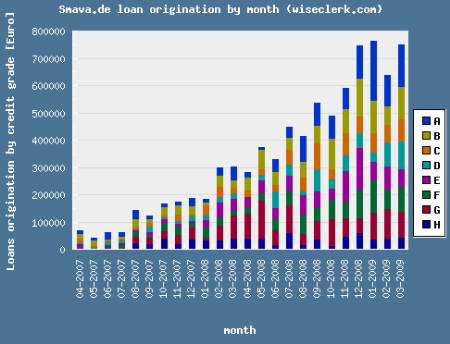
Smava shows continuous growth, with the volume of new loans per month approaching 1 million Euro (see chart)
Despite extensive and positive press coverage Smava is still a niche market with less than 5000 active users. Looking at the distribution of lenders by amount invested, the top 50 Smava lenders funded about 1,690,000 Euro (or about 21% of total loan volume). Currently lenders are limited to a maximum of 100,000 Euro investment.
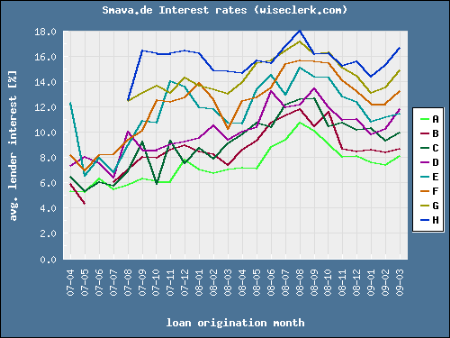
(Development of Smava average nominal interest rates for new loans; Source: smava loan statistic, Wiseclerk.com, 03-21-08)
I would estimate that the increased fees allow Smava to cover the variable costs. But to cover fixed operating expenses Smava needs to multiple its volume. First priority of Smava must be to accelerate growth.
P2P lending service Lending Club, today announced the availability of the first Self-Directed Individual Retirement Account to enable investments in peer lending. EntrustCAMA, part of the Entrust Group, serves as the administrator for these accounts.
This new Self-Directed IRA investment choice gives individuals the ability to build a portfolio of Lending Club notes and hold that portfolio in a tax-free or tax-deferred account. To meet the Federal deadline for this tax season, applications must be completed online, printed and postmarked before April 15, 2009. The account application is available at https://www.lendingclub.com/sdIRA/registerIRA.action
Key benefits stated:
Potential for high returns. Choose from a diversified group of hundreds of qualified borrowers.
Tax advantages. Investments in a Self-Directed IRA can grow tax deferred until retirement age.
Flexibility. Select the type of IRA which is right for you: Individuals: Traditional or Roth Small businesses: SIMPLE or SEP Fund the IRA directly with a check or an existing account (IRA or 401K) to transfer or rollover.
A Diversified Retirement Portfolio. This Self-Directed IRA gives your portfolio access to Lending Club Notes, going beyond traditional stocks, bonds and mutual funds.
Fees:
No account opening fees
One flat 250 US$ annual account maintenance fee starting in 2010 when you open an account before April 15, 2009
When a VC talks about peer to peer lending he is not talking about achieving a good ROI by lending to borrowers. He is talking about the chances he sees in investing in the p2p lending company.
Smava is at the right time in the right place (current economic situation)
he sees an upswing in lender and borrower interest; assesses that the model has proven itself
Their competitors in the US are doing quite well and he expects that Prosper will resolve it’s issues with the SEC.
I agree with the first point, but in my view it is too early to judge whether the Smava model really has proven itself (even the oldest loans are only through two thirds of their loan term). And the last point, I find an optimistic assessment of the situation. One could say that Lending Club is doing well, but Prosper and Loanio are in a situation that could at least be described as challenging.
Lending Club announced today that they have closed another funding round. Excerpt from the press release:
… closed a $12 million Series B round of funding. Morgenthaler Ventures led the round and is joined by existing investors, Norwest Venture Partners and Canaan Partners. Rebecca Lynn, a Morgenthaler Principal, is joining Lending Club’s board of directors.
Lending Club also announced today that it has added Pamela Kramer as Chief Marketing Officer. Ms. Kramer is an established marketing veteran … . She was most recently Chief Marketing Officer of MarketTools, Inc and, before that, spent 9 years in leadership roles with E*TRADE Financial … .