Signing up and selecting the loan went smoothly. For the requested loan of 1,052 US$ a guarantee of 579 US$ needs to be raised.
Sakho Devi has a grocery shop of her own, with which she earns her living. She has applied for a microloan to expand her small grocery shop, so that she can meet the demand from customers.
The listing also states some data about the partner MFI – Ajiwika Society – it’s interest rate, delinquency rate, default rate and target clients.
Tomorrow Kiva will announce that it will start to fund loans to borrowers in the United States. Kiva, which so far lets anyone support loans to small entrepreneurs in developing countries, is reacting to lender suggestions who wanted to use Kiva to help borrowers in need in the US.
In the US Kiva will partner with Accion USA and Opportunity Fund to select eligible borrowers. Initially the small business owners borrowing will be from the areas of Atlanta, Boston, Miami, New York and San Francisco. Continue reading →
German p2p lending service Auxmoney.com has added the option for borrowers to enhance a listing by adding an audio file. The borrower records the audio message by dialing a phone number and identifying himself by a pin supplied by Auxmoney.
Hearing the borrower describing his request creates a much more personal impression to me than only reading a text description.
To hear an audio-file created by a borrower follow this link and click on the speaker symbol (the audio is in German). Auxmoney Screenshot June, 8th 2009; symbol for audio profile marked in red
Spanish regional bank Caja Navarra is the first bank to offer it’s own customers a p2p lending service. Caja Navarra announced the p2p lending microsite. Caja Navarra markets this new peer to peer lending service as one investment option in a letter to its 400,000 customers.
The service allows any customer to place a loan request which can then be fulfilled by a relative, a friend, an acquaintance or a stranger. Caja Navarra says the borrower can benefit by receiving a lower interest rate than in a traditional bank loan. There are currently 3 loan requests listed (if I understand the site right). Continue reading →
Myelen.com is a service allowing lenders to loan money to small entrepreneurs in developing countries. The portal is run by the Microfinance, a.s. company in Prague (Czech Republic).
Like at Kiva and MYC4 lenders can read profiles of borrowers. Currently Myelen has partnered with 4 MFIs in Mexico. In the Myelen concept the lender signs a contract with the MFI and the MFI takes the default risk of the individual borrowers.
The microfinance institution takes over the credit risks of individual borrowers and lowers them by geographical and sector diversification.
The lender carries the market risk that the MFI does not repay the loan. Furthermore at Myelen the MFI covers the currency risk – but for most lenders there is still a currency risk because the loan currency at Myelen is Czech Koruna (CZK).
The minimum loan amount is 5,000 CZK (approx. 260 US$). The loans are repaid annually (or quarterly for larger amounts). Lenders earn interst. The interest rate varies depending on the MFI and the amount loaned. Typical interest rates are 4 to6 percent (higher for large amounts).
My experience – my first loan via Myelen
I registered yesterday at Myelen.com. The interface ia available in English and Czech. There is also a button to choose German language but clicking that only changes the navigation elements – the text is not translated to German. The sign up form asks for IBAN and SWIFT routing codes for the repayments. Since IBAN account numbers are currently only in use in Europe this limits Myelen to lenders from Europe.
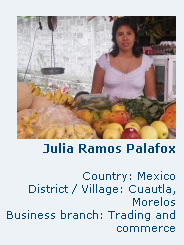
Signing up went smoothly, but I had to wait a few hours for my validation email. Today I selected my first loan to fund. First I was puzzled how to get to the loan selection. To get there the user needs to click on the “Support” link in the upper right. There I could then use drop down menues or browse the individual profiles (currently about 30). I decided to loan 5,000 CZK to Julia Ramos Palafox who has a fruit and vegetables stand in Mexico. The MFI – CrediComún listed a 5% interest rate. I was given the choice of selecting an annual or quartely repayment. One further option is to give an interest free loan (like at Kiva). The next step is to accept the loan contract. The loan contract is now sent via email to the MFI which signs it. Continue reading →
It always seemed to me that traditional banks tend to make most of their money on the backs of people that pay penalties for small errors rather than just charging for capital as their business model might otherwise suggest. Credit card companies seem to be doing the same thing, jacking rates to the maximum allowable limit if their customer goes late on a payment. All of this makes it look like the traditional banks and credit card companies are making money by being deliberately opaque, hiding their true cash cow of fees in fine print.
The peer to peer lending market has been exploiting the opportunity this opacity creates. Who would have thought these peer to peer lending sites had a chance against traditional banks? But borrowers and lenders warm up to them because they strive to become as transparent as possible.
But why do I have to get a loan for a specific need like an addition to my home? I don’t get a credit card for a particular need, its just so I have it if I need it. The reality is that the current peer to peer lending market is uncollateralized. I can’t go hold a chunk of a house ransom if a borrower doesn’t pay me back for a home improvement loan I gave him. I can’t “repo” the motorcycle I helped that guy in Utah purchase if he defaults, so what sense does it make that these are specific loans for specific goals? I’m merely making uncollateralized loans to individuals for whatever purpose they want. Its really just a bet on the person’s credit rating and “confirmed” financial situation.
So why couldn’t we think of it more like revolving credit? Why couldn’t I get a Visa or MasterCard from a P2P loan site instead? The P2P lending company would sponsor the process issuing a credit card to borrowers funded by lenders pooling their money. Adding to the existing P2P loan benefits, the lender makes more money because revolving credit interest rates are higher than “standard loans” and the borrower has much more clarity into the factors that can make his APR go down and credit limit rise over time. Continue reading →