This week Zopa celebrated the milestone of 100 million GBP in p2p loans funded (since it’s launch in 2005).
Here is how ITV London tonight featured Zopa yesterday:
This week Zopa celebrated the milestone of 100 million GBP in p2p loans funded (since it’s launch in 2005).
Here is how ITV London tonight featured Zopa yesterday:
Below is a map of the p2p lending landscape in the US and Canada. It shows active and discontinued p2p lending services (including p2p microfinance).
The fastest growing services are Lending Club, which funded 12 million US$ new loans in August, and Kiva. Prosper’s growth is stagnating. Other US based services are Vittana, United Prosperity, Zidisha (all microfinance) and People Capital (student loans). CommunityLend is the only p2p lending site active in Canada.
All of these marketplaces have been featured earlier in the P2P-Banking.com blog. If you want more information about any of them just enter the company name in the search box on the top right of this blog.
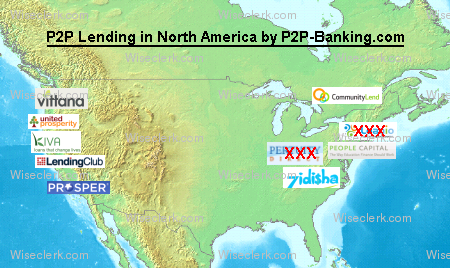
Notice to other websites: You are free to copy and use this map, provided you agree not to alter or resize the image and you will set a link to this article.
Related resource: P2P Lending Sites in Europe (Map)
 Fundingcircle.com launched on Friday August, 13th. According to figures the company released, the p2c lending service had a good start. Apparently many lenders took advantage of the cashback offer, and immediately after lending sold loan parts to other lenders on the secondary market. Review the following numbers reported by Funding Circle:
CommunityLend announced that lenders and borrowers from British Columbia can use the p2p lending service now. It is the third province added after Ontario and Quebec.
 Auxmoney.com is the second largest (by loan volume) p2p lending service in Germany. The new loan volume per month is about 700,000 Euro (approx 900,000 US$). A recent estimate puts the monthly revenue of Auxmoney at about 57,000 Euro (approx. 74,000 US$; based on August numbers). The majority of these revenues comes from the sale of so-called ‘certificates’, which the borrower can optionally buy. Examples for certificates are credit scores, income validations or car value assessments.
The fees for the optional certificates as well as the listing fee are due in any case – regardless whether the borrower’s request for a loan is funded or not.
Effective September 1st, 2010, Auxmoney raised several fees:
With the legal construct Auxmoney has selected, the listing fee, the fees for the certificates and the extensions need not be factored into the APR that Auxmoney calculates.
Could these circumstances damage the image of p2p lending?
P2P Lending worldwide has received positive press coverage and benefits from offering an alternative to the currently ill reputed banking sector. Only occasionally are single players causing bad publicity (e.g. the high default rates of Prosper or the Boober failure). Looking at the German market, press coverage for p2p lending was nearly all positive. One exception was the warning of a well-known consumer advocacy which accused Auxmoney of using false marketing claims on its website. Auxmoney sued the publisher – the case is still ongoing.
The latest change in the fee policy of Auxmoney could lead to a negative change in the perception of p2p lending by consumers. Should internet users start to associate p2p lending with high fees that are charged even if no loan was obtained (currently on average 10-20% of all loan listing on Auxmoney are funded – see green line in this chart) then p2p lending would risk losing any competitive advantages over bank loans.
Fees at other p2p lending services have risen several times in the past too in the struggle of these marketplaces to become profitable. While these fee increases do impact the attractiveness for the users the difference is that at least the fees in most cases only apply to loan transactions on funded loans.
 In early summer 2010 Yes-secure.com launched the second p2p lending service active in the UK. Dr. Chandra Patni, CEO of Yes-secure answers my questions.
P2P-Banking.com: Dr. Chandra Patni, please tell us about the background of the Yes-secure management team and what lead to entering the p2p lending market?
Dr. Chandra Patni: I came up with the business opportunity in 2008, having reviewed Zopa I felt that a social networking based person to person lending marketplace site could become a successful alternative to Zopa. I realised there were opportunities to build and complement the social lending market. Consumers need choice. YES-secure.com allows person-to-person lending alongside social networking as people want to know who they are lending to.
P2P-Banking.com: How is Yes-secure funded?
Dr. Chandra Patni: YES-secure.com is funded by private investors alongside the directors of the company.
P2P-Banking.com: What benefits does Yes-secure offer to lenders and borrowers?
Dr. Chandra Patni: Lenders: YES-secure.com provides UK savers and investors a new way to beat inflation and earn better returns than by investing their savings in fixed deposits in a bank. Along with the introductory offers and waivers, there are a wide range of markets (A*- E) allowing lenders to manipulate their investment across various markets getting them high, assured and steady returns. Debit card verification upon registration, stringent underwriting procedures and assigning markets in keeping with the borrowers’ creditworthiness make YES-secure a safe investment destination. Additionally, YES-secure offers a secure means of social network based lending and borrowing implying lower default rates and higher returns for lenders.
Borrowers: Borrowers can get competitive rates from real people. They simply describe how much they are looking to borrow, over what period, and the maximum interest rate they are willing to pay. Then they can simply sit back and watch people bidding to lend to them. Once they find a rate they like, they can accept it and get the money paid straight into their bank account. More traditional methods of personal loan approval rarely take personal information (such as connections, personality, and general circumstances) into account and are approved or declined based solely on credit history and financial circumstances. YES-secure combine both the important credit background as well as pertinent personal information on each borrower. Continue reading
