 In the UK Zopa expects a record month of new p2p loans funded. CEO Giles Andrews told P2P-Banking.com today: “We are going through some dramatic growth at the moment. July was a record month with 908 loans for 4.5 million GBP, but we should do 1100 for 5.5 million GBP in August.”
Countries
Fixura Starts P2P Lending in Finland
 A few days ago Finnish p2p lending site Fixura launched. The bilingual (Finnish & Swedish) site already lists over a hundred loan requests.
CEO Simon Sandvik told P2P-Banking.com:
This social lending company differs from the ‘standard’ ones as it does not provide lending auctions. Instead, the borrower sets his/her own interest rate, amount (1, 000 – 10,000 EUR) and duration of the loan. Then a Finnish credit scoring company processes the data and the borrower gets a one-to-five star rating. If a borrower is marked for payment issues in the past, the loan request automatically gets rejected.
… investors can also diversify their investments through different loans in 100 EUR lots. …
The company operates totally free of paper as it uses the local banks’ identification systems, a kind of e-signature. The investors can invest directly online and the borrowers can sign their contracts.
If a loan does not get fully funded the borrower can choose after 14 days from the first investment to accept a part of it, or reject it as he or she sees fit.
Currently investors pay 4 Euro for each withdrawal. Fees for borrowers are
- 5% origination fee
- 2% annual fee
- 4 Euro per transaction
Compared to other p2p lending services these fees are rather high.
P2P Lending Sites in Europe
Visualizations are great to show data that would otherwise just be a long list. I decided to create a map of the p2p lending landscape in Europe. It shows active and discontinued p2p lending services in Europe (including p2p microfinance). Not listed are sites that are in pre-launch stage. All of these marketplaces have been featured earlier in the P2P-Banking.com blog. If you want more information about any of them just enter the name in the search box on the top right of this blog.
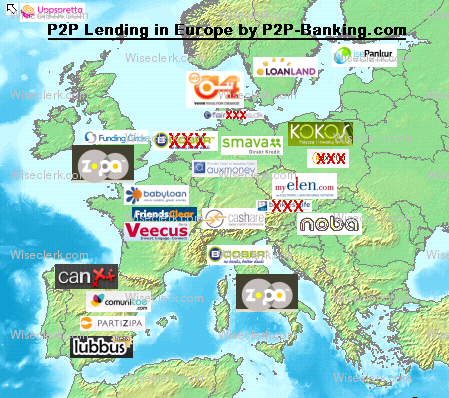
Notice to other websites: You are free to copy and use this map, provided you agree not to alter or resize the image and you will set a link to this article.
Notice to p2p lending sites: If you want to be included in a future version of this map, contact me to learn how.
Funding Circle (Fundingcircle.com) P2C Lending Launch in UK
Funding Circle has  launched it’s peer to company lending service in Britain. As reported by P2P-Banking.com in February the startup received 1.1 million US$. Any UK resident can lend either by individually selecting businesses or by using the autobid feature and spreading the investment over several matching businesses. While loans last for 1 to 3 years FundingCircle – unlike other p2p lending sites – allows lenders to access their money easily: Selling of parts of loans funded to other lenders is possible (secondary market).
In 2010 lenders are not charged any fees to use Funding Circle (in 2011 there will be a 1% annual servicing fee and a 1% sales fee).
All businesses applying for loans are screened by Funding Circle’s underwriters using data supplied by Experian to ensure they are creditworthy. A business may apply for a Funding Circle loan amount between 5,000 and 50,000 GBP. Continue reading
Cashare Plans To Use Digital Signatures in P2P Lending Process
In Switzerland P2P Lending Service Cashare announced that it plans to be one of the web service pioneering the use of SuisseID a digital signature. Documents signed with this digital signature are as binding as a conventional signature on paper.
Opportunities for P2P Lending
Several European countries (e.g. Italy, Spain, Germany, Belgium) have enacted laws that equate digital signatures with conventional signatures.
P2P Lending can use digital signatures to
- validate the identity (and depending on the signature card the address) of users
- automate processes that otherwise would require a signature on paper and enable paperless process chains.
Does P2P Lending Work for Microfinance? Lessons from Zidisha Inc.
Guest article, by Julia Kurnia, Director Zidisha Inc.
Entrepreneurs in low-income countries often face a dilemma: their business activities don’t earn enough to support their families, but they lack the investment capital needed to make the businesses more profitable. Restrictive political and economic conditions and geographic remoteness make it expensive for local banks to lend to small business owners. Some of these borrowers are serviced by microfinance institutions, but individual business expansion loans often carry prohibitive collateral and interest requirements due to microfinance institutions’ high administrative costs. So the businesses don’t grow, and the families they support remain impoverished.
Charitable microlending platforms such as Kiva.org and MyC4.com aim to improve disadvantaged entrepreneurs’ access to capital by providing platforms for microfinance institutions to raise subsidized loans directly from web users in wealthy countries, on the assumption that the high cost of financial services in developing countries is due to the organizations’ limited access to affordable lending capital. Yet this solution does not address another crucial barrier to affordable financial services for small business owners in developing countries: the high cost-to-revenue ratio inherent in small loans offered in marginalized geographic areas. The average Kiva field partner institution must charge borrowers more than 30% interest on loans financed at zero interest by Kiva lenders. Even at these rates, most microfinance institutions simply cannot afford to extend services to the remote rural areas where access to financial services makes the greatest impact on people’s opportunities for economic advancement.
It is generally assumed that such high interest rates are a necessary cost of lending to entrepreneurs in isolated and impoverished areas. In the classic microfinance model championed by Nobel laureate Muhammad Yunus in the 1970s, loan officers go on the road to collect repayments in person from borrowers, who are required to attend training sessions and participate in compulsory savings exercises in order to ensure responsible conduct. Even today, most local microfinance institutions which raise capital from Kiva or MyC4 are based along this model, with loan officers visiting borrowers at their businesses and communicating with lenders on their behalf. It is assumed that the borrowers not only lack the necessary computer skills to communicate with lenders themselves, but also that they cannot be trusted to repay loans, as residents of wealthy countries do, without constant visits by loan officers.
Zidisha Microfinance is a nonprofit microlending platform that operates on very different assumptions. First of all, there are no local intermediaries: instead, the entrepreneurs themselves post loan applications on the website and communicate directly with lenders via Facebook-style profile pages as their business investments grow. To make this possible, Zidisha taps into the growing population of computer-literate, but still economically disadvantaged, small business owners and explosive growth of internet access that have transformed developing countries in recent years. Borrowers access the Zidisha website from cheap cybercafés, old laptops donated to local charities and schools, and even the internet-capable smart phones which have begun to proliferate in even the poorest locations, often with one handset being shared by an entire village. Current Zidisha borrowers assist new applicants with navigating the website, and enlist the help of younger tech-savvy relatives when needed. New client orientations and technical assistance is also provided by Zidisha’s Client Relationship Managers, young adults from the United States and Europe who relocate to the borrowers’ countries and liaise with borrowers on a volunteer basis. Continue reading