
I love unusual marketing ideas. Therefore I contracted Ross and Ed, 2 british students, to ‘advertise’ P2P-Banking and to support them in their quest out of college debt. You can read about their idea at BuyMyFace.com.
I love unusual marketing ideas. Therefore I contracted Ross and Ed, 2 british students, to ‘advertise’ P2P-Banking and to support them in their quest out of college debt. You can read about their idea at BuyMyFace.com.
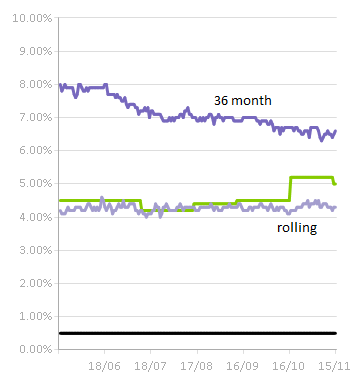
 Borrowers needing a small loan can turn to p2p lending marketplace Ratesetter, which matches borrower requests with funding supplied by private lenders. Borrowers can choose a variable rate loan (rolling loan) or a 36 months fixed rate loan. Nominal rates for the 36 months loan have fallen considerably in the past six months from approx. 9% to now under 7% (that translates to a representative APR of slightly under 9%).
 Ratesetter has facilitated over 10 million GBP in loans since its inception.
Last week Ratesetter completed raising series C round of funding, raising 1.5 million GBP (approx. 2.35 million US$). The total amount raised so far is 3 million GBP.
RateSetter CEO Rhydian Lewis said: ‘…RateSetter is continually working to narrow the spread between what Savers can earn on their money and what creditworthy Borrowers can pay. This investment will ensure that customers will continue to get great value and a great service‘.
 UK startup Civilised Money has raised 100,000 GBP from 121 individual investors using the p2p equity platform Crowdcube. The investors will own 10% of the funding after the legal process of the funding is completed. The funding was completed in just 9 days, showing the potential p2p equity has in the UK.
Civilised Money plans to offer crowdfunding first and p2p lending in a second step. Katherine Byles of Civilised Money told P2P-Banking.com earlier this week that this is actually the second funding round for the company: ‘We have a first round of crowdfunded investment from ‘The Pillars’ 20 key supporters.‘.
Asked whether the technology is self-developed or licensed, she told P2P-Banking.com: ‘The technology is licensed. We have a one-off revenue share based licence for one of the most powerful and flexible P2P platforms available.  Through the core technology platform we will be able to roll-out a number of products, enabling us to cut the cost of using these – once funds are on the platform moving them between the different products is a simple and fast process.‘
Asked about the USP as compared with Zopa, RateSetter or Fundingcircle Byles said: ‘Civilisedmoney will offer all the people-to-people financial services products in one integrated service.  It has launched with crowdfunding. People-to-people loans are coming next. It is developing new products too. Civilisedmoney is becoming a one-stop-shop for all your people-to-people financial products that create a viable alternative to banks. …‘
The company has ambitious goals as a quote from information provided in the pitch shows: ‘While its service is not yet available in the U.S., CivilisedMoney’s plans are to expand from the U.K. to greater Europe, and then eventually to Africa and the U.S. (CivilisedMoney’s services offered will depend on region, since, for example, crowdfunding equity stakes for startups isn’t yet legal in the U.S.)‘.
A new twist to peer-to-company lending. So far p2p lending marketplaces facilitated lending from the crowd to other companies now U-Haul has its own p2p marketplace called U-Haul Investors Club. There anybody can purchase collateralized debt security notes issued by Amerco (the parent company of U-Haul). The minimum deposit required to start investing is 100 US$.
The loans are backed by collateral. Typical interest rates range from 3 to 7%. In the time since the opening of the U-Haul Investors Club in February 2011 approx. 7 million US$ in equipment financing was raised.
(via SocialLending.net – read more in Peter’s article here).
Starting next weeks Americans can help to jump-start the economy sipping coffee at Starbucks. By donating 5 US$ they help to fund community loans to community businesses—including small businesses, microenterprises, nonprofit organizations, commercial real estate, and affordable housing— all across the country committed to creating and sustaining jobs. Donors who contribute $5 or more will receive a red, white, and blue wristband with the message “Indivisible.â€
 The initiative is called Create Jobs for USA. Loans will be given out by the Opportunity Finance Network (OFN), which represents a nationwide network of 180 Community Development Financial Institutions (CDFIs) set up to provide financing to community businesses in underserved markets where accessing credit through traditional lending institutions is challenging or not available. The Create Jobs for USA Fund at OFN will be seeded with a $5 million contribution from the Starbucks Foundation.
The donations to “Create Jobs for USA” will not be loaned to the CDFIs. They will be turned into equity that can be leveraged. If that equity can be leveraged 7 to 1, that would result in 350 million US$ loan funding, if Starbucks customers donate 50 million US$.
 German p2p lending service Smava has raised 4 million Euro in a new round. New investor in this round is the largest Italian private bank “Banca Sella”. Smava also joins in on Italian p2p lending service Prestiamoci saying that Smava aims to grow to a leading European p2p lending service.
This is actually the second start Smava undertakes for European expansion. Smava Poland was merged after a rather short time in operation with another Polish service.
After this round VC Earlybird holds 54%, VC Neuhaus Partner holds 20%, Banca Sella holds 10% and the founder team holds 4% of Smava shartes.
In its press release Smava stresses its successful growth. However in the past year Smava had to deal with a significant decline in new loan volume funded per month.