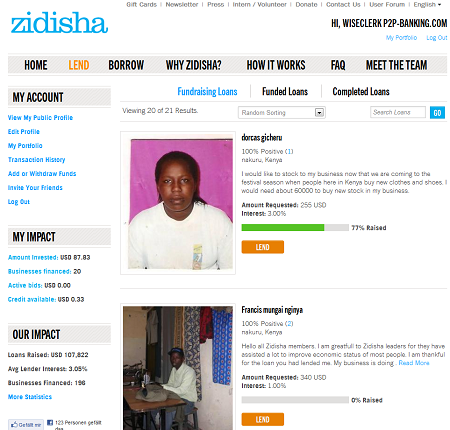
Kiva Zip is an experimental site facilitating direct p2p microfinance loans without any intermediaries. The original Kiva model relies on MFIs (microfinance institutions) which locally validate borrower request and disburse the money and collect the repayments.
Kiva Zip eliminates the intermediaries directly connecting lender and borrower in person to person microlending. This will reduce interest rates for the borrowers (which during the initial testing phase of Kiva Zip pay 0% interest). The use of direct electronic and/or mobile payments further reduce the costs of the loan transactions.
On the other hand Kiva expects that these loans carry increased risks for lenders. Continue reading →
This is the second part of an interview with Julia Kurnia, Director and Founder of Zidisha Microfinance.
Does the Euro crisis in any way impact Zidisha’s business?
The Euro is the home currency of many of our lenders. To the extent that the Euro crisis causes it to depreciate against the US dollar (in which Zidisha account balances are denominated) and against the borrowers’ currencies in which loan values are fixed, it will increase financial returns when these funds are converted back to Euros. That said, lending with Zidisha is intended to be a philanthropic activity, and most of our members seek to generate social benefits in a way that is financially sustainable. Zidisha loans typically allow economically disadvantaged households to expand their cash businesses to the point where incomes are increased by 150% to 200%. The additional cash is very often invested in the children’s education – both by providing sufficient living income so that teenagers do not need to drop out of school to support their families, and by covering the costs of continued schooling. The return to society from this kind of investment in education of the next generation of the rural poor in developing countries is impossible to quantify. This will continue to be true regardless of currency fluctuations.
A week ago Zidisha got a new design. What is new?
Our new design reflects feedback from the Zidisha community, and the growth of our organization. We opted for a clean, modern style and an uncluttered, simple layout that is in keeping with our values of directness and transparency. The new site is more effortless to navigate, easier to learn and read about Zidisha entrepreneurs, and simpler than ever to make a loan. We’ve also included more social media buttons so that visitors can conveniently share Zidisha with friends and family, and connect with us via Facebook and Twitter.
Zidisha is doing direct p2p lending. Do you think it is likely that there will be a substantial shift from indirect p2p lending (like Kiva does) to a direct model without MFIs in the future? Yes, I think that is the future of online microlending. As Zidisha has proven that the concept is viable, I’m sure that we will inspire many similar initiatives. I expect to see other organizations – both new start-ups and established platforms – experiment with direct P2P lending across the international wealth divide. This will be a welcome development, generating positive social impact beyond the reach of our organization, valuable learning opportunities for P2P lending and microfinance practitioners, and useful variety for our clients. Continue reading →
Yesterday I invested a small amount and will become a shareholder of Crowdcube Ltd., which runs the British p2p equity marketplace Crowdcube.com (see earlier articles about Crowdcube). Crowdcube is currently using it’s own platform to raise 300,000 GBP (approx. 470K US$) for a stake of 9% in the company.
If you decide quick, you can become a shareholder of Crowdcub too (minimum investment is 10 GBP). For UK residents investments of over 500 GBP mean they are eligible for a 30% income tax rebate under the EIS scheme. At the time of this writing the pitch is 54% funded and it looks like it will fully fund within the next days.
Crowdcube provides a slide presentation and a forecast. The forecast is a bit sketchy with some figures being debatable in my view but overall I think Crowdcube is a promising venture for the following reasons:
The founders achieved quite a lot in the short time since launch
Good marketing angle. New pitches might allow them to uphold high PR resonance (at least locally and industry sector specific). With luck and craftsmanship they might achieve equal marketing spin in p2p equity as Kickstarter has achieved in crowdfunding
I expect p2p equity in UK to get a boost by rising tax reliefs (50% !) under new SEIS scheme (see yesterday’s post)
Crowdcube, if growing fast, might reach a level where (for UK) it profits from network effect. However the pitch is missing competitor analysis and strategies to deal with them.
Good revenue/cost ratio. With less (technical) complexity than say Zopa or Ratesetter (but much higher risk for investors in pitches)
Should they succeed in creating a secondary market that is not awkward/clumsy in the future, then that will heighten the attractiveness for investors as it offers liquidity for the investments
I am fairly optimistic that the influx of pitches won’t be a problem. It is hard to gauge how the funding success percentage of these will be as that depends on the quality of pitches. The single biggest threat to Crowdcube’s business model in my view is the prossibility of one of the companies funded at the market place failing big time and leaving very unsatisfied investors.
I plan to post further reviews of the progress (naturally I won’t share any confidential data made available to shareholders).
German laws require a banking license to hand out loans. To comply with regulation the two active German p2p lending services partner with a transaction bank, which originates funded loans and then sells the debt claim to the individuals (‘lenders’) that did bid on the loan request on the p2p lending marketplace. Smava now switched it’s bank partner. Since Smava’s launch in 2007 the bank partner was the biw Bank für Investments und Wertpapiere AG. For all new loans after Dec. 1st, Smava cooperates with the Fidor Bank AG (see earlier coverage on Fidor). Smava feels that Fidor is a great match and praises the integration advantage Fidor offers with its web APIs. The change does not bring any immediate benefits for lenders other than a) unlend money will now earn 0.5% interest p.a. and b) the e-money license of Fidor allows lenders to start lending without verifying identity first – but that’s rather symbolic as it applies only to amounts of up to 500 Euro (and the minimum bid on Smava is 250 Euro) meaning that new lenders could test Smava with up to 2 bids before going through postal identification process.
P2P Equity
Smarchive, the fourth startup pitching at German marketplace Seedmatch (see earlier coverage on Seedmatch) raised 100,000 Euro in less than 3 days. The pitch originally was for 50K, but was oversubscribed to the maximum possible amount (100K).
Seed Enterprise Investment Scheme (SEIS)
In the UK the market the surrounding conditions for the emerging p2p equity market get better and better. From April 2012 investors in eligible startups will be able to claim 50 percent income tax relief (on a maximum investment of 100,000 GBP per year). The minimum required investment is just 500 GBP per startup. The new law will replace the Enterprise Investment Scheme (EIS) which currently already offers a generous 30% tax break. The British government will also ease some of the restrictions of the current EIS scheme. The SEIS will bring a huge boost to p2p equity marketplaces in the UK. Maybe an idea to be copied in other legislations to foster startup foundation?
ThisisMoney on P2P Lending Risiks and Quakle
ThisisMoney has two (1,2) long articles on the failure of Quakle and risks associated for lenders with p2p lending in general. While not wrong, the articles oversimplify some things. And actually there are more risks for lenders then the two mentioned (compare my old article ‘For Debate: A Flaw in Current P2P Lending Models?‘). The author is a strong advocate of the P2P Finance Association: ‘Checking for the association membership is crucial. It’s a self-governing industry body, so does not carry the same weight as regulation by the Financial Services Authority – something the industry wants but lacks as yet – and is currently the best benchmark for those considering lending.‘. Not a bad advice, but with the association and the market so young, I see that as a bit of limiting, possibly excluding any new entrants that might launch.
Today I am glad to be able to publish another interview with Julia Kurnia, Director and Founder of Zidisha Microfinance. As the interview text is a bit long for a blog post, I have split the interview in two parts.
Nearly 2 years have passed since our first interview. In that time Zidisha has grown considerably. Looking back, how satisfied are you with the achievements?
Two years ago, few believed that low-income individuals in developing countries could successfully participate in a genuine peer-to-peer lending community. The conventional wisdom was that people in remote, impoverished communities would not benefit from or repay loans unless the loans were administered in person by expensive local bureaucracies. As a result, the world’s poorest borrowers pay some of the world’s highest levels of interest and fees – between 35% and 40% is the global average for microfinance loans in developing countries. Though there are quite a few other microlending websites that allow individuals to fund loans in developing countries, all of them rely on local microfinance organizations to communicate with lenders, create loan applications and collect repayments. In these intermediated microlending platforms, the communication is all one way, so that the borrower is often completely unaware of the lenders who funded his or her loan. And the intermediaries pass on their high overhead costs to borrowers, so that even when loans are financed at zero interest by charitable lenders, borrowers end up paying well over 30% in fees and interest. Such high rates reduce borrowers’ profits, sometimes to the point of making them poorer than they were before they received the loan. Unlike the postings on other microlending platforms, the loan applications and comments posted on Zidisha’s loan pages are written by the borrowers themselves. This opens the way for dialogue between lenders and borrowers, so that lenders can receive answers to their inquiries about the loan and business directly from the entrepreneur they are funding. At the same time, the direct peer-to-peer connection reduces the administrative cost of loans by automating and outsourcing to borrowers and lenders themselves many of the record-keeping and credit-screening functions traditionally performed manually by local microfinance institutions. As a result, the average Zidisha borrower pays about 8% in annual interest and fees, including interest paid out to lenders. Over the past two years we’ve facilitated over 100,000 US$ in microloans for low-income individuals in four countries. Zidisha borrowers have maintained a repayment rate of 99.5% for ended loans – disproving the notion that the working poor in developing countries cannot be trusted to repay loans without the support of expensive local organizations.
How is the borrower feedback? Are there any suggestions for points to improve?
Last month we completed the first survey of all Zidisha members worldwide. In contrast to lenders, who gave a variety of reasons for choosing to join Zidisha, borrowers were unanimous in citing our low interest rates as the principal benefit of borrowing with Zidisha. Other benefits cited by borrowers included: no forced savings or collateral requirements, flexible credit conditions and repayment schedules, and the fact that Zidisha lenders place trust in their integrity and rewards responsible conduct rather than relying on legal protections alone to ensure repayment. 100% of borrower survey respondents said that they are actively recommending Zidisha to others – and indeed, we have never needed to advertise our platform in order to attract new borrowers. When asked for suggestions for ways we can improve our service, a majority of respondents proposed the ability to raise larger loans. Zidisha currently limits maximum loan sizes based on amounts applicants have successfully repaid in the past, in order to ensure that they have the ability to repay the loans comfortably. However, some borrowers clearly feel that this loan size limitation policy constrains the growth of their businesses unnecessarily. Continue reading →
In August I discovered Appbackr. Appbackr is a marketplace where everyone can invest in IPhone apps and Android apps. Crowdfunding for app development? That sounded very interesting and innovative. I read the information supplied and the way it works is that investors prefund future sales of apps. The investor buys the copies at a lower wholesale prices and makes a profit later, when the copies actually sell in the app store. Clearly the risk is the uncertainty as to when the prepurchased copies will sell or if the sales volume will not be high enough at all and the copy will not get sold, which will result in a total loss of that investment.
Funding is done during an open bidding period. The developer lists his app on the marketplace and provides a description and information what the funding will be used for. Provided a minimum reserve is met, the funding will be successful, even if the maximum amount the developer seeks is not reached during bidding period.
Concept versus Live Apps
Appbackr differentiates between ‘Live Apps’ and ‘Concept Apps’.
A ‘Live App’ is already online in the Apple or Android Store and has started selling. For most Apple Apps Appbackr provides sales stats, which allow an educated guess how good the app is selling. The markup investors earn on Live Apps is 27% (once they are sold).
A ‘Concept App’ is an app that is under development or just an idea with a plan. The developer states a date, when he plans to launch in the store. For ‘Concept Apps’ the markup is 54%. The higher margin reflects the added risk for possible developing problems, which could in a worst case scenario lead to the app never making it into a store with zero copies sold.
A major difference between these two kind of apps is that the payout for ‘Live Apps’ is ‘sequential’ whereas the payout for ‘Concept Apps’ is ‘simultaneus’, meaning that those investors, who invested first during the bidding period ,get paid first for sales of Live Apps (you are informed how many copies need to sell before your copies will sell). For the ‘Concept Apps’, each backr will receive a fraction of each sale. That means you only get full payout for ‘Concept Apps’ after the last funded copy has been sold, too.
I had a good start – everything looked promising
After a lot of reading and browsing I did my first purchases/investments in early September. And it looked like I had a lucky start with good picks.
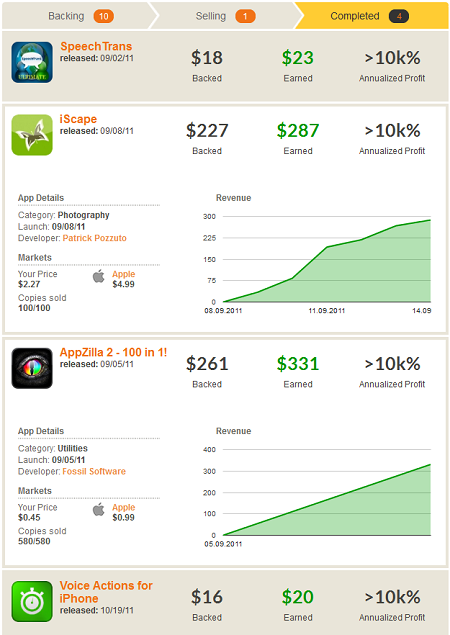
Screenshot of the Appbackr Dashboard for my Apps in status ‘Completed’. I unfolded the details for the AppZilla 2 app and the iScape App. It shows that ‘my’ 100 copies of iScape sold over the course of only 7 days. For the AppZilla 2 app it went even better. It took only 1 day for all ‘my’ 500 copies to sell. Note that Appbackr calculates annualized profit solely on the duration of the sales period. De facto I purchased the copies on Sep., 5th and was paid back $330.60 on Nov., 7th. My money was tied up for roughly two month which translates to a tremendous annualized profit of roughly 160%.Continue reading →