
Pretdunion Gains Banking License And Raises Funding

It is a successful autumn for French p2p lending service Prêt d’Union. After two years of work, Prêt d’Union was granted a banking license by the French authority. Prêt d’Union also raised a second financing round for 3.8 million Euro (approx. 5.2 million US$) from Crédit Mutuel Arkea and Kimaventures and others. The total funding raised is now 4.8 million Euro.

“The funds raised are for marketing, software development and operating costs. Note that we have dedicated 2.2 million Euro for the approval of the Bank of France to be recognized as an institution credit, such as Cetelem or Sofinco, “said Charles Egly, CEO of Prêt d’Union (statement originally in French, translated).

See a video interview with founder Charles Egly on Frenchweb.

Offering p2p loans for 36, 48 and 60 month loan terms the company aims to reach a 0.1% market share of  the consumer credit market in France.

Update: Lending on Prêt d’Union is restricted to lenders that have ‘accredited investor’ status (this excludes the majority of population).
RateSetter Finishes Successful First Year

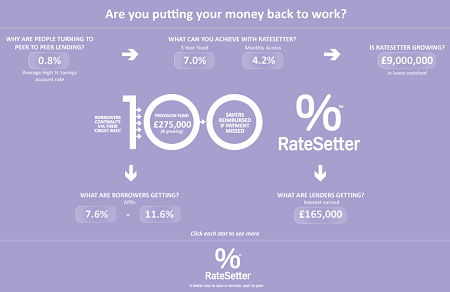
In England p2p lending service RateSetter celebrated it’s first year in business anniversary a few days ago. The loan volume matched is close to 9 million GBP, spread out over 2.400 loans.RateSetter has currently about 65.000 members.
RateSetter has a rather unique business model in the p2p lending landscape which builds on anonymously matching demand and supply for two loan “products”: 36-month loans and rolling loans (the total loan volume is spread nearly 50:50 on these products).

RateSetter says that due to the provisions fund mechanism “every single RateSetter lender has received every single penny of capital and interest that they expected.“. The fund is an instrument set up by RateSetter to “reduce the risk for lenders“. Borrowers pay an amount upfront into the Provision Fund based on their creditworthiness.  Yesterday RateSetter announced that on Sep. 3oth the team managing the Fund decided not to distribute any money from the Fund back to the lenders, which is possible if the team considers the Fund to be excessivly capitalised.

Borrower representative APRs ranged from 7.6% to 11.6%. 79% of borrowers are homeowners. The two purposes car loans and home improvement loans were given for more than 50% of the loans. In the last six month, interest rates for 36 months loans on RateSetter have been falling, whereas the rates for the rolling loans remained mostly at the same level.

RateSetter is a founding member of the Peer-to-Peer Finance Association (see: ‘Peer-to-Peer Finance Association Founded by British P2P Lending Services‘).


(Source: RateSetter)

Germany – Do Borrowers on Smava Differ From the Average Population?

A new study of the DIW Berlin (see page 3-9) (authors: Nataliya Barasinska, Nicola Jentzsch und Dorothea Schäfer) has analysed Smava loan data from the years 2007 to 2011 and found out that people who use p2p lending Smava for borrowing resemble the average population using conventional bank loans. Against expectations there was no major difference in age structure:

Regarding gender there is a gap, 28% of Smava borrowers are female; whereis in the comparison group 40% of borrowers are female. Regional distribution of borrower residence did not differ from average population. Continue reading →

New Study on P2P Microfinance and Zidisha

Sander van Damme has written the master thesis ‘Peer to peer Microfinance: the case of Zidisha.org‘ at the Louvain School of Management (Belgium). The 70 page study dives deep into analysis of Zidisha‘s complete loan portfolio (Q4 2009 – Q1 2011). It offers a very comprehensive overview on the p2p microfinance operations of Zidisha, the motivations of lenders and borrowers and developments of the interest rates on the marketplace.

Excerpt from the conclusion:

When looking at the trends in social media, the propagation of the internet and the innovations in mobile banking, we believe this website offers us a glimpse of what the future of aid and banking will look like. Although not necessarily a mainstream tool for everyone on this planet, it will surely become part of many a person’s portfolio. Rather than donating anonymously to some big NGOs who will use the money for projects we do not know about; people want to see their impact and be able to connect with each other across the globe.
Whereas we set out to discover whether peer to peer microfinance was a viable solution in the first place, we came across a business model that in the long run could allow both investors and entrepreneurs to profit from their exchange.

Funding Circle Allows Multiple Loans and Higher Risk Loans

Funding Circle will allow multiple loans by the same borrower and also open up to “C” rated borrowers which were so far excluded from loan funding. These changes will be enacted on Sept. 19th. In the blog Funding Circle explains the reasoning for allowing multiple loans:

Businesses typically have multiple finance needs throughout the year, for example they may need finance to purchase new assets or to fund new projects. Previously at Funding Circle, businesses were restricted to one outstanding loan. Many of our borrowers have come back to us with new finance needs and until now we have not been able to help them. In addition, a number of very creditworthy businesses have previously borrowed up to 50,000 GBP with Funding Circle when our maximum loan limits were lower, but which would have always passed our underwriting models for larger loan amounts (our current maximum is 100,000 GBP). …

and for introducing “C” band loans: Continue reading →