Funding Community Launches P2C Lending in the US

Last week the p2c (peer-to-company) lending service Funding Community launched. P2P loans in the US so far were done nearly entirely to individuals. Funding Community wants to change that and enable loans to local businesses. Funding Community is open to lenders from most states (and not restricted to accredited investors). All loans are 9 months loans. In addition to interest payments lenders may get rewards from the company (e.g. discounts). One example is a fitness company that offers 9,7% interest plus 2 personal traing sessions as reward.

Note that technically lenders at Funding Community do not lend directly to the company that seeks the loan. Instead, lenders lend to Funding Community, which, in turn, lends money to small companies, including the particular ones the lender selected.

Secured loans

Funding Community states that all loans are secured

The interest rates we provide, as well as a security interest in our assets are designed to decrease the risk to lenders. In addition, we take a security interest in small businesses to whom we make a loan and also generally require a personal guarantor to support repayment. We also set aside a small pool of capital to cover a portion of loans that default. It bears repeating, however, that you may not lend to us or use Funding Community expecting a return or profit. You may only use Funding Community if your primary purpose in making the loan is to help us overcome short-term cash-flow considerations in supporting small business growth in the United States.

For now, Funding Circle started with making loans to businesses located in New York and plans to expand into other areas later.

Fees

Funding Community charges companies a 2.5% loan origination fee and lenders a 0.5% service fee.

Isepankur Launches Secondary Market – P2P Loans Now Tradeable

Today Isepankur launched the possibility for lenders to sell and buy loan (parts) on a secondary marketplace. Lenders can list the loans they want to sell at the secondary marketplace and set a price which either is equal to the outstanding principal or apply a premium (up to 5%) or a discount to that. The fee Isepankur charges if a transaction closes is 1.5% (each) from seller and buyer.

I talked about the advantages a secondary market offers in p2p lending before. Most major marketplace have added the possibility to sell or buy loans. The latest to introduce this feature was Ratesetter.

In the past weeks Isepankur also introduced borrower groups (A, B and C), which group loan applications by discretionary income. Combined with the credit history classification already used (600-1000) loan applications are now classified by a combination of both (e.g. A800).

Auxmoney Raised 12M from Union Square Ventures and Index Ventures

As reported earlier German p2p lending service Auxmoney completed a series A round in the end of 2012. Today the company disclosed that Union Square Ventures and Index Ventures participated in that round and invested 12 million US$. Together they hold 21,8% of the Auxmoney ownership.

Both VC have made previous investments in p2p lending companies. Union Square Ventures invested in Lending Club and Funding Circle. Index Ventures invested in Funding Circle.

CEO Raffael Johnen told P2P-Banking.com: “We are happy to have won Union Square Ventures and Index Ventures as investors. Both have comprehensive experience with online marketplaces nad their expertise will help us to accomplish our plans to grow”. Johnen plans to use the raised amount to continue development of the technology. Furthermore he want to increase the staff (currently about 30). Main goal of Aumxoney is the growth of the loan volume.

Linked Finance Launches P2C Lending in Ireland

Linked Finance brings p2c lending to Ireland, enabling Irish residents (and companies) to lend to Irish companies. Borrowing companies are grouped into one of four categories (consumer, Manufacturing, industrial and agricultural, young businesses or knowledge, information technology (IT) and expertise). Linked Finance reviews each potential borrower and only allows businesses to borrow if they have successfully completed a full credit vetting process. The process is based on validating key up-to-date financial information and ensuring the creditworthiness of each borrower posted on the site. Linked Finance had start-up investment from Enterprise Ireland, and partners and investors in the venture include entrepreneurs Bobby Kerr, Senator Feargal Quinn, and Kingsley Aikins, as well as Irish American businessmen Peter Hooper and Carl Shanahan.

Review of My Isepankur Portfolio after 5 Months of P2P Lending

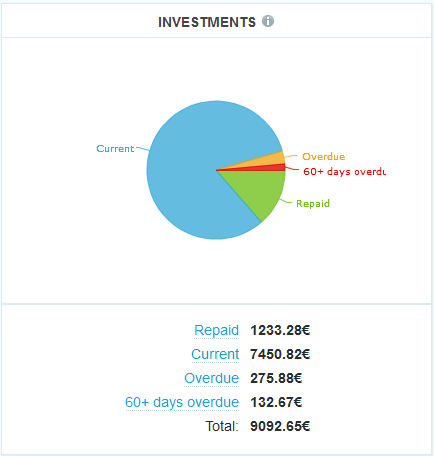
When p2p lending service Isepankur opened up to investors from all EU countries five month ago, I started lending there. In this post I continue the series of posts reviewing the development of my loan portfolio. I have deposited 6,000 Euro (approx. 7,800 US$) since starting. The account currently has 126 Euro in cash, 70 Euro waiting in bids on loans to close and 6,550 Euro is invested in loans. So far I was repaid 476 Euro principal and received 271 Euro interest.


Chart 1: Screenshot of account balance

Distribution of loans on credit grade ranges

My investment is spread out over about 350 loan parts (a bit less loans as sometimes I have 2 or 3 bids in one loan). 5,435 Euro (83%) is invested in top credit grade (“1000”) loans. 780 Euro (12%) in “900” grade loans. And the remainder are experimental bids in “600”-“800” grade loans. Continue reading

Auxmoney Changes Business Modell; Raised Series A

Documents available to P2P-Banking.com show that German p2p lending service Auxmoney raised a series A round in the end of 2012 from 2 companies. The new investors now hold 21.8% of the shares, the 3 founders Philip Kamp, Raffael Johnen and Philipp Kriependorf hold 40.4% of the shares and the remainder is held by various seed investors (mainly from Austria and UK). The volume of the Series A round was not disclosed. In fact the round itself was not announced in public.

Yesterday Auxmoney did change its business model. In the past Auxmoney approach was subject to continued criticism (see also), because Auxmoneys largest fee income came from listing fees that every applicant for a loan had to pay. And with 80-90% of applications not funded, many critics felt that this model was unfair to the borrowers.

New fee model

Since yesterday Auxmoney charges borrowers a transaction fee for funded loan applications, but no more listing fees. This is in line with fee structures used by most major p2p lending services. Lenders pay a 1% transaction fee on successful bids.

No more auctions

In the past Auxmoney used a mix of loan listings that closed when they reached 100% funding and loans with reverse dutch auctions. In future all loan listings run for a maximum of 20 days and close immediately when they reach 100% funding. Raffael Johnen, co-founder of Auxmoney told P2P-Banking.com:  ‘Lenders told us, that when they had bidded, they wanted to be sure to have invested in the loan part and disliked when they were outbid in  the course of the auction‘.

New interface

Auxmoney also redid parts of the user interface and the dashboard for lenders. Johnen promised faster and more transparent information from the collection process. Continue reading