Wokai, which funded microloans in China, is closing down. According to the announcement Wokai did not succeed in finding a new CEO. Read earlier articles on Wokai’s launch in 2008.
Author: wiseclerk
Smava Changes Business Model; Brokers Bank Loans
 German Smava, launched 2007, yesterday announced that it will offer more products and evolve into a marketplace where borrowers seeking loans get multiple offers. The site logo and layout have been redesigned to reflect this change. Smava said p2p loans will be continued to be on offer and the new products (bank loans) added will give the borrower more choices.
My take on this – what does Smava achieve with this change?
Smava’s new loan volume was static since mid-2010. With the current change Smava:
- can increase revenues. Since borrowers can be offered more loan terms and get multiple offers from banks, the probability of a sale increases. That bank loans need less explanations than innovative p2p loans further spurs this. Smava earns lead and sales commissions from the banks.
- can justify high marketing costs to acquire the borrowers better now as the resulting traffic is more efficiently monetized. Unlike before Smava no longer needs to balance demand and supply (borrower growth versus lender growth) but instead can totally focus on marketing to borrowers.
- decreases costs, as the intense vetting of loan applications (of which about 90% were rejected) is no longer necessary in most cases, since the bank does it for the referred applications
Why does Smava still keep p2p lending?
The question is not if Smava will continue p2p lending (the announcement said they will), but rather if Smava will continue development on that offer. That is unlikely since little happened in the last years. My assumption is that Smava keeps p2p lending on offer mostly for PR and marketing purposes.It allows Smava to position itself as different to loan brokers and loan comparison sites and keep a little of the image of financial innovation attached to the site. Continue reading
Zopa Will Offer More Loan Terms
 Zopa will add more loan term selection for borrowers starting in the second half of May. So far Zopa was offering loan terms of either 36 or 60 months. In the future there will be Shorter Markets (24 and 36 months) and Longer Markets (48 and 60 months). While borrowers can elect the exact loan duration, lenders can only choose between those markets.
Asked how this action might contradict the removal of 12, 24 and 48 months loan options by Zopa in 2008 (see article) , Zopa CEO Giles Andrews replied ‘… The main problem before was that lenders chose to lend mainly over 12 and 24 months while most borrowers were looking for 36+. So we had a real mismatch in supply and demand. We should avoid that this time by not allowing lenders only to choose 24. We think it’s reasonable to do that given that lenders charge an extra premium for longer loans currently, so on that basis they will be getting a “premium” for loans made in the 24 and 48 month markets using their 36 and 60 month rates. …‘
How My Appbackr Experience Failed My Expectations
Appbackr is a marketplace where everyone can crowdinvest in IPhone apps and Android apps. The way it works is that investors prefund future sales of apps. The investor buys the copies at a lower wholesale prices and makes a profit later, when the copies actually sell in the app store. I described the concept in more detail in my article ‘Experimenting with Appbackr – Promising and Trecherous‘. In the 6 month that have passed since that review, my experience turned worse.
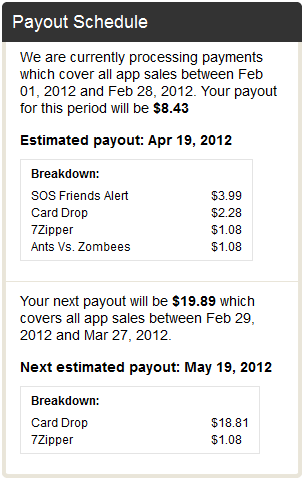 There are two major problems with Appbackr
- Even when Apps achieved the sales of the copies the investors have pre- purchased, then it still frequently happens that the investors do not get payed on time. The information given in the dashboard (see screenshot) is useless, because the given dates lapse without payment or notice. On March 24th, the payout schedule said I would be paid 53 US$ for sales of the SOS Friends Alert App – the date passed, no payment arrived, no information was given.
Even worse the interface is no help at all in keeping track – it just pretends the payment arrived (for the SOS Friends Alert app the status is ‘Completed’ saying 57 US$ earned 12 US$ profit, while in reality I did not receive any payments for this app so far. The backrs are left to manually keep track on their own. - Appbackr has no means to enforce agreements with developers. Two concept apps I funded (Boogie Monster and Glass Ceiling) are 6 and 4 months past announced launch date – again no notice, nothing happening. Vy Nguyen, Manager Finance at Appbackr answered my complaints in January saying: ‘appbackr will try its best to enforce the contracts facilitated on its marketplace, but as the actual contract is between the Developer and Buyer, we can only negotiate on your behalf. Similar to other marketplaces, the main communications should be between the Developers and Buyers, with appbackr’s role being to facilitate that communication. Our goal in making payment details available in the myappbackr dashboard was to help backrs of multiple apps reconcile their monthly payments from appbackr, track down exactly which payments, if any, have been delayed, and contact the developer directly as necessary. We do have a late payment notification in place, but it is only set to go out to backrs when the payment is delayed for longer than 1 month.’. That sounds pretty weak to me.
Furthermore Appbackr is taking steps in the wrong direction. They removed (without explanation) the statistics tab which I predominately used to screen and select IPhone apps on the marketplace to invest in. Continue reading
Zopa Profitable in 2011
P2P-Kredite.com reports that 2011 was the year in which Zopa achieved break-even and made a small profit. Zopa’s profit in 2011 was 26,143 GBP (following a loss of 392,289 GBP in 2010). Zopa’s turnover was 2.2 million GBP (approx. 3.5M US$), up from 1.7 million GBP in 2010. However the profit in 2011 is partly due to one-time effects. Zopa currently has a market share of about 2-3% of the newly funded unsecured consumer loans in the UK. Continue reading
Funding Circle Raises 10M
 British p2c lending marketplace Funding Circle announced that they have raised 10 million GBP (approx 16M US$) from Index Ventures and Union Square Ventures. Funding Circle enables individual lenders to lend to establishes businesses in the UK. Since its launch a loan volume of 28.6 million GBP has been funded. According to numbers published by Funding Circle so far only 5 out of 686 loans have defaulted giving lenders an average gross yield (annualised, compounded return lenders are earning before fees or any bad debts) of 8.4%.
Samir Desai, co-founder of Funding Circle, said: “This deal represents the next step in the growth of Funding Circle and will help us to create a lasting alternative to banks for small business loans. Index has been a prominent supporter and advocate of what the business is trying to achieve, and we are delighted to continue our partnership together. We are also excited to welcome Union Square Ventures as co-investors. They bring with them a wealth of expertise and experience …â€.