Interview with Filip Karadaghi, Managing Director of LandlordInvest

What is LandlordInvest about?

LandlordInvest is a UK-based peer-to-peer lending platform for residential and commercial mortgages. We launched in December last year after becoming fully FCA authorised. In January this year, we made bit of P2P history as we launched the first residential mortgage backed Innovative Finance ISA, ahead of major players such as LendInvest and Funding Circle.

What are the three main advantages for investors?

  1. Security – we believe that loans should be asset-backed as it creates a form of security for investors if a borrower defaults. I personally would not invest in unsecured loans given the risks and the potentially very lengthy enforcement process to reclaim part of the capital, if any at all.
  2. Returns – We offer returns of up to 12%, although we recently funded a loan with a rate of 19% to investors. The loan was arranged with a trusted bridging lending partner and is secured over a flat in Chelsea, one of London’s most prestigious areas.
  3. Diversification – We offer investors the possibility to invest in both relatively low-risk buy-to-let mortgages and more risky bridging loans. Investors can build their portfolio according to their risk appetite and other considerations.

What are the three main advantages for borrowers?

  1. Manual underwriting – we are more pragmatic in our underwriting than most high-street lenders and assess each loan on its merits. For us, the most important part of our assessment is that the borrower has a verifiable track-record and that the security is enforceable in the event of the default.
  2. Speed – we recently assessed a loan, had it fully funded and completed in two days. It was for a borrower that was let down by his exiting lender for an obscure reason at the last minute and approached us.
  3. Online application with a simple online control panel – A borrower may apply for a loan through a simple online form and keep track of the status of their application, loan schedule, loan payments in a easy to use control panel.

What ROI can investors expect?

We aim to offer returns between 5-12% per annum, depending on the product.

You recently launched an IFISA product. How has the investor uptake been so far and was it a big advantage to be in the forefront of approved providers?

The demand for our IFISA has been good. IFISA account holders, although only around 20% of the total registered investors, account for 50% of all funds on the platform. As such, IFISA account holders usually deposit more than non-IFISA account holders and also invest more.

I believe that the main advantage of being one of the first platforms able to offer the IFISA is that we have managed to establish a presence in the industry. If it was not for the IFISA, we would probably be less known than we currently are, given our relatively recent launch.

It remains to be seen what happens when the major players are able to offer the IFISA, but I believe it will be a benefit for us as it will make the IFISA a more mainstream product, benefiting everyone in the P2P industry.

Is the technical platform self-developed?

Filip KaradaghiA prototype of the platform was developed overseas, but the final platform in use today was developed in-house by our tech team, led by our co-founder and CTO Joe Vallender. We continue to make all further developments in house, and are releasing new features regularly.

What was the biggest challenge in launching LandlordInvest and what have been challenges since?

The biggest challenge has been operating under a “real” P2P model, i.e. no pre-funding of loans. As we were one of the first platforms operating under this model, some investors did not fully understand how it works, as many were used to the pre-funding model operated by many players within our niche. One of the drawbacks with a “real” P2P model is that a loan does not start to accrue interest until a loan is complete. This means that there is a certain cash drag. However, one of the benefits with a “real” P2P model is that lenders lend directly to the borrower(s) and the servicing fee charged by us is usually lower than what platforms that operate a pre-funding model charge. This means that we pass on more interest to the lenders.

How is the company financed? What background does your team have?

LandlordInvest was initially entirely financed by the founding team and have recently raised financing from business angels. We’re currently in discussion with several private and intuitional investors to raise another round, which will help us to further ramp up our capacity.

Which marketing channels do you use to attract investors and borrowers?

We use a multichannel approach including, establishing good relations with the press, having an interactive presence on various forums and blogs, affiliate marketing programs and social media presence.

We still believe that the best marketing is doing what we set out to do as the best marketing channel is always word-of-mouth. If we are able to satisfy the platform investors, then there is a high chance that they might recommend us to someone else.

Is LandlordInvest open to international investors?

LandlordInvest does accept overseas residents, subject to KYC and AML checks.

However, it is a requirement that investors must have a UK bank or building society account to be able to invest on our platform.

I hear you are planning a secondary market? Will that work with premium and discounts or at par? What other features do you plan to roll out this year?

We are indeed developing a secondary market and expect to launch it in the beginning of May this year. Investors will only be able to sell loan or loan parts at par. Investors will also be able to sell parts of loans.

We are always developing the platform as we want to deliver the best experience investors can have when investing our platform.

We welcome feedback from investors and have implemented a number of features following direct conversations with investors, and will continue to do so.

Where do you see LandlordInvest in 3 years?

We have established ourselves as one of the leading platforms within our niche and delivering good risk adjusted returns to the platform investors. This has also been our aim since we founded the company and we will do our utmost to reach that aim.

P2P-Banking.com thanks Filip Karadaghi for the interview.

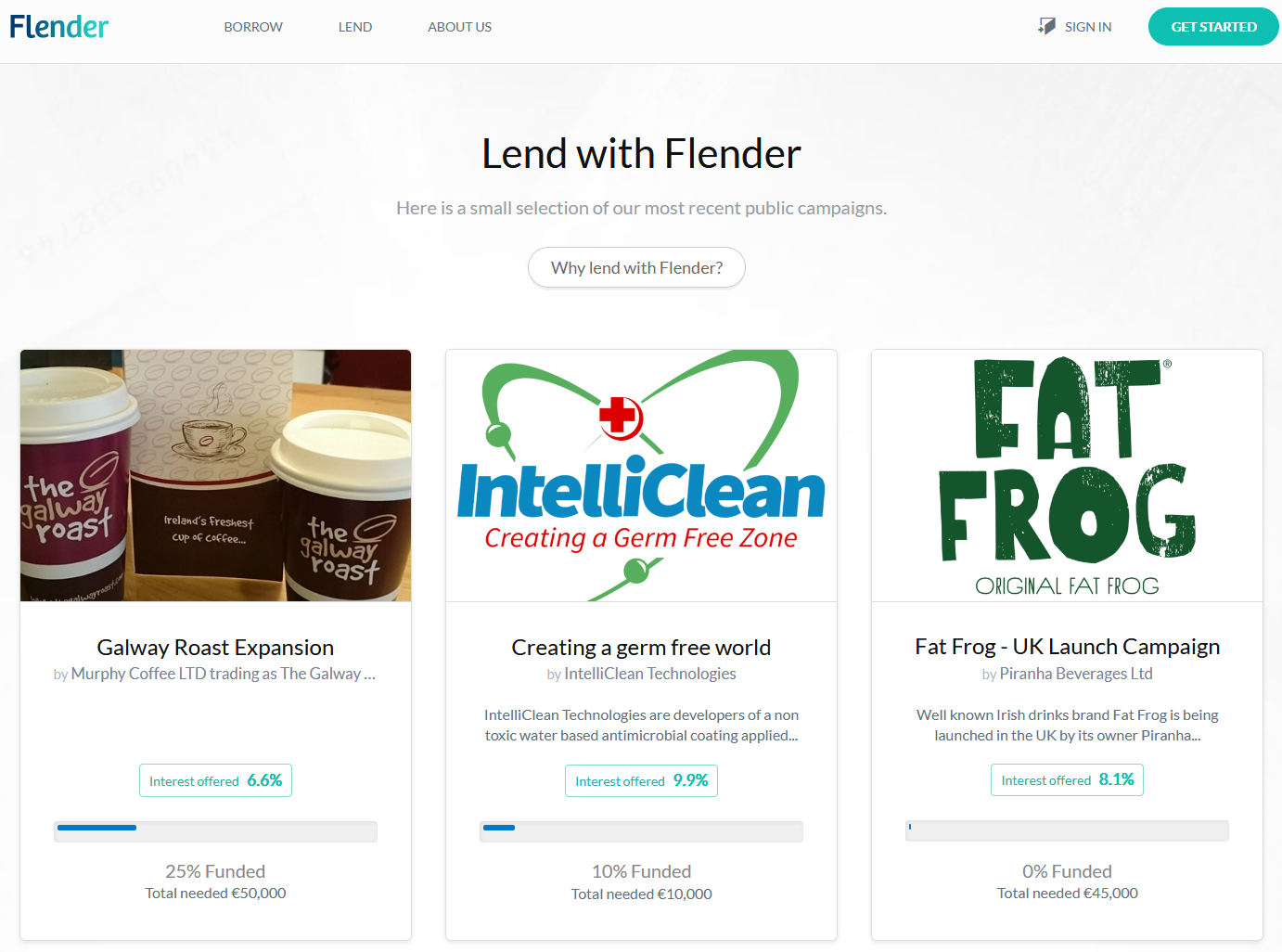
Flender – new p2p lending marketplace in Ireland

Flender, which recently soft launched a p2p lending marketplace in Ireland, received full FCA authorisation last week, saying it took two years of consultation with the FCA and the legal team to achieve approval. This will be needed for the launch in UK, planned for later this year.

Limited time offer: Cashback: 10% cashback on any investment over 1,000 GBP for P2P-Banking reader.  Sign up to use. (Update Aug. 2017: the cashback offer has been extended to August 31st, the minimum investment requirement is now 2,500 EUR)

Flender offers both SME and consumer loans on the marketplace. The main points for investors are:

  • no fees for investors
  • 50 Euro minimum bid
  • open to international investors (prerequisite is a bank account in the European Union)
  • interest rates of the currently listed loans range from 8.1% to 10.4%
  • reverse auction bidding (though at the moment, loan supply outstrips lender demand, therefore I don’t expect any underbidding soon). currently no autoinvest

Flender charges origination fees for business loans from the borrower. While there are no origination fees for borrowers for consumer loans, Flender does have a margin income on those (same with business loans).

Once the UK operation launches, investments can be made cross-border. An interesting aspect is that the borrower will take the FX charges.

Flender does have big plans. On the list are an IFISA offer, several features for investors and borrowers to customize the experience and mid term a secondary market. Flender currently has a team of 7 employees.

I published an interview with the CEO of Flender in the end of 2016, when they raised 500K GBP through equity crowdfunding on Seedrs. Flender will likely be back on Seedrs to raise another round later this year.

As my experiences with another Irish p2p lending marketplace are good so far (it has low default rates), I registered on Flender too. There are currently 4 business loans listed seeking a total amount of about 150K Euro.

Flender marketplace
Screenshot of Flender marketplace loan listings (excerpt)

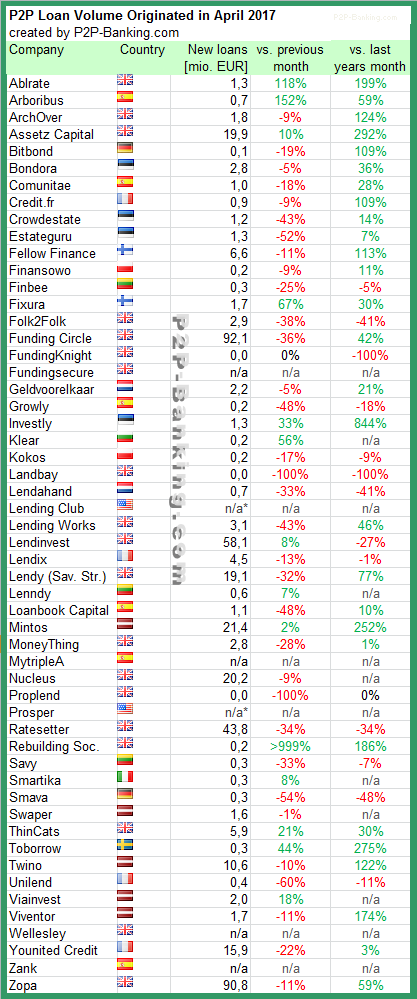
International P2P Lending Volumes April 2017

The table lists the loan originations of p2p lending platforms in April. Funding Circle leads ahead of Zopa and Lendinvest. The total volume for the reported marketplaces adds up to 445 million Euro. I track the development of p2p lending volumes for many countries. Since I already have most of the data on file I can publish statistics on the monthly loan originations for selected p2p lending platforms. This month I added Nucleus.

Milestones reached this month are:

  • Younited Credit crossed 500 million Euro loan volume since launch

Investors living in national markets with no or limited selection of local p2p lending services can check this list of international investing on p2p lending services. Investors can also explore how to make use of current p2p lending cashback offers available. UK investors can compare IFISA providers.

p2p lending statistic April 2017
Table: P2P Lending Volumes in April 2017. Source: own research

Note that volumes have been converted from local currency to Euro for the purpose of comparison. Some figures are estimates/approximations.
*Prosper and Lending Club no longer publish origination data for the most recent month.

Notice to p2p lending services not listed: Continue reading

My Lendy Experience – Portfolio Review After 2 Years Investing

When I started in late 2014 the UK p2p lending marketplace Lendy was still called Saving Stream, but it rebranded this year. Lendy is a platform offering bridge loans secured by property. I last reviewed my portfolio performance here on the blog in January 2016. Since then the following major changes have taken place at Lendy:

  1. Different interest rates
    Initially all loans had carried 12% interest. Now Lendy assigns different interest rates to each loan. Interest range for investors on new loans now are in the range between 7 and 12%.
  2. Lendy sold the security of the second defaulted loan (Garden Center). While all lenders got principal and interest paid on this loan, the sale price of the security was below the loan amount. Lendy covered the shortfall from own funds (provision fund).
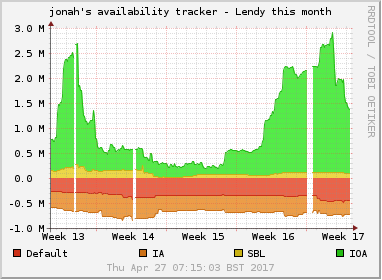
  3. Since March 2017 investor can not buy loans on the secondary market and deposit funds afterwards (this still is possible on the primary market). This has reduced liquidity of the secondary market somewhat, but in general it is still pretty liquid for those loans that have a middle to long remaining term.
  4. Since April 2017 there is a new default policy in effect. For loans more than 90 days overdue interest continues to accrue but will not be paid until Lendy has received payment by the borrower. All loans more than 180 days overdue are now automatically classified as default loans. The number of defaulted loans has risen to 14 at the time of this writing.

Especially the last point has triggered debates on the chances for recovery and there are concerns voiced among investors about to optimistic valuations. The secondary market swings from time to time between mosty empty (except for loans in default) and plenty.

My portfolio

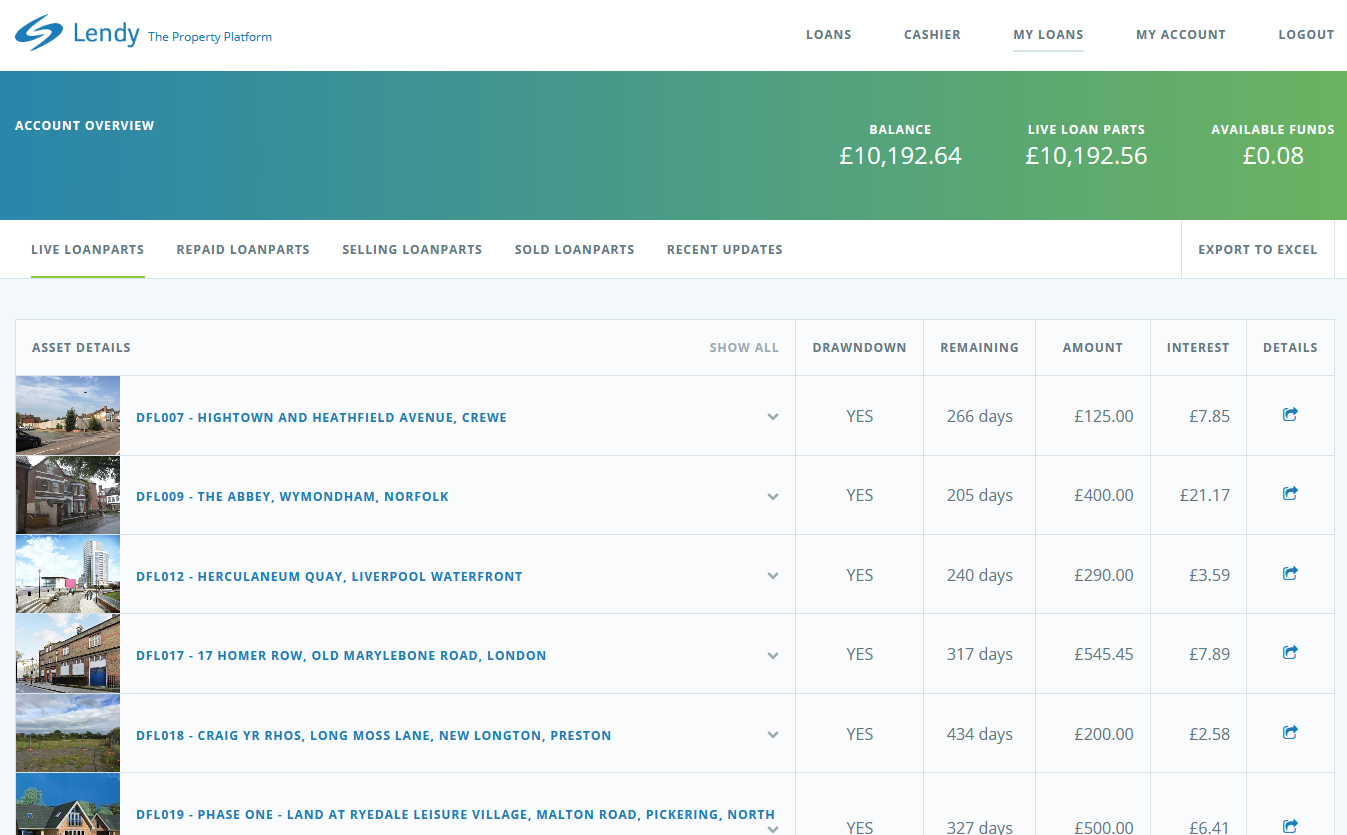
I have continued to ramp up my portfolio reinvesting returns and making new deposits via Transferwise and Currencyfair. This was before the Brexit decision. As for now I am simply reinvesting. My portfolio amount is 10K GBP spread out over 14 different loans. The vast majority is in 12% interest rate loans. I have made three exceptions in the past, but usually only with low amounts and when rebalancing the portfolio, I try to sell these lower interest loans first. So far I have not had any loans in overdue or default state – but there are many of those on the platform (see above). My loans have long remaining terms with the shortest being 147 days at the moment.

My yield (self calculated with XIRR) so far is 12.1% in GBP. Unfortunately I deposited most funds during the time when the pound was at a high, therefore calculated in Euro currency the yield is only 4.4% for me.

Lendy is still one of my preferred p2p lending marketplaces, due to interest rates, real estate as a security and liquidity. I do see the risks in the valuations, but I figure that at least the security will cover part of the loan amount and will with a high probability prevent total loss in a defaulted loan. I might get more picky in selecting loans, but so far Lendy for me is actually a platform that requires less management and monitoring than several other marketplaces I use.

Lendy portfolio
Screenshot of top of my loan portfolio list at Lendy – click for larger view


My Moneything Investment Experience after 13 Months

Last year I started investing on British p2p lending marketplace Moneything. Read my past article about opening a Moneything account. Moneything mostly offers property backed loans, with a few different asset-backed deals in between. I used Transferwise and Currencyfair to deposit money from my Euro account. Recently I also used the Revolut App to transfer money from another UK p2p lending marketplace to Moneything.

Looking back over the past year my experience with investing on Moneything has been very good. I am invested in 31 loans right now, mostly at 12% interest rate with small amounts also at 10.5%, 11% and 13% invested. I have had no defaults and there are no fees for investors. The website functions well and support is reported to be very responsive (I actually did not need it yet). The secondary market is extremly liquid, loan parts often sell within second. The only two minor downsides of the Moneything platforms for me are that investor demand by far outstrip loan offers. And there is no autoinvest, so usually it is necessary to login shortly after 4pm UK to invest into new loans. My yield (self calculated with XIRR) so far is 12.0% in GBP. However due to currency fluctuation in EUR it is only 7.2% at the moment.

So if all is great, why did I not invest more? Well, I planned to, but shortly after I started, Brexit vote took me by surprise and I abandonned my plans to ramp up my investment amount, due to the higher currency volatility uncertainty. Instead I am now mainly reinvesting funds and in addition add funds already in GBP, which I move over from other UK platforms via Revolut.

Earlier this month Moneything gained full FCA approval. This is the prerequisite for launching an IFISA product, which allows tax-free investing for UK investors (compare IFISA providers in our database). Surprisingly Moneything just said, they are in no hurry to launch an IFISA offer but rather wants to built loan originations first. This makes sense because the increased deposit influx by an IFISA offer would imbalance demand and supply even further.

P2P-Banking Launches Database to Enable Investors to Compare IFISA Providers Easily

P2P-Banking launches a new IFISA database, that enables investors an easy comparison of offers by IFISA providers. UK taxpayers can invest up to 20,000 GBP per year tax-free in ISAs. This amount is per tax year, so a person could invest 20,000 GBP this tax year and invest 20,000 GBP in a different ISA next year. The Innovative Finance ISA, short IFISA, was introduced in 2016 with most offers becoming approved by HRMC only in the 2017/2018 tax year.

The new database of IFISA offers allows speedy selection and sorting to review IFISA products by different providers and then links to the provider’s website for in detail information. Investors can filter by interest rate, term, loan type, minimum investment amount, possibility of transfers in and out, flexible IFISA, bonus & cashback promotions and several other criteria. The  comparison focusses on IFISAs by p2p lending marketplaces but also lists IFISAs investing in crowd bonds and other investment types. Currently more than 15 IFISA providers are listed and P2P-Banking will list new offers as they are approved by HRMC and launched in order to help investors get the best IFISA rates that match their investment strategy and risk appetite.

Several companies have reported huge demand in their new IFISA offers. Lending Works reported a huge spike in investor deposits after launch and last week the consumer loans marketplace said, it has recorded £8.8m of subscriptions into its IFISA in the first 3 months with 815 investors lending. CapitalRise has stated earlier this month that the IFISA product raised 900,000 GBP in the first 4 weeks. Crowd2Fund, said that 95 per cent of its investments are now made through the tax free wrapper. CEO Chris Hancock said the platform is experiencing 50 per cent month-on-month growth and is expecting to originate 2 million GBP in loans in April. ‘Last week, 58 IFISAs were opened from 115 investor registrations,’ he said. ‘I think the IFISA market has grown three-fold in terms of investor demand over the past year.’

More p2p lending marketplaces have gained FCA approval recently and are preparing to go live with IFISA offers in the next weeks. Readers of P2P-Banking can subscribe to the free notification service and receive an email whenever the database is updated and a new provider is added.