German startup Valuna.de wants to help companies to raise capital through loans from private investors without a bank. The first offer is by printing service QuickPrinter which offers 15 percent interest for a 7 year 100,000 Euro loan. Minimum amount for investors is 100 Euro. The platform Valuna offers marketing, but does not handle the financial transactions which are conducted directly between the lenders and the company. More information in an detailed article on the Valuna launch (German language).
The spanish p2p lending market
So far there are no p2p lending services active in Spain. Manuel Ángel-Méndezwrote a comprehensive article on the situation in Spain for El País. Some of the key facts from this article:
- Giles Andrews, of Zopa, confirms: "We have had conversation with several companies in Spain"
- Pol Navarro, director of innovation at Banc Sabadell,thinks that p2p lending will not be a short term threat to banks. "it is to early to tell if p2p lending will be a successul business model in Spain"
- Banking organisations expect, that p2p lending will profit from the introduction of a personal identification number (digital DNI) which will be introduced within the next 18 months. Fernando Alfaro of Bankinter sees to chances for p2p lending services: low costs of entrance (IT costs) and millions of immigants in need of loans, that do not have a credit history
Partizipa uses crowdfunding to fund companies
 Spanish startup Partizipa.com does p2c lending instead of p2p lending. Individual investors can lend money together to fund a company. Currently a solar power plant in Andalucia is listed for funding. The amount to be raised is 285,000 Euro. Minimum individual investment is 5,000 Euro. The project advertises 13.85% ROI.
Earlier investors bought land in Bulgaria through Partizipa.
I did a short interview with Agustín Cárdenas, one of the founders of Partizipa:
P2P-Banking.com: Can you please describe Partizipa?
Agustín Cárdenas: Currently, we are offering P2C (person to company) lending, making it possible to invest small sums of money in big businesses. At the moment we are still developing the frame-work for P2P lending, and we hope we will be able to offer it sometime later this year. As of now, we cannot provide any further details. Our main aim is to build a community in which any given member presents a new idea for a business to the others for it to be enriched, completed and financed. If the business is successful, then every investor will share the profits according to his/her investment.
P2P-Banking.com: Who can invest? Only residents of Spain, or anybody?
Agustín Cárdenas: The only prerequisite to become a member of the community is to have a bank account in Spain under his/her name.
P2P-Banking.com: Does Partizipa administer and transfer the funds, or does it just
make contact between investor and business opportunity and both handle
the contract and the payment themselves?
Agustín Cárdenas: If the business is created by us, then it is us who manage the entire process up until the moment of completion and the sharing of profits. In any other case, even though we supervise all the process, we only put in contact the business originator and the investors.
P2P-Banking.com: When did you start the company?
Agustín Cárdenas: We are an extraordinarily young company. We have been operating only since September 2007. So far, our registered users have financed projects valued at 2.3 million Euro.
Social lending timeline
Created by Jean-Christope Capelli

(Source)
Finding the best MyC4 loans
MyC4.com accelerated growth during the past month. This is shown by stats on MyC4Stats.com (provided by Wiseclerk.com) showing the loan volume by origination month. Compared to earlier months the loan volume rose sharply in December and January. In December 150,000 Euro loans and in January 250,000 Euro loans were disbursed to African entrepreneurs.
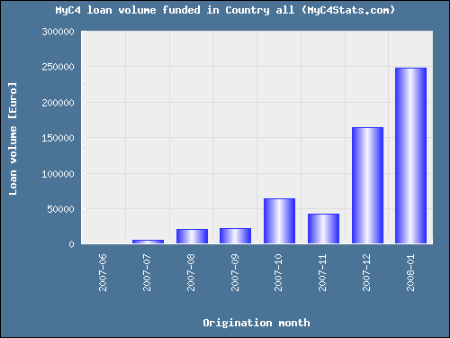
(Source: MyC4Stats.com)
The new MyC4Stats page offers reports helping lenders to find open MyC4 loan listings with the best rates. At MyC4 – unlike at Prosper – every lender funds a loan at his individual interest rate. In fact 50 different lenders funding one specific loan may each earn different, self-set interest rates. While MyC4 sets a maximum for the weighted average interest rate for each loan, it is still possible for an individual lender to bid higher and earn more after funding.
Example: A 2500 Euro loan to Clementine Gbrou, who exports grains to Europe the maximum weighted Wanted interest rate was 12% (lender interest, not borrower). This loan closed with a weighted average interest rate of 11,64% (lender interest). The individual lenders in this loan earn DIFFERENT selfselected interest rate between 3% and 13.5%. Several lenders thus achieved above average rates.
How to find the best loans?
To select the loans with the best rates for bidding in the listing phase a quick overview of available listings sorted by the maximum possible interest rates that can be bid, is important. Several tables on MyC4Stats help lenders on this. Sample screenshot:
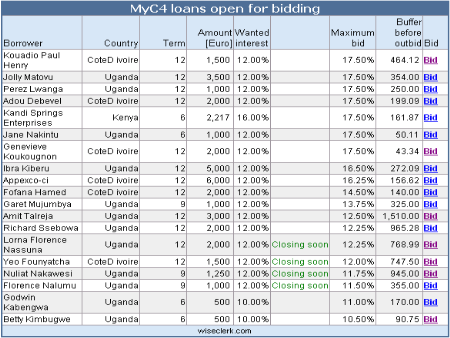
(Source: MyC4Stats.com)
The report presents the listings sorted by maximum interest rate (column Maximum bid) that can be bid and states the Euro amount above this rate that serves as a buffer before being outbid. The buffer is caused by the rule that new bids must always be place at least 0.5% lower then the current high bid.
First anniversary of Boober
 A year ago Boober.nl launched as first peer to peer lending service in the Netherlands. While Boober faced some hardship (especially on regulation issues) the first year of Boober can be called a success for the company. So far Boober has funded over 2 million Euro in loans in the Netherlands. Compare this to the 1 million Euro Smava.de has loaned in the much larger German market in the last 10 months.
But not all lenders are satisfied with the results. The PIVN an association of lenders, on Jan. 14th called for an investment stop. The main cause are fee changes. Richard van den Toorn, Secretary of PIVN, told P2P-Banking.com:
It's not going very well with Boober, although they claim otherwise. The
PIVN (association of investors) has indeed given an advice not to invest
in new loans until some of her demands have been met. Reason for giving
such an advice is that Boober changed their payment-policy for the
investors radically, without consulting the PIVN first. It's so much the
height of their fee …, but that they are making sure the
benefits are going to Boober first, leaving the investors [lenders] with the risk of
remaining payments from the borrower. Continue reading