Financial startups have formed the ‘Coalition for new Credit Models’. Among the founding enterprises are Prosper and Loanio. Two of the changes the coalition asks Congress and the Administration to make are:
Adopt legislation classifying person-to-person lending as a consumer banking service, not a securities offering.
Create a Start Up Liaison at Treasury Department or within banking regulators to guide and fast-track the development of new financial products by start-up companies and organizations seeking to innovate the way consumers and businesses raise and access capital.
Bankless-Life.at was launched as the first p2p lending service in Austria by the non-profit association “Von Menschen für Menschen” (engl. by humans for humans). The members-only site (membership fee is 60 Euro per year) allows borrowers with a given minimum credit score and a minimum income requirement of 1,000 EUR per month to apply for loans between 1,000 and 30,000 EUR. The wanted interest rate is set by the borrower, selectable loan terms are 12, 24, 36, 48 or 60 months.
Lenders are charged 3 Euro per bid. The fees for borrowers are rather high: In addition to the membership fee borrowers pay 0.5% to 2.5% (depending on term) origination fee, 0.8% tax plus 2% premium of the loan amount for the Anleger-Pool, which is a mechanism similar to the one used by German Smava spreading default loss risks among lenders.
According to chairman Siegfried Fischer Bankless Life has 1,800 members two weeks after launch.
News from the far north: Uppspretta (engl. resource) launched the first Icelandic p2p lending service earlier this month. Uppspretta’s main goal is to allow startup companies to apply for microloans.
Uppspretta.is was founded by Björk Theodórsdóttir, Ingi Gauti Ragnarsson and Ragnheiður H. Magnúsdóttir. Uppspretta co-operates with Naskar, a group of Icelandic woman entrepreneurs, using them as a show-case for lenders and enabling a start with a secured supply of lender funds.
Iceland is a interesting market for p2p lending. While the market is small in size, the reputation of banks is nearing zero after the banking disaster last year. Theodórsdóttir told P2P-Banking.com: “There is definitely market for such a service as P2P lending in Iceland. We have been well received and in light of the bank‘s reputation, people celebrate the opportunity to bypass them. It‘s yet to be seen the impact Uppspretta will have on the lending market but we are optimistic that Uppspretta will be an real option beside the banks.”
Furthermore she pointed out that unlike other players Uppspretta is free of regulatory chains: “We worked closely with the regulators in Iceland and the conclusion was that Uppspretta would not require any licence to operate.”. Uppspretta charges a fee of 4 percent of the funded loan amount.
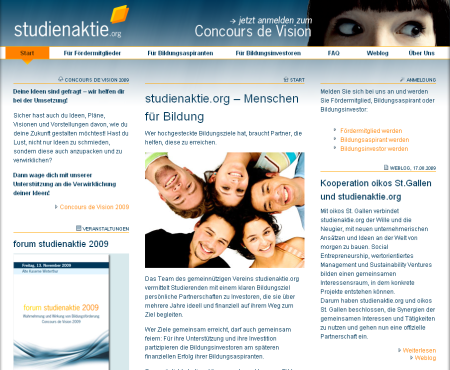
Studienaktie.org is a Swiss non profit association offering p2p lending to students. The name translates to student share and is rather fitting, since the concept literally allows the investor to invest in a student and profit from his career development. Unlike with other p2p lending platforms for students, investors do not really give a loan, but rather buy a share offered by the student.
An example illustrates how this works out. A student might offer to sell you a share for 100 CHF (approx 97 US$) now while in return promising to pay you 0.25% of the annual salary he will earn in 2017. Meaning if his salary will be 80,000 CHF in 2017 the investor will be repaid 200 CHF for his share then.
So this is really a bet of the investor on the students career chances. To help on the selection investors can browse anonymous dossiers of the students and contact them. Chances for a positive ROI a probably good since Studienaktie originated at the university of St. Gallen, which has an elite reputation. Studienaktie is open to students of other universities, too.
The contract is signed directly between investor and student and the payment is directly facilitated between the 2 parties. Studienaktie only provides the platform. Investors pay a yearly membership fee of 100 CHF to participate.
The aim of the non-profit organisation is to enable more and better education.
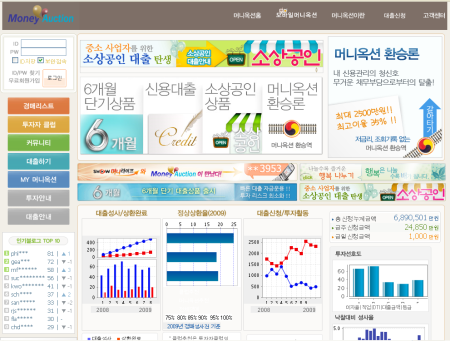
Moneyauction, a Korean p2p lending company, says it is “the No. 2 [website] in Korea’s non-bank area, but the number 1 website in the finance area”. And it has impressive figures to prove it. Between June 01th, 2007 and Sep. 15th the loan amount applied was 56.6 million US$.
Moneyauction partnered with telecommunication carrier Korea Telecom and offers a mobile service allowing borrowers to apply for and lenders to bid on loans via their cell phone.
In 3 months Moneyauction plans to launch a secondary market (called ‘Divided bond trading’). A spokesman told P2P-Banking.com that he expects this new feature to boost the transaction volume.
In an video interview in June, Konrad Hummler, managing partner at Swiss Bank Wegelin & Co, states how he sees p2p lending as a threat to banks. P2P lending services could replace vital functions of banks. He says government influenced major banks are to inefficient. Established institutions will use calls for regulation to protect their business against newcomers.