Prosper Settles Class Action Lawsuit – Pays 10M US$

In a Form 8-K SEC Filing of today, Prosper announced that it settled the class action lawsuit that has been going on since 2008 (see first coverage by P2P-Banking.com). The plaintiffs claimed that Prosper sold unregistered securities. The claimants originally filed for 47M US$. Under the settlement Prosper will pay 2 million US$ now and 8 million US$ spread out over the next 3 years.

The class members in the Lawsuit alleged that PMI offered and sold unqualified and unregistered securities in violation of the California and federal securities laws. The class members in the Lawsuit sought rescission damages against PMI and the other named defendants, as well as treble damages against PMI and the award of attorneys’ fees, litigation costs, and pre-judgment and post-judgment interest (collectively, the “Claims”). In exchange for a full release of the Claims as to all class members against all defendants, and subject to Court approval, PMI agreed to pay settlement consideration in the total amount of $10 million according to the following schedule: (i) $2 million within 10 days of entry of an order by the Court granting preliminary approval of the settlement (“Preliminary Approval”); (ii) $2 million on the one-year anniversary of Preliminary Approval; (iii) $3 million on the two-year anniversary of Preliminary Approval; and (iv) $3 million on the three-year anniversary of Preliminary Approval.

Lending Club’s Cost Advantage Over Banks

If you are not totally new to p2p lending then you probably already heard the list of competitive advantages the p2p lending services have over banks: They don’t need branches, they don’t have old legacy infrastructure/software they need to maintain, they need less staff, their processes are faster, …

But how can this advantage be quantified?

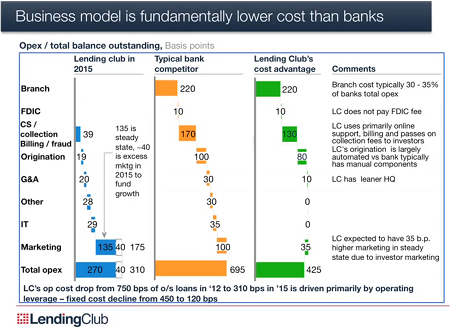
On the Lendit 2013 conference Lending Club CEO Renauld Laplanche told the audience about a study conducted by McKinsey that calculated the cost advantage Lending Club has compared to a typical bank. He showed this chart:


(Source Lending Club /Lendit 2013; view larger image)

For 2015 the chart projects a cost advantage for Lending Club of over 400 basis points over banks. This is huge. Not surpisingly Lending Club has the biggest advantages by maintaining no branches and in collection and origination. or marketing Lending Club will have higher costs than banks.

Banks will eventually embrace p2p lending

Laplanche foresees that more and more banks will actually make use of p2p lending services as platforms to invest or to fund their borrowers to profit from the faster processes and the lower costs. At the conference Laplanche announced the first cooperations with banks and says he expects more to come.

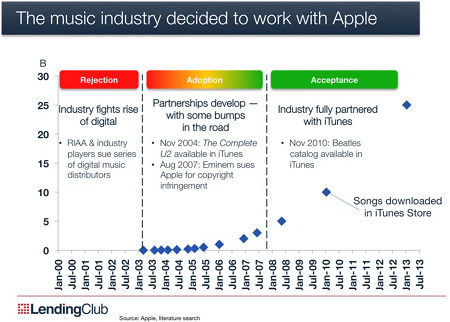
His reasoning is that p2p lending like many other innovations will pass through 3 stages: rejection, adoption and then acceptance by the incumbents. Following this argument, p2p lending could right now be early in the stage of adoption by the industry.

He showed this chart to illustrate how the music industry reacted to disruption by Apple:


(Source Lending Club /Lendit 2013; view larger image)

Zopa Announce Business Loans

Zopa has announced that they will start to offer business loans soon. Zopa will start with loans to sole traders.

Soon we will introduce business loans to Zopa, offering good value loans to sole traders.

We’ve chosen to start our business loans with sole traders for two reasons:
1. We saw that there were few opportunities for smart sole traders, with a good credit and trading history, to access good-value loans.
2. Sole traders are often looking for loans of a similar size and time period as our personal loan borrowers so offering these loans doesn’t require big changes for our savers to the way they choose to lend

Milaap Raises 1.1M US$

P2P microfinance service Milaap (see earlier coverage on P2P-Banking.com) raised 1.1 million US$ from Jungle Ventures (Singapore), Toivo Annus,Lionrock Capital, Jayesh Parekh and Unitus Seed Fund. The current round of funds will be utilized to expand engineering and marketing investments for enhancing the online product experience, and to invest in scaling up marketing and outreach efforts.

Milaap says that so far 100% of the microfinance loans originated have been paid back.

Ratesetter Raises 5M Funding – Valued at over 30M

Ratesetter has raised 5 million GBP funding in June from existing shareholders, who include Peel Hunt founder Charles Peel, fund manager John Chatfeild-Roberts and Lazard chairman Ken Costa, plus a new Hong Kong-based investor. The founder Peter Behrens and Rhydian Lewis still own an almost 40% stake in the company which in this round had a valuation of more than 30 million GBP. Ratesetter, which aims to fund over 100 million GBP in p2p loans this year, reached break-even in January and will use the new capital to foster further growth.

(Source: Lucy Tobin, London Evening Standard, July 1st 2013)