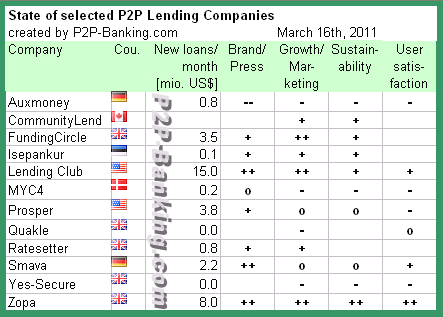
State of Selected P2P Lending Companies

More than 2 years have passed, since P2P-Banking.com published the first overview table of p2p lending companies. At that time the focus was to create a comprehensive list and to get a perspective on the loan volumes.

Today I want to look at a smaller selection of p2p lending companies and do a rating on more factors than just loan volume. While I describe below what factors led to my rating, please note that the rating represents my personal opinion.

The table lists the companies in alphabetical order and gives:

New loan volume per month

This amount is in most cases retrieved from the last month(s) figures from the company websites (if they have statistic sections), and then converted into US$ at today’s currency exchange rates. In other cases it is a rough estimate by me based on volume figures published in media in the recent past. For CommunityLend I failed to find a per month figure (the total figure from launch to mid-February is here).

Brand/Press

Extend and tone of press coverage in the past months. Since a large share of new users is introduced to p2p lending services via media, positive media coverage is extremely important. Continued positive media coverage has helped some companies to associate positive values to their brand.

Growth/Marketing

This column especially rates if the new loan volume is growing continuously month after month. Furthermore it puts the absolute volume into perspective to the size of the market. It is obvious that absolute numbers in a country with a small population (e.g. Canada) will be much lower than those in a country with a large population (e.g. US). Furthermore it takes into account if the (online) marketing measures of the the company succeed in winning new borrowers and lenders (though in most markets lenders do not need to be actively acquired).

Sustainability

Sustainability rates a mix of several factors:

  1. ROIs for lenders / default rates
    Most p2p lending companies that failed in the past, did so as a result of high default rates which led to negative lender ROIs and caused massive lender churn
  2. Ability of company to raise new funding
    Most p2p lending companies still have to bridge a considerable time-span at their current growth rate before they become cash flow positive. The ability to raise more funding to finance continued operation is essential for their success
  3. Business model

User satisfaction

This rates the publicly voiced user opinion. Major factor are the comments in forums. To a lesser degree I took the user experience published in blog articles into account. The problem with lender experiences published in blogs often is that the writer is casting a positive image, since he earns commissions for newly referred customers through the affiliate program of the p2p lending site. Also these review are often written at the start of the lending activity at which point the lender’s ROI is naturally unharmed by the experience of defaults.


Empty fields: I had not enough information to rate these. E.g. with some of the new UK p2p lending companies I felt I had too few indicators to reach an opinion on the sustainability.

Availability of information also influenced the selection of companies. Due to language barriers including more services (e.g. the Japanese p2p lending companies) was not feasible for me.

Peer-to-Peer Equity: Crowdcube

With the introduction of p2p lending some lenders wrote that the concept enabled everyone to feel as banker.

Now, newly launched Crowdcube.com enables any UK resident to feel as venture capitalist for a financial commitment as low as 10 GBP. Investors can browse pitches which usually include business plans and financial projections and sometimes even video pitches.

In return for the investment, investors get shares of the company. For example entrepreneur Daniel Vinson wants to raise 50,000 GBP. He is offering 49% equity in return, meaning investors roughly get 1% shares in return for 1,000 GBP investment. So far 11 investors have pledged 1,200 GBP.

There are 6 entrepreneurs pitching for funding at the moment. Interested investors can answer questions and for some businesses a lively discussion has started.

Crowdcube, founded by Darren Westlake and Luke Lang, launched 2 weeks ago. Crowdcube’s business model is to offer a platform to match entrepreneurs with peer investors and business angels. Costs for entrepreneurs are a success fee of 5% of the funding amount plus legal fees of 1750 GBP for completion of each company investment.  For a limited period they are waiving the 250 GBP listing fee to register as an entrepreneur and add a pitch.

Investors are charged a processing fee by Crowdcube for each transaction equal to the sum of 0.20 GBP plus 4% of the value of the transaction. Continue reading

P2P Lending Site Ratesetter Raises another 600k

UK p2p lending service Ratesetter has raised another 600,000 GBP from undisclosed existing and new investors. The total equity funding of the company now is 1.5 million GBP. The additional funding will be used for marketing purposes.

RateSetter co-founder and CEO Rhydian Lewis said: “We’re thrilled that RateSetter has earned the confidence of some well-respected investors. The response to RateSetter has been very positive and has exceeded our expectations. Our users enjoy the benefits of high returns on their savings and low cost, flexible borrowing.”

P2P-Banking.com wrote an review on Ratesetter when they launched in October 2010 (RateSetter brings rolling monthly loans to p2p lending). Since then the company grew considerably reaching 2 million GBP lent by lenders in the first two month.

If you are a Ratesetter lender or borrower please do share your experiences and opinions. Write a review on Wiseclerk’s Ratesetter forum. Thank you.

Yes Secure to Add Secondary Market

Yes-secure, a British p2p lending marketplace launched in June 2010, will very soon add a secondary market called Secondary Loan Slice Market.

According to information the company provided P2P-Banking.com, the secondary market will have the following features:

Advantages for Loan slice buyers:

• Loans offered at premium and discount: Lenders are able to buy loan slices from other lenders at a premium or discount to the principal remaining amount. Lenders can invest in quality loan slices which they missed out on earlier.

• Ability to view repayment history: Potential buyers for the loan slices can view detailed information about the borrower repayment history, enabling them to make informed low-risk decisions based on track record of reliable repayments.

• Earn interest from day one: As the existing loans slices can be transferred within a few minutes, they can start earning interest with immediate effect.

• Build a balanced investment portfolio: Lenders can quickly build themselves an active and balanced portfolio by picking and choosing through different markets, rates and terms; this automatically leads to risk-diversification through loan portfolio management.

The advantages for Loan slice sellers:

• Encourages liquidity: Investors can easily generate cash as and when they require by selling their loans slices to other registered members of YES-secure.

• Flexibility: Investors can easily manage their investment portfolio, buying and selling chosen loan slices and fine-tuning their lending portfolio to suit their risk profile.

• Loans sold at premium or discount: Lenders can set a price for their loan slices at rates within +/-10% of the remaining principal amounts of their loans.

It is interesting to see that Yes Secure does not face the regulatory challenges Zopa cites (see: Zopa Rapid Return Secondary Market) or has overcome them.

Zopa Rapid Return Secondary Market

One of the disadvantages for lenders in many p2p lending markets is that money lent cannot be withdrawn early during loan terms.

Zopa UK now introduces a secondary market called ‘Rapid Returns’, which allows lenders to cash out on all or selected market loans early. To do this a lender simply selects all or specific markets to ‘sell’ his loans.

For each of these loans, the system looks for other lenders offering to the same market at the same or a lower interest rate. Where a match can be found, each loan is then permanently transferred to the lowest bidding lender in that market. The winning lender will then earn the interest rate that the previous lender was getting on that loan, even if they offered at a lower rate. The lender receives the total outstanding capital on the loan from the offered funds of the winning lender.

Zopa deducts a 1% admin fee from the transferred capital.

There are some limitations: Loans made through ‘Zopa Listings’ are not eligible. Also excluded are loans where the borrower ever has missed a repayment. Some more restrictions apply.

And of course there needs to be a matching lender offer with a rate low enough.

Asked why lenders can not bid on loans on offer – thereby buying at a discount or premium – a Zopa employee explains:
“What you describe here is a true secondary market which …, we are not regulated to provide. I hope all will become clear when the full functionality is available in the next couple of weeks.

Our overarching rule when developing Rapid Return has been that it should allow lenders who want to exit some of their cash to do that. It is not designed to tinker with a loan book – in particular we wanted to avoid a scenario in which an experienced lender could cash out of some loans at the expense of an inexperienced lender.
As a final note on the ‘never missed a repayment rule’ – we started development with this rule as ‘not currently in arrears and hasn’t missed a repayment in the least three months’ but when we looked at the proportion of the total loan book for each, there’s a negligible difference. It’s therefore much clearer and fairer to go with the former.”

Currently Rapid Returns is only collecting offers on the buying lender’s side, letting lenders amend their bid offers to include Rapid Return loans. The feature will actually go live in a couple of weeks. Then selling lenders can mark their loan books for sale.

I expect that the Rapid Returns feature will further boost Zopa’s growth in the British market. Congratulations.