Today p2c lending marketplace Unilend and Groupama Banque announce a partnership wherein Groupama Banque will lend directly 100 million euros to French small and medium enterprises through Unilend over the next four years. This is a first time ever partnership between a French bank and Unilend, a French p2p lending marketplace.
Bernard Pouy, CEO of Groupama Banque, said: “this ambitious partnership will allow Groupama Banque to sustain the growth of French businesses all across the countryâ€. Nicolas Lesur, CEO and co-founder of Unilend, added: “this is a key milestone for Unilend, the marketplace lending industry and the financial sector more generallyâ€.
Through Unilend, Groupama Banque will have the opportunity to lend money directly to the businesses of its choice alongside Unilend’s lenders. Groupama Banque, a subsidiary of mutual benefit insurance company Groupama, counts 536,000 clients all across France. Groupama’s values are social responsibility, proximity and solidarity and â€this partnership with Unilend is just another illustration of these valuesâ€, according to Sylvain Burel, in charge of Groupama’s communication. Unilend has originated 7.5M EUR of loans since inception in December 2013 from 3,000 registered lenders.
Victory Park Capital to lend 150 million GBP via AssetzCapital
In a similar arrangement announced today, US private equity company Victory Park Capital will lend 150 million pound via AssetzCapital marketplace in the next 5 years.
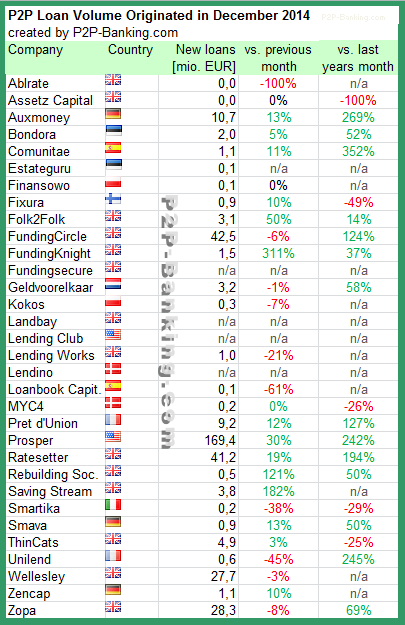
Several p2p lending marketplaces managed to grow the loan originations in December despite the Christmas season. Especially Prosper had a record month. I added one more service. I do monitor development of p2p lending figures for many markets. Since I already have most of the data on file I can publish statistics on the monthly loan originations for selected p2p lending services.
Table: P2P Lending Volumes in December 2014. Source: own research Note that volumes have been converted from local currency to Euro for the sake of comparison. Some figures are estimates/approximations.
Notice to p2p lending services not listed: If you want to be included in this chart in future, please email the following figures on the first working day of a month: total loan volume originated since inception, loan volume originated in previous month, number of loans originated in previous month, average nominal interest rate of loans originated in previous month.
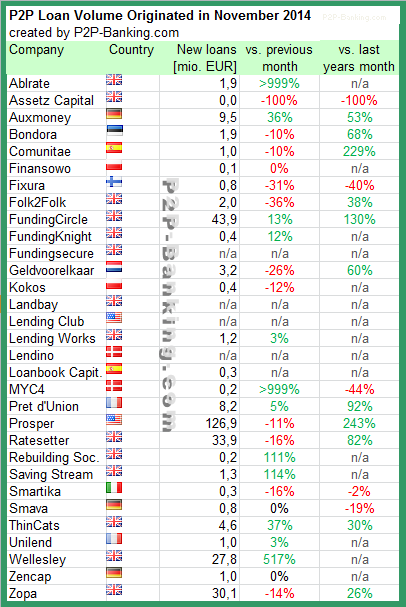
November was a month of mixed results for the listed p2p lending services. Some grew, some had a small decline in newly originated loan volume this month. Ratesetter crossed a total volume of 400 million GBP originated since inception. Ablrate profited from the deal with the first institutional investor, which boosted volume. I added one more service. I do monitor development of p2p lending figures for many markets. Since I already have most of the data on file I can publish statistics on the monthly loan originations for selected p2p lending services.
Table: P2P Lending Volumes in November 2014. Source: own research Note that volumes have been converted from local currency to Euro for the sake of comparison. Some figures are estimates/approximations.
Notice to p2p lending services not listed: If you want to be included in this chart in future, please email the following figures on the first working day of a month: total loan volume originated since inception, loan volume originated in previous month, number of loans originated in previous month, average nominal interest rate of loans originated in previous month.
Lending Works is an online marketplace lending platform for unsecured personal loans. We offer extremely competitive lender returns and fixed rate, flexible loans up to £25,000 over 1 to 5 years.
What are the three main advantages for investors?
Lender protection – our unique Lending Works Shield consists of a reserve fund to cover loan arrears and insurance to protect against the primary reasons for borrower defaults, including loss of employment, fraud and cybercrime. No other peer-to-peer lender offers this. In addition, our underwriting processes are extremely robust, resulting in a 0.00% arrears and default rate since launch
Great returns – our lender returns are extremely competitive and are protected by the Lending Works Shield, so the rate you see is the rate you get
Flexibility – lenders can access their funds early using our Quick Withdraw facility, or can automatically reinvest monthly repayments using Auto Lend
What are the three main advantages for borrowers?
Low cost loans – our loans are offered at market leading rates. By directly connecting our customers and cutting out the bank, we’re able to cut down the cost of a loan significantly
Simplicity – by utilising the latest technology and being an exclusively online platform, we’re able to pay out funds within one working day of completing the simple online application process
Flexibility – borrowers can make overpayments or settle their loans early at any time, without charge
What ROI can investors expect?
Lenders can expect returns of around 4.1% over 3 years, up to 6.0% over 5 years. These rates are protected by the Lending Works Shield so there shouldn’t be a need for lenders to factor in bad debts.
How did you start Lending Works? Is the company funded with venture capital?
We started building Lending Works in 2012 and launched the platform in 2014. The idea was to create a simple and safe platform to enable ordinary consumers to get a fair deal. We tried to make lending and borrowing through Lending Works as simple as possible – most of our customers do not have the time or desire to actively monitor and manage their account. That’s why we opted to steer away from an auction-based or “market†model and introduced features like Auto Lend to automate the reinvestment process.
The company is funded primarily by angel investors. We’ve raised around £4m in funding to date which has enabled us to navigate the launch period successfully. We’re now focused on driving exponential growth through innovative partnerships and new loan origination channels.
Is the technical platform self-developed?
The technical platform is completely bespoke and was initially built by an external digital services agency. Since launch we’ve brought all development activity in-house which allows us to innovate quickly and to regularly release updates. We hired our first Head of Technology, Michael Raasch, in September. Michael has over 25 years’ experience working for large investment banks and has been fundamental in preparing our platform for large scale. Continue reading →
I just returned from the Lendit Europe conference in London. It was a great occasion to meet so many of the people that developed p2p lending to the current state and hear what they have to say about the future.
The entire industry is enthusiastic as all figures report fast growth which will be further boosted by the tax incentives (NISA) coming for retail lenders in the UK . Cormac Leech, analyst at Liberum, projected that interest rates (and yields for investors) will in effect slightly rise for the UK platforms while they might slightly sink on Prosper and Lending Club. Others do wonder if the UK services will manage to scale loan demand fast enough to match the expected retail investor money looking to invest through the new ISA.
Impressions from Lendit Europe (photo used with permission)
There were multiple examples that marketplace lending is achieving broader and broader reach, both in terms of countries served (e.g. Ovamba, the p2p lending platform operating in Cameroon that GLI Finance invested into) as well as specific markets served (e.g. more and more property investing or Bitbond tackling Bitcoin based p2p lending).
Impressions from Lendit Europe (photo used with permission)
I did not watch all the panels and presentations in the main conference room (the keynote presentation slides are online here; the videos will be made available on the Lendit site in the a few weeks) as I spent much time to meet up with people that I previously only knew from email or phone conversations.
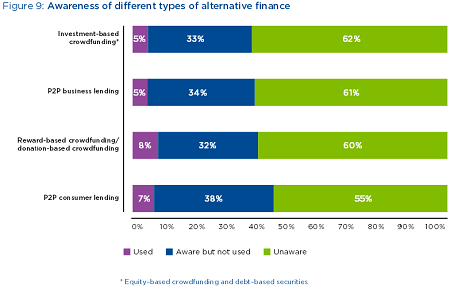
Today the Nesta Study ‘Understanding Alternative Finance – The UK Alternative Finance Industry Report‘ was released. The researchers Peter Baeck, Liam Collins and Bryan Zhang worked in four stages to compile this great report. One included questioning more than 15,000 users with the help of the platforms in distributing the surveys. Furthermore to gauge awareness of the general public for alternative finance 2,007 consumers and 506 SMEs were questioned.
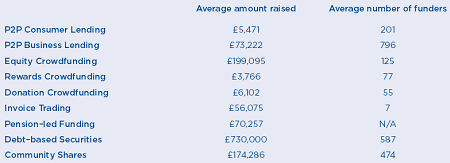
The more than 90 page report documents and visualizes the fast ongoing growth of all alternative finance sectors in the UK and the positive reception by the users. I will conclude by citing some graphs from the study to induce everybody interested in p2p lending and alternative finance to read the full study.