My Finbee P2P Lending Portfolio after 8 Months

In August 2015 the new p2p lending marketplace Finbee launched in Lithuania. Finbee finances small unsecured consumer loans. The CEO told me that they meet all borrowers in person and that these are mostly looking to refinance other debts at higher rates, which they have paid in accordance to schedules punctually over months or years. Typical interest rates for investors are in the range of 20% to 32%. The platform is still very young, but recently loan volume picked up and Finbee crossed the milestone of 1M Euro loans financed since launch.

I started small and deposited only 50 Euro right after launch to test it and gain first hand experiences. Only two months ago I started depositing more and right now my deposited total amount is about 1,550 Euro.

The auction mechanism

Finbee lists all loan request and investors can bid either manually or via autoinvest (autolend). There is an auction period for each loan with investors underbidding each others in an reverse auction, meaning the interest rate will sink once the loan is filled. A pecularity of Finbee is, that each investor with a winning bid gets the individual interest rate he made the bid on, meaning there is no uniform lending rate for investors in the same loan (this is different from the way most other platforms handle reverse auctions, where usually all investors with winning bids get the same rate which is set at the highest winning rate at auction closing).

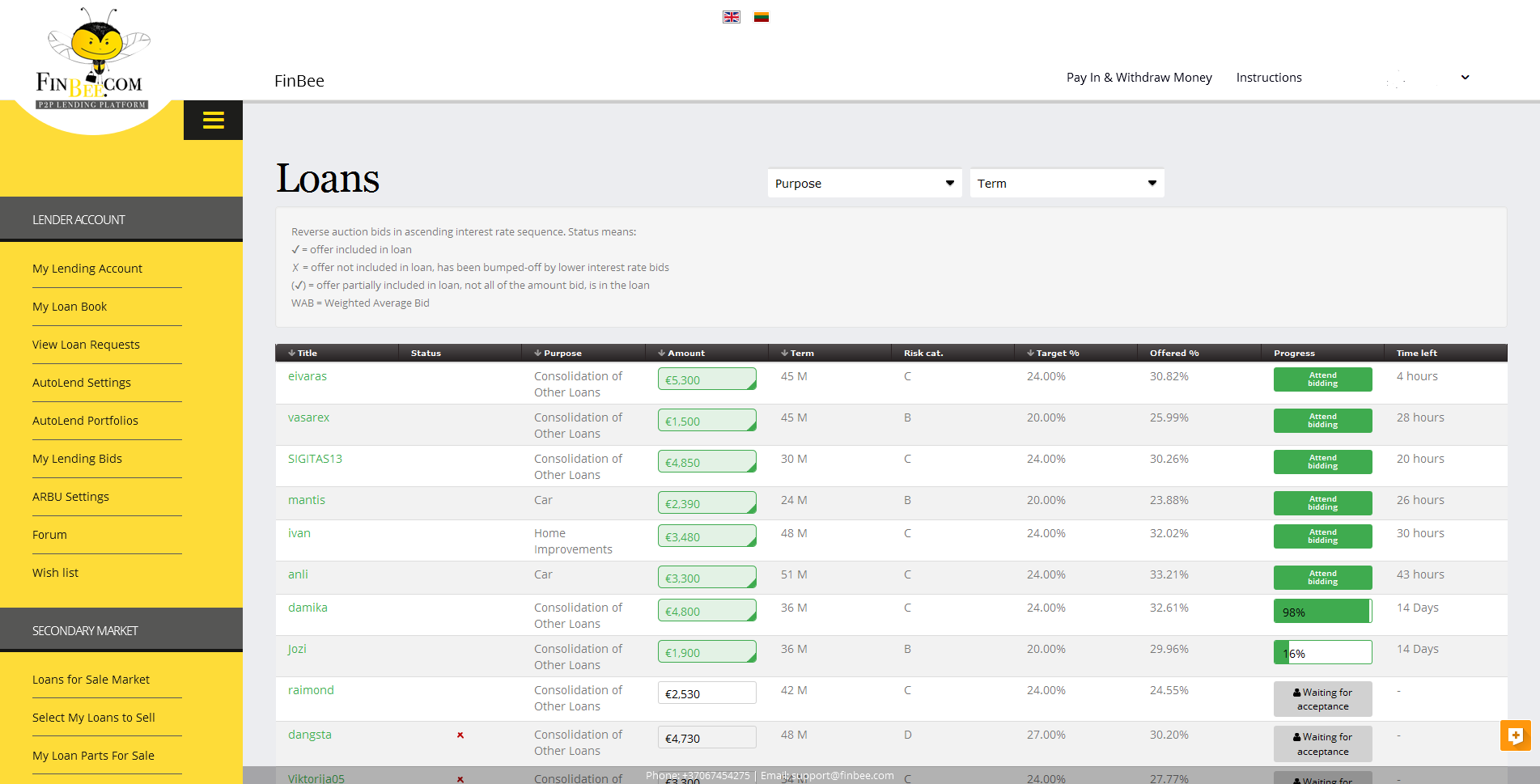
Finbee Loans
Loan requests at Finbee. The ones with the green button at right are open for bidding. Auction periods are initially set to 14 days but then reduced to 48 hours, once the loan is 100% filled by bids.

This auction mechanism often causes a mad rush in the last 5 minutes. Lots of bids are made right before closing and it is usual that the top closing interest rate drops 3-5% in these last minutes.

This is aided by a mechanism abbreviated ‘ARBU’ (Automated Response to Bumbed-off Underbids). Investors can enable ARBU to make lower bids on their behalf, once their original bid is outbid. The mechanism is quite configurable in selectable settings, but the catch is that it will not make more than 5 lower bids per loan. This led me to do quite a bid of configuring and experimenting with my settings. I also changed my strategy from multiple smaller bids on the same loan (e.g. 5 bids at 20 Euro), to now just 1 or 2 bids per loan at 30 to 35 Euro.

My strategy

In the first months I have just observed what is happening on the Finbee marketplace. Since February I go for the riskiest loans, risk category ‘D’ and sometimes ‘C’ with the highest loan amounts and the highest interest rates. I do all bids manually and have ARBU enabled with my settings, which I tweaked quite a bit. If I have multiple successful bids in one loan I try to sell some of the loan parts on the secondary market at premium in order to reduce the concentration. On the secondary market only current loans, that have made at least one repayment, can be sold. I also try to sell my late loans on the secondary market, but that means I have to wait for them to turn current again before I can sell them. Continue reading

Interview with Gideon Valkin, CEO of FriendlyScore

What is FriendlyScore about?

FriendlyScore is about allowing borrowers to use their online footprint as a way of increasing the amount of information a lender has about them. This can be useful for borrowers who lack credit history to get access to products they deserve, and also for allowing borrowers with some history to get better products by making lenders more comfortable with their risk profile.

How can your company help p2p lending marketplaces? Can you please share some references?

We help lending marketplaces make better credit decisions by enabling them to get way more data on their customers. By incorporating FriendlyScore into the platform’s decision engine, we can help prevent outright fraud; validate user identity and personal information; and most importantly, gain propensity insights from the users behaviour. This allows the platform to approve more borrowers (or lenders), reject more fraudsters and bad borrowers, as well as price their risk more accurately.

Gideon ValkinA borrower your software identifies as creditworthy has been previously ruled out by the scoring mechanism of the marketplaces. How would the marketplace deal with this loan when showing a credit grade/score class for this loan to investors? Assign a new class?

Our most common use case in the p2p space is for FriendlyScore to be offered as an optional way for borrowers to bump up to a higher internal credit rating if they get a high FriendlyScore. In other words, it is an opportunity for borderline declines to get bumped up to higher-riskaccepted, and for the accepted applications to get a better risk grade and hence a lower interest rate from the lending community. This allows the marketplace to increase approvals and hence conversion and also to more competitively price good borrowers. As our algorithm develops, we expect to be able to function as a standalone credit score.

How do you price your service for p2p lending marketplaces?

Our standard pricing is on our website at https://friendlyscore.com/page/pricing. We charge a subscription price to make the decision simple and easy for marketplaces. We are open to alternative, variable pricing models where they make more sense for the customer on a case-by-case basis.

Do you think your service will be more beneficial for marketplaces in developed countries or in developing markets or what factors indicate in which markets you could add most value?

We can service marketplaces in any market because, at the core, we are simply a data enrichment and machine learning platform for improved decisioning. We are however seeing steadily increasing interest from emerging market lenders which makes sense based on the following two macro factors that drives demand of our product:

1) Shortages of credit bureau data (much more prevalent in emerging markets). 2) High internet and social media penetration (much higher in developed markets but converging quickly). We will always be able to help developed market lenders access non-traditional borrowers (students, young professionals and foreign nationals). However, in developing markets where vast portions of the population lack financial history, and will soon be using the internet as much as anywhere else, we have a chance at bridging an accessibility gap in finance that unfairly applies to a large portion of the normal population. Continue reading

Fellow Finance Expands to Poland

P2P lending marketplace Fellow Finance is now open for borrowers in Poland. Polish customers can now apply for peer-to-peer loans with maturity from 1 to 3 years up to 12 000 PLN. For Fellow Finance investors this gives an opportunity to diversify their investments geographically and in two currencies (EUR and PLN) with single consolidated user interface and reporting in investor’s own preferred currency. The ability to operate in multiple currencies also enables Fellow Finance to scale its platform to new geographies swiftly in the future.

‘Poland is a huge market in Europe with 38 million people. The Polish economy is one of the fastest growing in Europe. Consumer and consumption behavior are changing with the expanding economy. Mobile penetration and online lending have seen a fast and continuous growth in the last 4 years. Launching operations in Poland makes Fellow Finance a genuine international platform where investors can easily do direct investments in consumer loans across geographies and in multiple currencies. …’ says Jouni Hintikka, CEO of Fellow Finance. Continue reading

Marketplaces Step Up Incentives for Investors

Currently there is an increase of promotions by p2p lending marketplaces in order to acquire and activate retail investors. Cashback offers are more frequent and Funding Circle is giving away iPads to investors that will invest at least 20,000 GBP during the Funding Circle spring promotion. Investors welcome these added benefits, but for marketplaces it is a fine line to walk. They want to grow originations, but risk that investors will expect getting extras and might hold back further investments until the next offer is made.

Funding Circle Spring Promotion
(Image source: Funding Circle)

Google Advertising Lending Club Loans

I have written about the partnership between Google and Lending Club earlier. The image below shows an actual advertising message Google is sending to its Adwords customers. Note that a special loan is offered, not a standard Lending Club loan. This partnership is a great match for both Google and Lending Club. Google can enable its customers to get access to the funds they need to grow their business and potentially spend more on advertising services supplied by Google. Lending Club can target selected businesses, which were prescreened based on the data Google has via the Adwords customer relationship.

google-lendingclub
Image source: Business2community.com