No more Prosper group fees

Prosper.com announced that it will discontinue group fees in the near future for all new loans. Group fees, also called Group leader rewards or Group rewards allowed the group leader to charge a fee that is payed by borrowers with loans in this group.

The announcement:

At Prosper, we have been listening to your feedback regarding groups and group leader rewards.

The original philosophy behind Prosper Groups was to enable borrowers in close-knit communities to leverage the reputation and peer pressure of their group to attract more bids from lenders, resulting in potentially lower interest rates for borrowers, and lower default rates for lenders. We have found, after nearly two years of experience, that the strongest groups are comprised of close networks of friends and associates, where compensation is not the dominant motivation for the group leader’s services.

As a result, we are making changes to Prosper Groups. In the next month, Prosper will discontinue payment rewards on new loans for group leaders. Group leaders will continue to earn payment rewards on all eligible loans originating before the change. Group leaders can also receive referral rewards for referring borrowers or lenders to Prosper under our Referral Program.

We hope this change will encourage group leaders to grow their groups by inviting new members from their pre-existing social networks, turning Prosper Groups into a more powerful community development tool and making Prosper simpler for both borrowers and lenders.

For more details on these changes, please visit our Group Changes Frequently Asked Questions (FAQ).

Thank you for helping us become the Internet’s leading community lending site.

The original idea of the Prosper groups was, that social connections, that already existed offline, would be replicated within the Prosper group structure.
But most groups evolved online only with no previous offline connections between the members. The (the lack of) value of the groups for the Prosper concept has been discussed repeatedly in the Prosper forum. While some group leaders did a good job screening and vetting borrower applications and the group leader could be seen as a compensation for time invested; the majority of lenders seems to see the removal of group fees as a step in the right direction.
MyC4 – Microlending for profit to African entrepreneurs

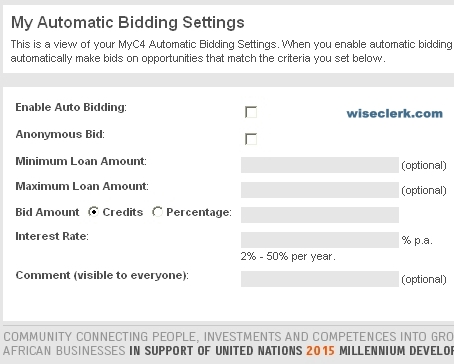
myc4 betaDanish startup C4 World on it's platform MyC4 allows lenders to finance micro loans to African entrepreneurs (Afripreneurs). P2P briefly featured the MyC4 plans earlier. The goal is to "eradict poverty through business". The service is currently in beta, but signing up and lending at MyC4 is already possible.

MyC4 differs in its approach from Kiva: At MyC4 lenders do earn interest on the loans. Currently interest rates of 20-24% are typical with loan terms of 6 or 12 month.

myc4

P2P-Banking.com joined the Beta as a MyC4 Builder. The gathered experiences are published in an exclusive P2P-Banking.com review of MyC4:
http://www.wiseclerk.com/myc4-p2p-banking-review.pdf (0,4 MB, 3 pages)

Lendingclub receives 10 million VC funding

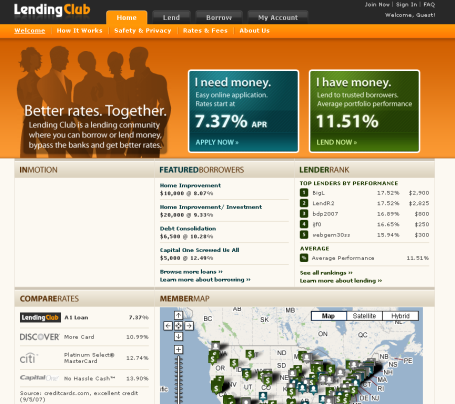
Lendingclub has received a 10.26 million US$ venture capital investment from Norwest Venture Partners and Canaan Partners. The CEO Renaud Laplanche announced that the money will be used to expand Lendingclub beyond the Facebook platform.

In an interview, Daniel Ciporin of Canaan Partners says:

P2P services and functionality in general has been at the heart of web market disruption, from Ebay to MySpace to Facebook, using only a few of the most prominent examples. I think the opportunity is ripe now to apply P2P functionality in the consumer lending space, especially with the particular focus on pre-existing affiliations that Lending Club has.

Average lending club interest rate 11%

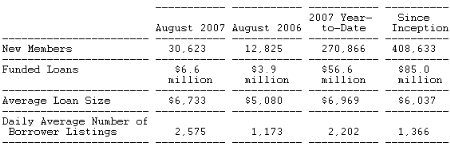
Lendingclub's loan volume has surpassed 750000 US$. So far the average interest rate is 11.10%. As you can see in the table the majority of loans went to borrowers with good credit grades.

Lendingclub states that the top states where Florida, New York and Massachusetts. This differs from the state distribution of the Prosper loans, where California, Texas and Georgia are the states with most loans.
A possible cause is that Lendingclub.com is only open to Facebook users and might therefore target different user demographics then Prosper.com. (Source)

Regulator forces Dutch p2p lending site boober to stop lending

Dutch p2p lending site Boober.nl is in big trouble. A court in Rotterdam ruled that Boober needs a license, with the judge supporting the position of the regulating authority AFM. After Boober published its interpretation what this ruling means, the AFM clarified its position in a press release.

Under pressure Boober finally posted a statement on its homepage saying that while the site remains open and existing loans will continue to be serviced, Boober stops any lender bidding. Statement:

Beste Boober Gebruiker

In tegenstelling tot wat dinsdag en woensdag is gecommuniceerd heeft Boober gisteravond na overleg met de Autoriteit Financiële Markten besloten om de krediet-bemiddelingsactiviteiten voorlopig te staken. Dit wordt geëffectueerd door uitleners voorlopig niet de mogelijkheid te geven op leningen te bieden . De site blijft gewoon beschikbaar en het besluit heeft geen enkele consequentie voor lopende leningen.

Boober betreurt de ongelukkige wijze waarop zij met de markt heeft gecommuniceerd en verwacht begin volgende week meer duidelijkheid te kunnen verschaffen.

Boober's service was controversial in the Netherlands from the start. It was even subject of discussion of the Dutch national parliament.

An update on what will happen next is expected early next week.

Richard van den Toorn, publisher of the great site Booberwatch.nl has supplied P2P-Banking.com with this chronology of events: Continue reading