Digesting new Zopa listings infomation

Zopa's new Zopa listings contain several pieces of information. Apart from the "basic information" which include loan amount, loan length, preferred rate, loan purpose, borrower ID, borrower signup date and listing end date, these are:

Credit score

The rating we give to the borrower’s credit score at Callcredit, a UK credit reference agency, relative to other Zopa borrowers

Affordability

Zopa rating (stars) for the borrower based on income and expenditure details provided by the borrower.

Stability

Zopa rating (stars) for the borrower based on details provided by the borrower, such as residence and employment.

Personal profile

Listing text supplied by borrower

Income/Expenses

Self reported detailed budget (see screenshot above for example) Continue reading

MyC4 lender headcount doubles after national TV coverage

After MyC4.com was featured on Danish national TV in a 15 minute feature many new lenders signed up. Within 3 days lender count rose from about 500 to currently 964. At MyC4 lenders (called investors) loan money to African entrepreneurs. The bidding frency of new lenders did lower closing interest rate dramatically. Loans now closed at 2 to 3 percent lender interest rate (previously usually 10 to 12 percent). MyC4 will now have to increase the number of listings, otherwise they might be temporably be sold out like happened to Kiva.
Yesterday the first loan listings from Ivory Coast went online.


Changes at Prosper

Prosper.com applied several changes as described in this announcement. Some of the changes were expected as plans had been known, some were surprises.

Portfolio plans

Portfolio plans allow the lender to automatically build a conservative, balanced, moderate or agressive portfolio. That means the lender no longer picks individual loans to bid on but chooses to invest in a plan. The feature is implemented based on Prosper's standing orders. The difference is that it uses standing orders predefined by Prosper, not by the lender. Prosper shows "estimated returns" for each portfolio – currently ranging from 8.37 to 11.06 percent.
Comment: Lendingclub introduced this concept earlier on. Lenders are currently examining and debating on which rationale Prosper did build the standing orders behind the portfolios.

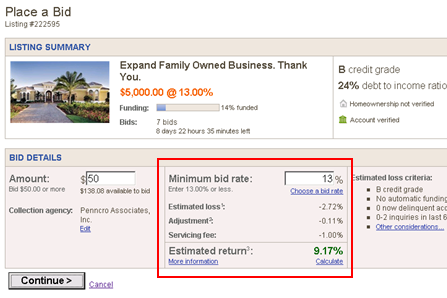
Estimated ROI is shown in listings

Prosper now shows the estimated return on each listing, including predictions for defaults and costs for the servicing fee. The default estimate is now based on Prosper's own data (past performance) rather then Experian data.

Comment: This display does improve lender information especially for unexperienced lenders.

Ended listings hidden (surprise!)

Prosper now hides all data of expired listings. Continue reading

How p2p lending is different from bank loans

Part I: Platform & lender view

Occasionaly, when I talk to analysts or journalists, their perception is that p2p lending is very similar to bank loans. They argue:

  1. The platform does check, if the borrower is eligible to receive a loan by validating credit history, income and other documents just like a bank would do (note: this argument applies more to Zopa and Smava, less to Prosper)
  2. The listings descriptions and photos just give the lender the illusion that they know where their money is going and for what purpose. In reality nobody checks the information in the listings and the listings could be all false.
  3. The p2p lending platform is just taking the role of the bank. The platform earns fees on each loans which is comparable to the spread the banks live on.

My opinion is that p2p lending is very different from banks giving loans.
One main difference is that the platform does not have the loans in their own books. The risk is carried by the lender. The platform must aim to provide as much information as possible to allow the lender to gauge the risk and it must prevent the lenders from fraud. It is then the decision of the lender, if – based on the information – he wants to bid or refrains.

For the lender the ability to decide who gets the money is a major motivation compared to depositing the money in a banking product. The p2p lending services are aware that the listings are a central point to their marketing. Zopa, which currently does not have individual borrower listings, will introduce 'Zopa listings' in the future.
Regarding argument 2: It is true that listings are not checked on any of the platforms and a borrower could use the loan for a totally different purpose then stated in the listing. My opinion is that this is not a problem, as long as lenders are aware of this and as long as the protection from fraud (identity theft; no intention of borrower to repay in the first place) is high. I don't care if 2, 3 or even 20% of the borrowers lie in their listings. I believe that the majority is telling the truth and what I really care about is that my money is repaid. The borrower said he wanted to use the money for the college education of his daughter and actually used the money to buy a new car? I personally would not care as long as he repays the loan.

P2P lending services achieve a level of constant interaction with the lenders few banking products reach. In the Prosper forums many lenders express that they spend a lot of time on Prosper browsing and selecting listings and that they find this process somewhat addictive.
Conversely that means that p2p lending is not for lenders that to large amounts of money without spending time.

Conclusion: P2P lending IS different from the way banks loan money. It offers a different marketing angle, the risk is taken by the individual lender rather then the bank, and gives the lender has more control over what his money is used for.

Is identity theft a possible threat to the p2p lending concept

On most peer to peer lending services (Prosper, Lendingclub, Smava, Boober) the identity of the borrower is hidden to the lender. Only the service itself knows the identity of the borrower. Therefore the lender has no means to check if information given is accurate and has to trust the platform.

The service has to

  • ensure that it takes adequate measures to verify the identity the borrower has stated at registration is correct
  • instill trust to the lender that the fraud risk of borrowers impersonating under a false identity is minimal, non-existant or while existant not covered by the lender.

Prosper gives a "100% Identity Theft Guarantee" and in case of identity theft repurchases the fraudulent loan:

Prosper reserves the right to buy back loans at any time. If Prosper buys back a loan, the outstanding principal balance will be returned to lenders and the loan will be marked as "repurchased".

Prosper typically repurchases loans in accordance with Prosper's 100% Identity Theft Guarantee, under which Prosper has agreed to repurchase loans from lenders if the loan is found to involve identity theft of the named borrower's identity.

Prosper is committed to providing a safe and secure marketplace, and works with law enforcement authorities to prosecute to the fullest extent perpetrators of identity theft.

Rateladder had one of his loans repurchased today. But how often does this occur?

Looking at the Wiseclerk Prosper loan stats by status, the column Repurchased shows a value of 400000 US$. Out of the total loan value of 96 million US$ that is about 0.4%. Not all of the repurchased loans are due to identity fraud.

Prosper checks identity by several measures like checking documentaion supplied by the borrower, calling him, verifying bank adresses, sending postcards to his adress… There have been several discussions on this topic with details on the Prosper forum.

Other services use other measures. German Smava.de uses the PostIdent-process a service that requires the registering service to produce a government id (passport) in person. The Postident process is used by nearly all German online banks and is considered quite safe.

P2p lending services can tolerate only a low level of identity theft cases. The innovative approach of p2p lending requires that lenders trust the concept and the service. Fraud cases endanger that trust.