 In the UK Zopa expects a record month of new p2p loans funded. CEO Giles Andrews told P2P-Banking.com today: “We are going through some dramatic growth at the moment. July was a record month with 908 loans for 4.5 million GBP, but we should do 1100 for 5.5 million GBP in August.”
Author: wiseclerk
Fixura Starts P2P Lending in Finland
 A few days ago Finnish p2p lending site Fixura launched. The bilingual (Finnish & Swedish) site already lists over a hundred loan requests.
CEO Simon Sandvik told P2P-Banking.com:
This social lending company differs from the ‘standard’ ones as it does not provide lending auctions. Instead, the borrower sets his/her own interest rate, amount (1, 000 – 10,000 EUR) and duration of the loan. Then a Finnish credit scoring company processes the data and the borrower gets a one-to-five star rating. If a borrower is marked for payment issues in the past, the loan request automatically gets rejected.
… investors can also diversify their investments through different loans in 100 EUR lots. …
The company operates totally free of paper as it uses the local banks’ identification systems, a kind of e-signature. The investors can invest directly online and the borrowers can sign their contracts.
If a loan does not get fully funded the borrower can choose after 14 days from the first investment to accept a part of it, or reject it as he or she sees fit.
Currently investors pay 4 Euro for each withdrawal. Fees for borrowers are
- 5% origination fee
- 2% annual fee
- 4 Euro per transaction
Compared to other p2p lending services these fees are rather high.
P2P Lending Sites in Europe
Visualizations are great to show data that would otherwise just be a long list. I decided to create a map of the p2p lending landscape in Europe. It shows active and discontinued p2p lending services in Europe (including p2p microfinance). Not listed are sites that are in pre-launch stage. All of these marketplaces have been featured earlier in the P2P-Banking.com blog. If you want more information about any of them just enter the name in the search box on the top right of this blog.
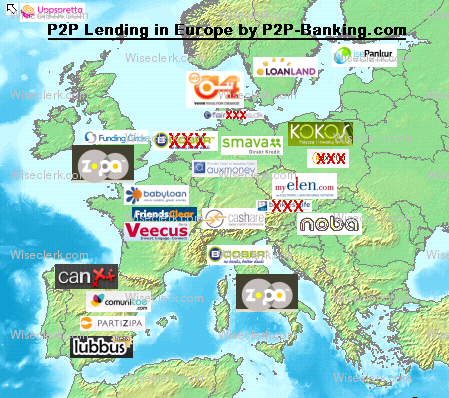
Notice to other websites: You are free to copy and use this map, provided you agree not to alter or resize the image and you will set a link to this article.
Notice to p2p lending sites: If you want to be included in a future version of this map, contact me to learn how.
Funding Circle (Fundingcircle.com) P2C Lending Launch in UK
Funding Circle has  launched it’s peer to company lending service in Britain. As reported by P2P-Banking.com in February the startup received 1.1 million US$. Any UK resident can lend either by individually selecting businesses or by using the autobid feature and spreading the investment over several matching businesses. While loans last for 1 to 3 years FundingCircle – unlike other p2p lending sites – allows lenders to access their money easily: Selling of parts of loans funded to other lenders is possible (secondary market).
In 2010 lenders are not charged any fees to use Funding Circle (in 2011 there will be a 1% annual servicing fee and a 1% sales fee).
All businesses applying for loans are screened by Funding Circle’s underwriters using data supplied by Experian to ensure they are creditworthy. A business may apply for a Funding Circle loan amount between 5,000 and 50,000 GBP. Continue reading
Cashare Plans To Use Digital Signatures in P2P Lending Process
In Switzerland P2P Lending Service Cashare announced that it plans to be one of the web service pioneering the use of SuisseID a digital signature. Documents signed with this digital signature are as binding as a conventional signature on paper.
Opportunities for P2P Lending
Several European countries (e.g. Italy, Spain, Germany, Belgium) have enacted laws that equate digital signatures with conventional signatures.
P2P Lending can use digital signatures to
- validate the identity (and depending on the signature card the address) of users
- automate processes that otherwise would require a signature on paper and enable paperless process chains.
Banks Need to Understand Their Customer’s Needs Better – FAST
 I just finished reading Bank 2.0 by Brett King. If I would work in middle-management of a bank – any bank – then I would be scared now, because the book clearly shows that banks are changing to slow. Or they simply deny that the world around them is evolving faster and faster and still try to continue business as it used to be.
Banks still spend too much time trying to solve the wrong questions like how to design branches or think about channel distribution. What they need to understand is that a customized solution fitted to the needs the customer has right now is needed.
If bank management does not foster innovations quickly they will lose contact to the customer. Banking function will continue but the interface to the customers might in future be held by p2p payment providers, p2p lending services, telcos, aggregators or other non-banking “insurgents”.
The book is filled with ample examples and observations from the authors work experience in banking. Available at Amazon US, Amazon UK and Amazon DE.