Kiva today has reached the milestone of 50 million US$, doubling the loan volume in the last 8 months. I have been lending on Kiva for nearly 2 years now and so far all of my borrowers have repaid me (unlike my MyC4 borrowers). Kiva is doing a very good job in keeping defaults low.
1 loan every 32 seconds
The current – impressive – statistics for Kiva are:
Total value of all loans made through Kiva:
$50,023,035
Number of Kiva Lenders:
363,222
Number of loans that have been funded through Kiva:
70,357
Percentage of Kiva loans which have been made to women entrepreneurs:
77.96%
Number of Kiva Field Partners (microfinance institutions Kiva partners with):
93
Number of countries Kiva Field Partners are located in:
42
Current repayment rate (all partners):
98.76%
Current default rate (all partners):
1.24%
Average size of loan for funding:
$449.02
Average total amount loaned per Kiva Lender (includes reloaned funds):
$137.81
Average number of loans per Kiva Lender:
3.70
The growth is stimulated by a large, active supporter base, that comes up with creative marketing ideas. Did you know that you can build a beard to support Kiva?
P2P lending is spreading internationally. While the biggest loan volumes are generated in the US market, many p2p lending websites have been established in other international markets.
social lending services enabling micro financing (e.g. Kiva, MyC4) – participants driven mainly by social motives
other concepts (e.g. Virginmoney which is special in the way that it does not do the matchmaking between borrowers and lenders, but supports the process between persons that already had offline relations- slogan “We manage loans between family and friends“)
Sites funding student loans can fall into any of these three categories or combine motivations.
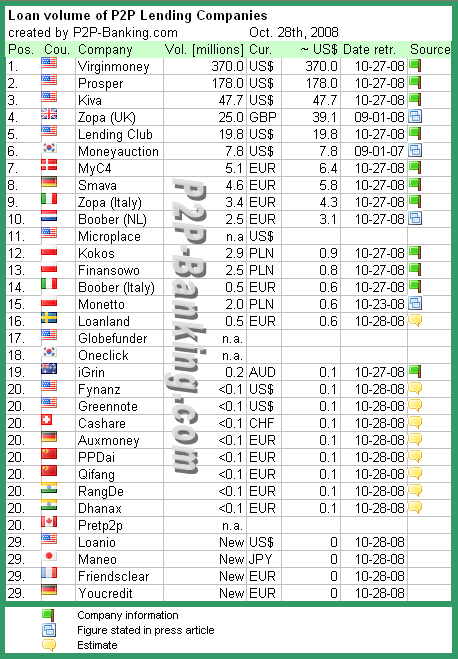
P2P-Banking.com has created the following overview table listing services that are in operation and ranked them by loan volume. The loan volumes are not directly comparable for they are cumulative since launch of each service and represent different time spans.
Asked for a figure, a Microplace spokesman pointed out “…it is important to note that MicroPlace is not a P2P site. We are a platform that offers investments to the retail public.“. No loan volume was quoted, but he stated “investments purchased on our site have enabled over 26,000 microfinance loans.”
In total approx. 685 million US$ have been funded through peer to peer lending/social lending services so far worldwide.
This image may be reprinted on other internet sites, provided it is not altered or resized and the following text (including the direct link to this article) is given as source directly below the image: Source: P2P-banking.com
If you are a representative of a p2p lending service and want your service to be included in the next update of this table, please send me an email with information about your company.
German p2p lending service Smava.de launched one year ago. Since the launch of Smava 393 loans were funded for a total loan volume of about 1.7 million Euro (approx. 2.6 million US$).
Lender’s viewpoint
In a february survey 33% of lenders answered to be very satisfied with Smava and 63% were satisfied. 48% said their ROI met expectations while 19% said it exceeded expectations.
So far a 7% ROI is realistic. Only 3 loans have defaulted and 11 are (less then 30 days) late. In the past Smava cured the majority of late loans. The Anleger-Poolmechanism spreads the losses of a default across all loans of a credit grade. Therefore when 1 in 100 loans in credit grade X defaults, the lenders invested in the defaulted loan still receive 99% of the principal, while for lenders in the current loans returns are lowered by 1%.
Technically and on the process level Smava functions as promised.
Borrower’s viewpoint
Provided the borrower has a credit grade of at least ‘H’ (95% of the German population have credit grades between ‘A’ and ‘H’ so about 5% are excluded) and he has a sufficient income, chances for obtaining a loan through Smava are good. About two third of the listings were funded. The fee of 1% of the loan amount that Smava charges borrowers is low.
Marketplace development
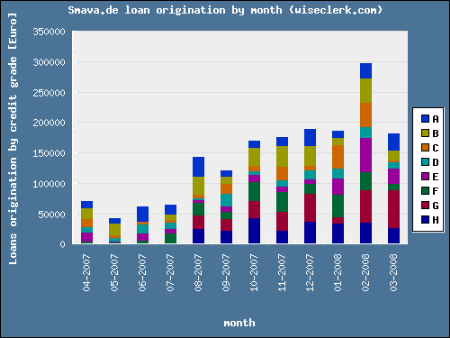
Smava’s growth has picked up in the last month (see chart).
So far Smava has not reached a broad appeal. While press release state 25,000 registered users, only 650 have invested money and roughly 450 wrote a loan listing. Looking at the distribution of lenders by amount invested, the top 50 Smava lenders funded about 700,000 Euro (or about 40% of total loan volume). Currently lenders are limited to a maximum of 25,000 Euro investment.
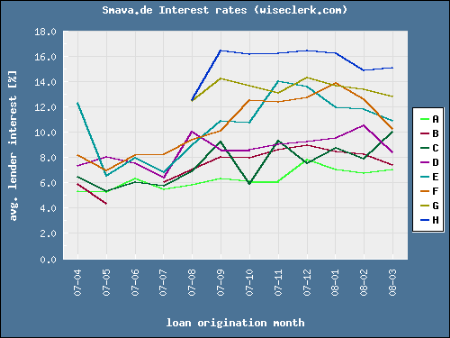
Attracting new borrowers has been the bottleneck for Smava’s growth so far. An increase of money supply by lenders with no matching demacnd increase led to slightly falling average interest rates in the last weeks (see chart). Before rates increased, especially for credit grade ‘F’ caused by sharpened risk awareness following several late payments.
Smava charges borrowers a fee of 1% of the loan amount. There are no fees for lenders. Total revenue of Smava in the first year therefore was 17,000 Euro (1% von 1.7 million Euro). Prosper, Lendingclub and Zopa have much bigger p2p lending volumes per year. Boober‘s loan volume in the Netherlands is about the same size as Smava’s but in a market with only one fifth the size (by inhabitants). First priority of Smava must be to accelerate growth.
As there is no Zopa loan statistics site, it is not possible to track the Zopa growth daily. You have to wait for the instances where Zopa announces milestones.
Today Zopa – in an announcement to celebrate it's third birthday, said:
Since we launched in March 2005, £20 million in unsecured personal loans have been arranged at Zopa in the UK. More recently growth has been boosted by the global credit crunch which is driving unprecedented demand for P2P personal loans as banks become less competitive and tighten their lending criteria. All of this has also pushed up returns to Zopa lenders to an all time high.
At the current exchange rate that is approx. 40 million US$.
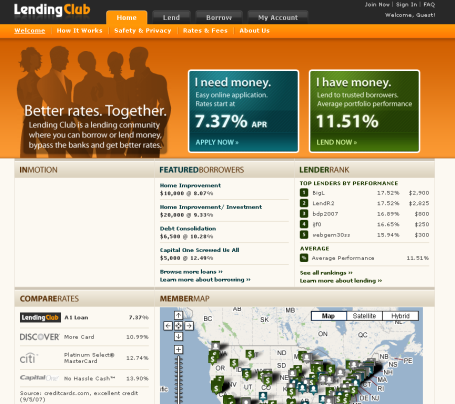
Lendingclub has a new homepage. At least I think it is new, but maybe I have overlooked it for quite some time since Lendingclub used to point the homepage to the Lendingclub blog and I usually went directly to the blog URL.
The homepage is mainly an information showcase for new borrowers or lenders. Unlike Prosper it has few real functions. While most data remains restricted to logged in users, it does show a few rankings and statistics.
Today Lendingclub announced that it passed the US$ 1 million loan mark. With 683 verified lenders Lendingclub is still small compared to Prosper numbers, but growing steadily.
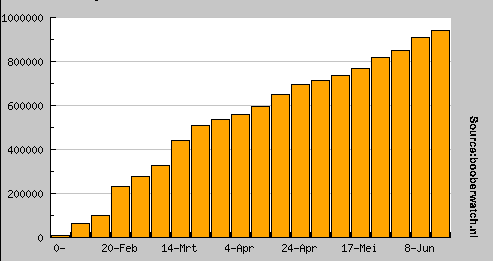
4 month after the launch, Dutch p2p lending service boober.nl is approaching a total volume of 1 million Euro funded loans (chart shows development of loan volume since launch).
In comparision, German p2p lending service Smava.de, launched only 8 weeks after Boober is growing much slower. Currently it reached approx. 150000 Euro loan volume. Look forward for a post on the development of Smava in the near future.
Boober plans to launch in Belgium as next country. While not started yet, the domain boober.be is already up, saying "beta".