Recent peer-to-peer lending developments in the Netherlands

Dutch Boober this week resumed full operations overcoming an imposed stop on lending. Lenders however now are facing even more restrictions. After a maximum amount of 39000 Euro was introduced for lenders earlier, a new rule now allows lenders to close no more than 100 loans. Since the minimum bid is only 5 Euro in the worst case that could mean, that a lender has to stop after lending out 500 Euro (100×5). Apparently this development means that the top lenders, responsible for 30% of Boober's total loan volume, are banned from lending more money. While lenders critizise this new development as overregulated forced by dutch regulator AFM, there is not much they can do about it. Theoretically each individual lender could apply for a license, but in practise license fees over 1000 Euro prohibit this move.

Frooble

After a failed launch in May p2p lending service Frooble.nl now wants to lauch with a new concept. Borrowers can seek short term loans of 1 to 3 month duration for amounts between 50 and 500 Euro. Apparently these parameters have been selected to avoid falling under the regulation of the AFM. It remains to be seen if Frooble can thrive with this business model.
Lendingclub with new homepage

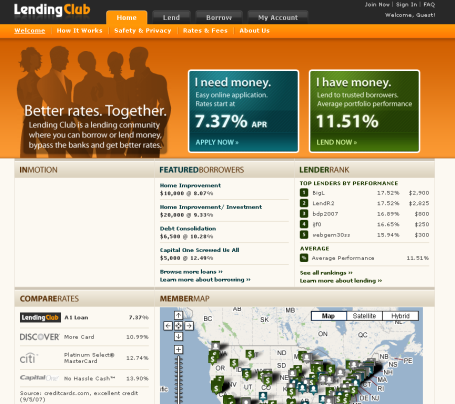
Lendingclub has a new homepage. At least I think it is new, but maybe I have overlooked it for quite some time since Lendingclub used to point the homepage to the Lendingclub blog and I usually went directly to the blog URL.

The homepage is mainly an information showcase for new borrowers or lenders. Unlike Prosper it has few real functions. While most data remains restricted to logged in users, it does show a few rankings and statistics.

Today Lendingclub announced that it passed the US$ 1 million loan mark. With 683 verified lenders Lendingclub is still small compared to Prosper numbers, but growing steadily.

Prosper announces monthly figures

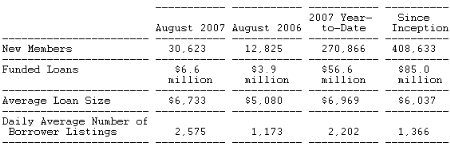
Prosper.com published a "People to People Lending Market Survey" for August. The Survey covers Prosper data and gives a commentary by Chris Larsen, CEO of Prosper.

Excerpt:

Membership and Loan Volume Statistics

Full Market Survey text

In the commentary the main point is the focus of lenders on higher credit categories: "…At the same time, lenders on Prosper are exhibiting rational behavior by steering their bids toward borrowers in the higher credit categories and being far more cautious about chasing higher rates offered by subprime borrowers. Evidence of this flight to safety is seen in Prosper's mix of funded borrowers. For example, the subprime category accounted for only 9 percent of loans funded in August 2007, a marked decrease from August 2006 and the 2007 year-to-date average of 25 percent and 14 percent, respectively. What remains to be seen is whether lenders on Prosper will start placing less weight on homeownership as a factor in their bidding strategies…"

When studying the figures careful attention should be given to the definitions. HR loans are completely excluded from the Estimated Annual Return on Prosper Select Index and the Average Borrower Rates on Prosper Select Loans table. Furthermore loans that did not fit criteria on delinquincies, credit inquiries and DTI are also not included in these tables.

No more Prosper group fees

Prosper.com announced that it will discontinue group fees in the near future for all new loans. Group fees, also called Group leader rewards or Group rewards allowed the group leader to charge a fee that is payed by borrowers with loans in this group.

The announcement:

At Prosper, we have been listening to your feedback regarding groups and group leader rewards.

The original philosophy behind Prosper Groups was to enable borrowers in close-knit communities to leverage the reputation and peer pressure of their group to attract more bids from lenders, resulting in potentially lower interest rates for borrowers, and lower default rates for lenders. We have found, after nearly two years of experience, that the strongest groups are comprised of close networks of friends and associates, where compensation is not the dominant motivation for the group leader’s services.

As a result, we are making changes to Prosper Groups. In the next month, Prosper will discontinue payment rewards on new loans for group leaders. Group leaders will continue to earn payment rewards on all eligible loans originating before the change. Group leaders can also receive referral rewards for referring borrowers or lenders to Prosper under our Referral Program.

We hope this change will encourage group leaders to grow their groups by inviting new members from their pre-existing social networks, turning Prosper Groups into a more powerful community development tool and making Prosper simpler for both borrowers and lenders.

For more details on these changes, please visit our Group Changes Frequently Asked Questions (FAQ).

Thank you for helping us become the Internet’s leading community lending site.

The original idea of the Prosper groups was, that social connections, that already existed offline, would be replicated within the Prosper group structure.
But most groups evolved online only with no previous offline connections between the members. The (the lack of) value of the groups for the Prosper concept has been discussed repeatedly in the Prosper forum. While some group leaders did a good job screening and vetting borrower applications and the group leader could be seen as a compensation for time invested; the majority of lenders seems to see the removal of group fees as a step in the right direction.

Comparing MyC4 to Prosper

Researching the MyC4 concept (see previous post) there are some usability features that call for a comparision to Prosper.com:

  1. Auction: The model of Prosper seems much more straightforward to me then the auction model of MyC4. The possibility of bidding above the maximum interest rate as long as the weighted average interest is below it, gives it a major twist. Every lender on a loan ends up with a different interest rate while borrower nominal interest rate is the weighted average (mind-boggling, isn't it?). And the full transparency of all bids during bidding process is interesting.
  2. Usability, communication and transparency: The interface is designed for much interaction. Everywhere the user can post comments (to profiles, to blogs, to loans, to listings). And with a user added avatar on every comment, it is very personal. No anonymity since real names are used (not screen names). Anybody can view the loans other lenders are invested in. Users can add icons to their profile to show which motivation led them to MyC4 (be it profit, education, social lending, …) 
  3. Defaults. So far none, but naturally it is much to early to judge. Hopefully MyC4 will have defaults as low as Kiva and prove that third world borrowers are more reliable.

There will be continued coverage about my experiences at MyC4.