Transparency in Credit Management; Risk Management at RateSetter

This is a guest post by Kevin Allen, Head of Insight at RateSetter.

Credit management and consumer trust: the words are inexplicably linked for the majority of financial services providers, particularly those dealing with personal finance. In fact the approximate to translation of the Latin “Creditum” meaning a loan is to the French “crédit” meaning trust. There is little doubt that consumers are increasingly alive to the mechanics of how institutions are looking after their hard-earned money – something that has stemmed from the global financial crisis when banks were guilty of lending household savings to all sorts of risky endeavours, with well documented results.

There is no clearer example of the importance of credit management than within the peer-to-peer lending industry. In the absence of the Financial Services Compensation Scheme, the biggest single risk to lenders is that borrower defaults reach a level so severe that it absorbs not only the interest they might earn but their capital as well. RateSetter were the first peer-to-peer company globally to introduce the concept of a provision fund that provides lenders with an added level of control against loss of even the expected interest amount.

The provision fund has proved very successful, not only in providing lender confidence, but also in terms of its track record. We also aim to gain depth and breadth to our lending portfolio through an evolution of our offering. This will always include our core consumer lending offering for customers to buy cars, make home improvements and consolidate expensive credit card debt, but will include property development and commercial business lending to support the UKs SMEs.

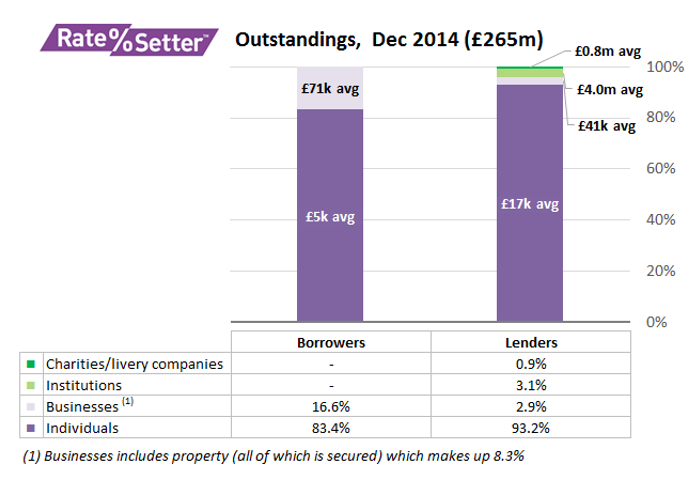
RateSetter aims to continue this growth to provide more confidence to prospective and existing lenders and to ensure we can maintain our “every lender, every penny” through all economic cycles. Although as we always say, we cannot guarantee anything. And our lenders will also be diversified to include individuals, charities, institutions and businesses. The breakdown currently shows us as potentially the only P2P lender in the UK whose recent lending is dominated by individuals;

Ratesetter loanbook

So, although a peer-to-peer lender can rely on us to manage the Provision Fund, this leads us to the natural questions: who exactly am I lending my money to? And, how much are they contributing to the fund? So everything we say and do is built around careful and cautious credit assessment and any potential impact on the provision fund. But, equally important to the mechanics, is the transparency for our users. While banks and building societies still, even today, maintain an impenetrable barrier for users trying to understand what is happening to their money, we have gone to the opposite end of the spectrum, making openness part of our DNA. Continue reading

How I Selected My Preferred P2P Lending Marketplaces – Part II

This is part II of a guest post by British investor ‘Pete’. Read part I first.

The number P2P / P2B platforms in the UK has increased quite quickly over the past few years and I have currently settled on 3 further UK platforms that suit my needs and I strongly believe will be with us long term. In saying this I am not in possession of any privileged information and I am not by inference making any adverse comment about other platforms.

In alphabetical order

Ablrate

One of the new platforms (launched July 2014) that I have chosen to invest in and so far I have had a very positive experience. Specialising in secured Aircraft leasing and Plant and Machinery I have had the chance to diversify into a market that I knew little about before I started on my ‘due diligence’. The market may be new to me but there is a wealth of responsive experience behind Ablrate and coupled with a website update and promised increasing flow of loans I anticipate that my exposure with Ablrate will continue to grow. One interesting ‘innovation’ available on certain loans is ‘Instant Returns’. With long draw down times on some loans the potential for ‘dead money’ is large, instant returns circumvents this issue.

Assetz Capital

I have been investing with Assetz Capital since the second quarter of 2013 and have built up a diversified £ five digit portfolio of secured loans which continues to grow1. As with Ablrate there is a good, responsive and experienced team behind the web site, something that has become more than apparent when dealing with the occasional distressed loans that we must all expect when investing. Assetz Capital have big plans for expansion (they have already grown considerably since I started investing) and a relatively recent change to the way loan parts are bought has removed a very large percentage of the ‘dead money’ scenario that many of us early adopters experienced, not universally liked, I for one view it as a very positive move that has helped to push up my return on investment. I look forward to new opportunities this year.

1 I do not invest by choice in the provision fund protected ‘Green Energy Income Account’ preferring to take on the risk in return for a slightly higher returns.

Wellesley & Co

Again I was one of the early adopters and took advantage of some very attractive introductory rates that were offered. The loan and repayment terms suited my needs perfectly for tax planning purposes. Since then the rates have unsurprisingly been lowered and whilst Wellesley & Co have expanded rapidly and their range of investments on offer has expanded I find myself already invested in those areas with other platforms so I am running full term with my current investments whilst keeping an eye open on what is on offer.

Bondora

I also invest in one non UK platform, Bondora. This would probably be regarded as the ‘odd one out’ in my list of platforms. Far more volatile than the other platforms that I invest in Bondora has expanded rapidly since I started investing in the second quarter of 2013. I have experienced several changes to the platform, some which I have liked and several that I have not. I have experienced new markets being opened up and some eye watering rates of default in these new markets. That said and in spite of the treatment of defaults by the UK tax man and the strengthening of the Pound against the Euro (@16% since I started investing) my return after tax has remained positive. I spend more time on this relatively small percentage of my total investments to keep the returns positive than I do on any of the others. Continue reading

How I Selected My Preferred P2P Lending Marketplaces – Part I

This is part I of a guest post by British investor ‘Pete’.

Perhaps an introduction is the best way of starting this blog post since it should explain my reasons and approach to Peer to Peer (P2P) and Peer to Business (P2B) lending.

I am a UK based independent professional engineer. An engineer in my discipline requires a love of detail, data and spreadsheets and being independent it is required that I run my own company so I understand basic accounting and number/data manipulation.

So why do I invest in P2P and P2B? In the past I have had Pension funds raided, Investment funds loosing capital due to stock market losses and fees, a mortgage endowment policy returning 1.9% over 25 years when a simple cash investment returned +9%, shares devalued by the UK government who then bought them out at the devalued rate … a long list of ‘professionally’ managed schemes that lost my money. With P2P and P2B I am in control, I either sink or swim based on my decisions.

I started lending at the start of 2012 with Zopa and to a lesser degree with Ratesetter but not before I had read as much as I could find regarding P2P and the various business models. Using on-line resources research into Company and Directors ‘histories’ followed, a process I continue to use before I start investing with a new platform. Risk and Taxation were the next topics I looked into.

Whilst projected default rates were available on  Zopa I took a pessimistic view and anticipated a higher rate of loss when I put together my first spreadsheet to log my transactions and real rate of return (I mainly use Excel with the XIRR function). My aim with Zopa was to diversify as quickly as possible so I quickly put together a large number of small loans whilst ensuring that I didn’t have ‘dead money’ waiting to be lent out. This strategy worked and my losses have so far turned out to be below the Zopa projected level. In recent years Zopa have changed the way monies are lent out and introduced a provision fund to cover bad debts (Ratesetter have always had a fund) and at the same time investors rates dropped (Zopa dictated the rate at which money was lent) so I decided with regret that Zopa was no longer for me and started to withdraw monies as they became available, a process that will continue for some years since I am still happy with the return from my remaining loans.

In the meantime my Ratesetter account quietly built up (the power of compounding interest) and I had started investing in Funding Circle (Sept 2012). I quickly found out that due diligence was required when investing in listed loans (I do not like automatic bidders, I will always manually invest/re-invest) and whilst time consuming it gives some reassurance that you are not investing blind. Whilst the returns I received (and still receive) from Funding Circle are above those I receive from Zopa and Ratesetter I have found the time taken checking companies can be disproportionate to the return if small loans are made. In spite of due diligence the defaults in my experience are higher and coupled with the current UK taxation system for individuals, defaults can hit your rate of return in a disproportionate way.*

It is for these reasons that I have in the last year started withdrawing cash from Funding Circle in the same manner I am taking with Zopa. In the meantime my Ratesetter account continued to build. Continue reading

Saving Stream Review – My Experiences

Saving Stream LogoExactly 4 months ago I deposited money at Saving Stream and started lending. Saving Stream is a UK p2p lending marketplace operated by Lendy Ltd. that facilitates bridging loans, that is short-term loans for typically less than a year, secured by commercial property. Investors can see valuation documents for each listed loan. Saving Stream operates since January 2013 and with 25 million GBP loan volume originated since launch it is one of the mid-sized p2p lending sites in the UK.

Saving Stream is open to international investors; you don’t have to be a UK resident. Investors are paid 12% interest, accumulating starting at the day they bid on a loan. The interest is paid monthly (starting with drawdown); the principal amount is repaid at the end of the loan term. Saving Stream does not charge investors any fees.

Since I don’t have a UK bank account I used Transferwise when depositing money in order to save on bank fees. For larger amounts (approx. >1,000 EUR) it might be even more efficient to use Currencyfair so check that too.

Some of the smaller loans (e.g. 200,000 GBP) fill within hours of coming onto the marketplace. I do like that I can deposit money (Cashier>Deposit>Step 1) and bid with this money without having to actually wait for the money to arrive (which usually took 1-3 days with Transferwise).

Saving Stream Loan Listing
Screenshot of Saving Stream loans listed

The Saving Stream p2p lending marketplace is very simplistic and easy to handle. There is a view of the live loans. Only the green ones have amounts open for bidding. The secondary market does not have a seperate view but is integrated into the live loans view. There are no fees and markups/discounts when buying and selling on the secondary market. So when a loan part is listed for sale, the amount is just added to the available amount for this loan. Continue reading

International P2P Lending Sites – Loan Volumes March 2015

In March Lendinvest reported a surge in loan originations and had an exceptional month with more volume originated than Ratesetter or Funding Circle. I do monitor development of p2p lending figures for many markets. Since I already have most of the data on file I can publish statistics on the monthly loan originations for selected p2p lending services.
Investors living in markets with no or limited choice of local p2p lending services can check this list of marketplaces open to international investors.

p2p-lending-volume-03-2015
Table: P2P Lending Volumes in March 2015. Source: own research
Note that volumes have been converted from local currency to Euro for the sake of comparison. Some figures are estimates/approximations.
*Prosper and Lending Club no longer publish origination data for the most recent month

Notice to p2p lending services not listed: Continue reading