The following table lists the loan originations for May. The top four UK services volumes are close together, with Wellesley catching up. I added two new platforms. I do monitor development of p2p lending figures for many markets. Since I already have most of the data on file I can publish statistics on the monthly loan originations for selected p2p lending services.
Table: P2P Lending Volumes in May 2015. Source: own research Note that volumes have been converted from local currency to Euro for the sake of comparison. Some figures are estimates/approximations. *Prosper and Lending Club no longer publish origination data for the most recent month
Prof. Dr. Andreas Dietrich of the Lucerne University of Applied Sciences and Arts, Simon Amrein, Reto Wernli and Dr. Falk Kohlmann have published the study ‘Crowdfunding Monitoring Switzerland 2015‘. It analyses the development of crowdfunding in Switzerland giving special attention to the development of p2p lending.
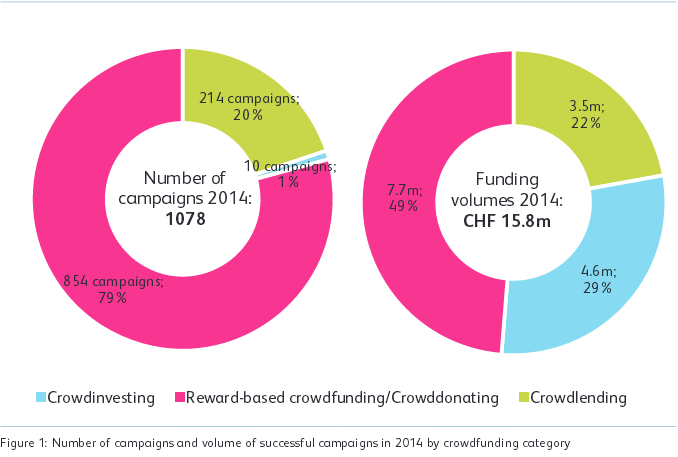
The Swiss market is growing fast; albeit on low absolute numbers compared to other European countries. The market is in a very early development stage. As the following chart shows the volume is mainly generated by crowdsupporting/crowddonating.
Source: Crowdfunding Monitoring Switzerland 2015 study
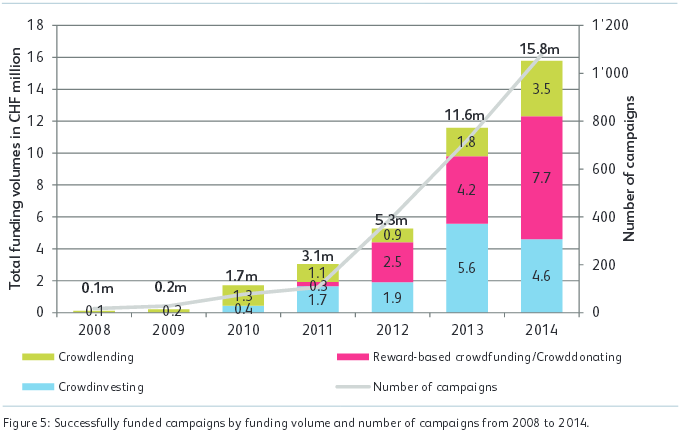
The total market for new loans to consumers in Switzerland in 2014 was 3.9 billion CHF. Via p2p lending 3.5 million CHF were originated in 2014, so that equals a market share of only 0.1%. But the p2p lending volume has nearly doubled compared to 2013 (1.8 million CHF). The authors state:
The crowdlending market has experienced the strongest year-on-year growth of all crowdfunding segments. … The number of campaigns rose from 116 to 214, and all of them were successfully funded. The current challenge of crowdlending platforms is not finding funders. On the contrary, it is (more) difficult to get borrowers on the platforms. Crowdlending campaign funders invested an average of CHF 1,100, which is substantially different from the figures in reward-based crowdfunding & crowddonating as well as in crowdinvesting. The average campaign amount was CHF 16,200, which was slightly higher than in the past year (CHF 15,000). The average loan amount in crowdlending is very similar to the average consumer loan as of the end of 2014. The crowdlending market is, however, still niche market.
Source: Crowdfunding Monitoring Switzerland 2015 study
Regulation limits that a private consumer loan cannot be financed by more than 20 different individual lenders.
The authors analysed loan data of the Cashare marketplace. Examining who uses p2p lending as a borrower the study finds:
The average borrower age is 38. One fifth had at least one child under the age of 16 at the time the loan was raised. At 37 percent, married people were proportionally under-represented, although they make up 54 percent of the permanent resident population. 19 Homeowners (19 percent) and women (24 percent) are also under-represented. The distribution of nationalities is slightly more representative of the Swiss population. 71 percent of the borrowers were Swiss, while 29 percent of the borrowers were not in possession of a Swiss passport. The average proportion of the foreign-born resident population in Switzerland was 22 percent between 2008 and 2013. The age distribution of the borrowers leads to the conclusion that crowdlending is currently still primarily used by the tech-savvy Generation Y. 60 percent of all loans raised since 2008 went to people under the age of 40. Only 4 percent of the borrowers for successful projects were over 60 years of age.
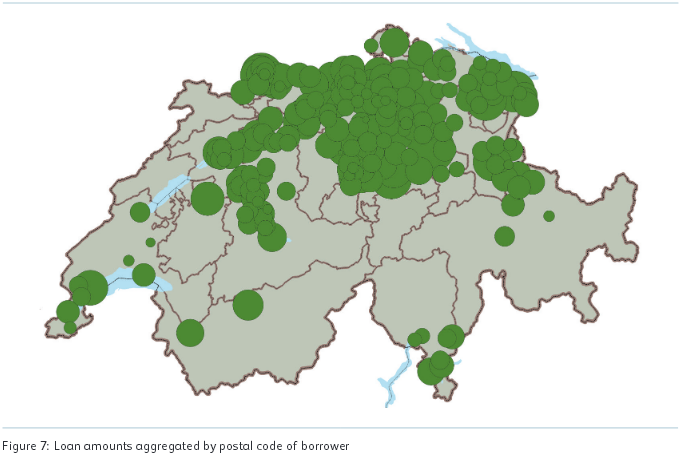
Also the borrowers regional distribution shows that use is much more common in the German speaking areas of Switzerland.
Source: Crowdfunding Monitoring Switzerland 2015 study
Today marks a significant chapter in Singapore’s fast-growing crowdfunding industry, as crowdfunding platforms CoAssets, FundedByMe, and New Union announce an alliance that sees the three platforms combining forces to develop the local and regional crowdfunding industry.
All three platforms – CoAssets, FundedByMe, and New Union – today have international reach of investors and campaigns. Together the alliance recorded over S$200 million dollars raised through crowdfunding campaigns in 2014, with growth expected to accelerate over 2015.
Said Getty Goh, founder and CEO of CoAssets, “As an individual company, there is only so much we can do. Hence, I am excited and honored to be a part of this three-way alliance. However, this is just a first step and we hope that more stakeholders will join this alliance so that it can eventually pave the way for Fintech trade association. As Fintech is a burgeoning sector, the best way forward is to come together and engage the authorities collectively. Akin to the Singapore Venture Capitalist and Private Equity Association (SVCA) or Real Estate Developers Association of Singapore (REDAS), having a Fintech association is not only a good way to promote self-governance, it can also bring greater awareness to what this industry is all about.â€
“We are excited about this development with likeminded partners in the industry. There’s so much more we can do together, once we focus on developing the market here and globally in 2015. Crowdfunding is definitely on an uptrend –– we experienced over 600% growth in 2014 year-on-year –– and expect that the next wave of growth will exponential especially considering this alliance, coupled with surging Asian demand,†said Daniel Daboczy, founder and CEO of FundedByMe.
“Technology and the world-wide-web have become irreplaceable to our daily life, and every day business — and today, this alliance represents the emerging wave of financial services that meet crucial needs in the business community. Our commitment is to work closely with government agencies and financial institutions to spearhead a progressive and trustworthy crowdfunding environment,” Jeremiah Lee, Founder and Managing Director of New Union.
The three platforms plan to launch their first combined crowdfunding project in Q3 of this year, as well as joint conferences over the months following their alliance announcement. Continue reading →
Latvian p2p lending marketplace Mintos today announced a buyback guarantee for all car loans issed by Mogo that are currently on the marketplace or will be listed on the platform until July 31st, 2015. The buyback guarantee applies for the lifetime of these secured car loan. Under the agreement Mintos concluded with Mogo, Mogo will buy back any of those loans that are 60 or more days delinquent.
All secured car loans are originated, pre-funded, and serviced by mogo. It means that similar to real estate backed loans, Mintos puts on the platform already funded loans (and most have had a number of successful payments) and investors can start earning interest from the moment they have invested in a loan. Mogo keeps 5% of each loan on its books.
This construct provides additional security to investors – a bit like the provision funds some UK marketplaces maintain; only that in this case it currently is a limit-time guarantee.
Taaleritehdas invested 2 million EUR in the peer-to-peer (P2P) lending company Fellow Finance Oy and, at the same time, sold the entire stock of its Financing Company Lainaamo Ltd to Fellow Finance Oy as a share exchange. Lainaamo has a consumer credit portfolio of approximately 20 million EUR with thousands of consumer customers. After the acquisition, Taaleritehdas owns 38.4% of Fellow Finance Oy. In addition, Taaleritehdas has an option to increase its holding in the company by 7.3%. Fellow Finance’s founders, Jouni Hintikka and Teemu Nyholm, each own 18.4% of the company. In total, Fellow Finance key persons have a 57.3% holding in the company.
According to its vision, Taaleritehdas aims to develop the Finnish capital market. Taaleritehdas believes that increased direct financing will be one of the most significant changes in the finance industry in the future. The focus in financing will increasingly shift from the bank-centric approach towards direct financing. Another strong megatrend in the financing sector, as seen by Taaleritehdas, is digitalisation. Both Fellow Finance and Lainaamo offer their services completely online. Ownership of Fellow Finance enables Taaleritehdas to offer its customers a new investment form and to utilise digitalisation in its own activities, as well. The merger of Lainaamo and Fellow Finance will not affect the position of borrower customers or investors. Continue reading →
Bitcoin lending platform Bitbond today announced an angel funding round of 600,000 EUR. The round brings Bitbond’s raised capital to a total of 800,000 EUR.
Led by Bitbond’s earlier seed investor Point Nine Capital, a number of business angels contributed to the round. Among them were Florian Heinemann, Uwe Horstmann, Christian Vollmann and Felix Jahn. Bitbond will use the additional funds to grow its user base and to increase its activity in emerging markets which are underserved by traditional lenders. The platform went live in July 2013. Since then over 600 loans were originated through the platform.
Founder & CEO of Bitbond Radoslav Albrecht said: “The additional resources will help us to continue realizing our mission which is to make lending and borrowing globally accessible. We are happy to have such experienced investors supporting us on this exciting journey.â€
According to the IFC (International Finance Corporation of the World Bank) the global credit gap of microenterprises and small and medium sized businesses is around USD 2 trillion. Bitbond seeks to help solve this problem by creating a global market for small business loans that is accessible to everyone via the internet.
Since its first external funding in August 2014 Bitbond introduced a number of technological advancements. These include exchange rate pegged loans which allow borrowers and lenders to mitigate bitcoin price fluctuations.
Editor’s comment: My personal opinion is that cross-border lending based on bitcoin is currently a high risk proposition to investors. While I appreciate some of the technological advantages the platform pursues, I think further development is needed, especially in debt collection processes.