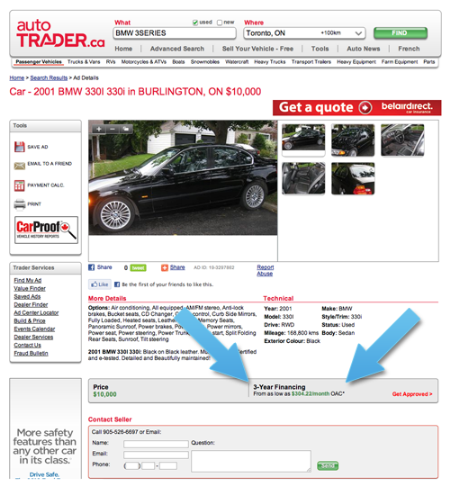
Communitylend has partnered with Canada’s largest used car site AutoTrader.ca, now offering a car financing option through Communitylend for every listed car.
The option is limited to private listings in Ontario for cars with a sales price of up to 25,000 CAN$.
This is a good partnership for Communitylend as it will profit from increased exposure to potential borrowers.
Trustbuddy AB has acquired the operations of Swedish p2p lending site Loanland effective November 19th. This means that Loanland will not close as reported earlier. Trustbuddy AB is a Swedish company with Norwegian origins. Trustbuddy will continue operations and in mid-term plans to integrate the activities of the service into their own platform. Loanland users were informed that the transfer of the membership agreements does not change anything for them.
Money360 offers a first in p2p lending: To my knowledge they are the first live p2p lending service applying the concept to financing real estate loans.
Loan sizes are much bigger than seen before in p2p lending. Minimum loan amount is 200,000 US$, maximum is 5 million US$. The minimum a lender can invest in an individual loan is upscale too: 50,000 US$. This does fit the target audience though as only accredited investors residing in California can join as lenders.
Loans are secured: Each Lender is listed with an undivided fractional interest on the promissory note and deed of trust.
When the transaction is complete and the loan is closed, Money360 will receive a closing fee of 2% of the loan amount. This fee is paid by the Borrower, typically out of the loan proceeds. Money360 charges the Lenders an annual servicing fee of 1.5% of the loan amount for providing all loan servicing functions.Continue reading →
Yes-secure, a British p2p lending marketplace launched in June 2010, will very soon add a secondary market called Secondary Loan Slice Market.
According to information the company provided P2P-Banking.com, the secondary market will have the following features:
Advantages for Loan slice buyers:
• Loans offered at premium and discount: Lenders are able to buy loan slices from other lenders at a premium or discount to the principal remaining amount. Lenders can invest in quality loan slices which they missed out on earlier.
• Ability to view repayment history: Potential buyers for the loan slices can view detailed information about the borrower repayment history, enabling them to make informed low-risk decisions based on track record of reliable repayments.
• Earn interest from day one: As the existing loans slices can be transferred within a few minutes, they can start earning interest with immediate effect.
• Build a balanced investment portfolio: Lenders can quickly build themselves an active and balanced portfolio by picking and choosing through different markets, rates and terms; this automatically leads to risk-diversification through loan portfolio management.
The advantages for Loan slice sellers:
• Encourages liquidity: Investors can easily generate cash as and when they require by selling their loans slices to other registered members of YES-secure.
• Flexibility: Investors can easily manage their investment portfolio, buying and selling chosen loan slices and fine-tuning their lending portfolio to suit their risk profile.
• Loans sold at premium or discount: Lenders can set a price for their loan slices at rates within +/-10% of the remaining principal amounts of their loans.
It is interesting to see that Yes Secure does not face the regulatory challenges Zopa cites (see: Zopa Rapid Return Secondary Market) or has overcome them.
One of the disadvantages for lenders in many p2p lending markets is that money lent cannot be withdrawn early during loan terms.
Zopa UK now introduces a secondary market called ‘Rapid Returns’, which allows lenders to cash out on all or selected market loans early. To do this a lender simply selects all or specific markets to ‘sell’ his loans.
For each of these loans, the system looks for other lenders offering to the same market at the same or a lower interest rate. Where a match can be found, each loan is then permanently transferred to the lowest bidding lender in that market. The winning lender will then earn the interest rate that the previous lender was getting on that loan, even if they offered at a lower rate. The lender receives the total outstanding capital on the loan from the offered funds of the winning lender.
Zopa deducts a 1% admin fee from the transferred capital.
There are some limitations: Loans made through ‘Zopa Listings’ are not eligible. Also excluded are loans where the borrower ever has missed a repayment. Some more restrictions apply.
And of course there needs to be a matching lender offer with a rate low enough.
Asked why lenders can not bid on loans on offer – thereby buying at a discount or premium – a Zopa employee explains: “What you describe here is a true secondary market which …, we are not regulated to provide. I hope all will become clear when the full functionality is available in the next couple of weeks.
Our overarching rule when developing Rapid Return has been that it should allow lenders who want to exit some of their cash to do that. It is not designed to tinker with a loan book – in particular we wanted to avoid a scenario in which an experienced lender could cash out of some loans at the expense of an inexperienced lender. As a final note on the ‘never missed a repayment rule’ – we started development with this rule as ‘not currently in arrears and hasn’t missed a repayment in the least three months’ but when we looked at the proportion of the total loan book for each, there’s a negligible difference. It’s therefore much clearer and fairer to go with the former.”
Currently Rapid Returns is only collecting offers on the buying lender’s side, letting lenders amend their bid offers to include Rapid Return loans. The feature will actually go live in a couple of weeks. Then selling lenders can mark their loan books for sale.
I expect that the Rapid Returns feature will further boost Zopa’s growth in the British market. Congratulations.
In Japan, Exchange Corporation K.K., which runs the p2p lending marketplace Aqush, raised an undisclosed amount from Silicon Valley venture capital fund 500 Startups.
According to today’s press release on average lenders on the Aqush p2p lending marketplace have invested 3,750 US$ with a ROI of 7.6% net of bad debt and fees.