CARE International UK runs the p2p microfinance platform Lendwithcare.org. For a minimum investment of 15 GBP anybody can help funding a loan to entrepreneurs in Africa or Asia.
Lendwithcare has partnered with local MFIs in Benin, Togo, Philippines, Cambodia and Indonesia that disburse the loan to the borrower. Lenders do not receive interest. Aside from the default risk (Lendwithcare claims less than 2% bad debt) lenders also bear the currency exchange rate risk. Lenders do fill their account via Paypal or credit card, withdrawels are through Paypal.
Though the concept closely resembles Kiva’s, it is interesting to see the approach used by a long-time established aid and development organisation. The site shows the experience CARE has with marketing and fundraising. It looks much more flashy (at least compared to the old Kiva page).
Lendwithcare was launched in April 2010. Since then 243 loans were funded. At the moment there are about 32 loan request by entrepreneurs listed.
Two weeks ago Inuka.org launched into public beta. Inuka’s initial focus will begin in East Africa, where it has partnered with several microfinance Institutions that will be responsible for sourcing loans, uploading them on Inuka’s online portal, performing credit reviews on potential borrowers and collecting repayments. Inuka has selected two microfinance partners in East Africa after a detailed on-site due diligence process.
Lenders do not earn interest on loans financed. Asked what differentiates Inuka from other p2p microfinance services like Kiva, Babyloan or MYC4, founder Kanini Mutooni told P2P-Banking.com:
– We only lend to female entrepreneurs in sub-saharan Africa which means were very much focused on a niche sector rather than just lending to anyone – Our loans are interest free which means that there is more of a philanthropic social element in lending as opposed to MYC4…
When I looked today, there were 11 loan request from Kenya online.
The bank of Italy has authorisedZopa Italy to operate as a payment institute. Zopa now cleared the legal problems it encountered in 2009. Maurizio Sella of Zopa Italy stated that Zopa will resume loan financing after performing some legal steps necessary in connection to being regulated as a payment institute.
Today VISA introduced p2p personal payments in the US market. VISA partnered with CashEdge and Fiserv which will incorporate the new service to their platforms Popmoney and Zashpay.
The service allows to make payments directly to the recipients VISA account.
The new VISA person-to-person payment service was launched first with selected partners in Europe in February.
VISA seeks to capture market share for online payments from Paypal.
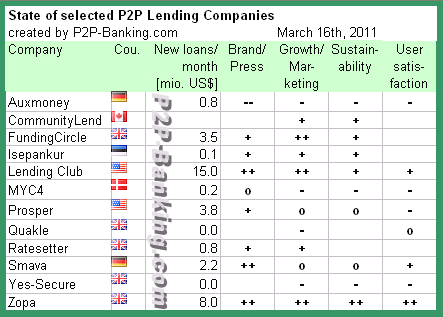
More than 2 years have passed, since P2P-Banking.com published the first overview table of p2p lending companies. At that time the focus was to create a comprehensive list and to get a perspective on the loan volumes.
Today I want to look at a smaller selection of p2p lending companies and do a rating on more factors than just loan volume. While I describe below what factors led to my rating, please note that the rating represents my personal opinion.
The table lists the companies in alphabetical order and gives:
New loan volume per month
This amount is in most cases retrieved from the last month(s) figures from the company websites (if they have statistic sections), and then converted into US$ at today’s currency exchange rates. In other cases it is a rough estimate by me based on volume figures published in media in the recent past. For CommunityLend I failed to find a per month figure (the total figure from launch to mid-February is here).
Brand/Press
Extend and tone of press coverage in the past months. Since a large share of new users is introduced to p2p lending services via media, positive media coverage is extremely important. Continued positive media coverage has helped some companies to associate positive values to their brand.
Growth/Marketing
This column especially rates if the new loan volume is growing continuously month after month. Furthermore it puts the absolute volume into perspective to the size of the market. It is obvious that absolute numbers in a country with a small population (e.g. Canada) will be much lower than those in a country with a large population (e.g. US). Furthermore it takes into account if the (online) marketing measures of the the company succeed in winning new borrowers and lenders (though in most markets lenders do not need to be actively acquired).
Sustainability
Sustainability rates a mix of several factors:
ROIs for lenders / default rates Most p2p lending companies that failed in the past, did so as a result of high default rates which led to negative lender ROIs and caused massive lender churn
Ability of company to raise new funding Most p2p lending companies still have to bridge a considerable time-span at their current growth rate before they become cash flow positive. The ability to raise more funding to finance continued operation is essential for their success
Business model
User satisfaction
This rates the publicly voiced user opinion. Major factor are the comments in forums. To a lesser degree I took the user experience published in blog articles into account. The problem with lender experiences published in blogs often is that the writer is casting a positive image, since he earns commissions for newly referred customers through the affiliate program of the p2p lending site. Also these review are often written at the start of the lending activity at which point the lender’s ROI is naturally unharmed by the experience of defaults.
Empty fields: I had not enough information to rate these. E.g. with some of the new UK p2p lending companies I felt I had too few indicators to reach an opinion on the sustainability.
Availability of information also influenced the selection of companies. Due to language barriers including more services (e.g. the Japanese p2p lending companies) was not feasible for me.
A petition (‘Petition for Rulemaking: Exempt securities offerings up to 100,000 with 100 maximum per investor from registration‘) submitted last July by the Sustainable Economies Law Center to the SEC, aims to exempt securities offerings of up to 100,000 US$ with a limit of 100 US$ per investor. If a new rule granting exemption would be issued by the SEC, this could substantially lower the hurdles for peer-to-peer equity platforms in the US.