British P2P Equity marketplace startup Crowdcube celebrates its first anniversary (Happy Birthday from P2p-Banking, too :-)). Lately Crowdcube picked up speed substantially in attracting more and more startups pitching for funding. While investors are currently very selective in what to fund, the volume funded has shown nice growth too. The following infographic by Crowdcube illustrates that (see ‘Amount invested’).
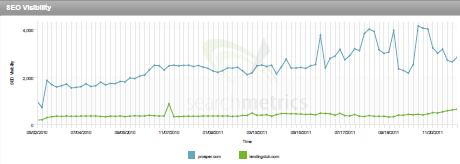
Internet ventures are dependant to a certain degree to new visitors that are referred to them via search engines. A visitor that did a search on a very specific search term, e.g. ‘get a personal loan’ will have a very high chance to sign up if after that search he is introduced to the Prosper or Lendingclub website. There are tools that measure how ‘visible’ a domain is on Google and other search engines providing an index chart, that allows to compare the visibility of several websites.
Prosper’s visibility index (blue line) is much higher than Lendingclub’s. Prosper.com ranks good for more and more important keywords in organic search rankings. Organic search means, that Prosper shows in a the search results at search engines that are not paid ads. But which search terms do the actually rank for? Continue reading →
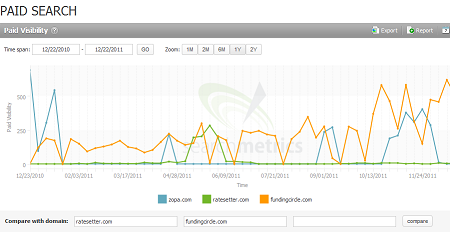
I did some research on use of Google Adwords in the online marketing strategy of Zopa, Funding Circle and Ratesetter.
Who is most active in search engine advertising?
I was surprised to see that Funding Circle is the most active in advertising on Google Adwords.
The chart shows that Fundingcircle had active ads nearly the whole year, while Zopa ran the ads only for certain intervals and Ratesetter only gave it a small try. Continue reading →
I really like this time. The new year lies ahead with crispy, yet unknown innovations. What p2p lending developments might happen in 2012. Here are some personal opinions. Last year I failed big time with most of my predictions for 2012 not coming true.
Deeper integration of mobile (probability <25%) Can you use a p2p lending service from a Smartphone? Sure. Some even have special apps for that purpose. But that’s not what we are talking about here. We are at the advent of a couple years timespan where several players (compare this infographic) will be fighting over market shares in the developing mobile payment market. If there is a role for p2p lending services, it is yet undiscovered (aside from the use p2p microfinance makes of it in underdeveloped countries).
Introduction of a p2p financed ‘credit card’ (probability very low) Carried over from last year – did not happen I envision a p2p lending service where the borrower does not get a loan in one full amount initially but can access liquidity on demand (within a predefined credit line). From the funding side this would work somewhat like lenders investing in Ratesetter’s rolling monthly loans. On the borrower side the customer could either request an additional payout via a web-interface or more sophisticated the service could issue a branded credit card / debit card for that purpose, enabling the customer to access cash instantly on an ATM. This concept has very interesting advantages as it allows the p2p lending service to build a durable relationship to the borrowers. And for the borrowers it offers the potential of lower rates on short term debt than the high rates credit cards typically carry.
In January 2011 I wrote down my predictions for p2p lending trends in 2011. Now let’s see how far I was off. The black text is my original prediction, with the review added in green and yellow.
Advent of whitelabel providers (probability 100%) Okay let’s start this with a safe bet. In 2011 there will be 1-2 companies offering a solution that can be branded and used by p2p lending services and / or p2p microfinance sites. The interesting question here is how the acceptance by potential customers will be. My guess is that it will be slow selling until the companies have set the first pilot customer live. While there are now whitelabel providers, their business seems to have been very slow in 2011. It seems that the first areas where we will see some activity is possibly p2p equity. As for conventional p2p lending – the companies supplying solutions have become more sophisticated and at least one as adopted their price model. It is now more a revenue sharing deal rather than a big upfront payment, that most startups could struggle with.
Introduction of a p2p financed ‘credit card’ (probability very low) I envision a p2p lending service where the borrower does not get a loan in one full amount initially but can access liquidity on demand (within a predefined credit line). From the funding side this would work somewhat like lenders investing in Ratesetter’s rolling monthly loans. On the borrower side the customer could either request an additional payout via a web-interface or more sophisticated the service could issue a branded credit card / debit card for that purpose, enabling the customer to access cash instantly on an ATM. This concept has very interesting advantages as it allows the p2p lending service to build a durable relationship to the borrowers. And for the borrowers it offers the potential of lower rates on short term debt than the high rates credit cards typically carry. Like the idea and want to discuss/develop it further? Self-promotion plug: You can hire me as a consultant. Has not happened.
A bank will acquire an existing p2p lending service (probability <25%) Carried over from last year – did not happen 2011 might see a bank (or other financial institution) buying a running p2p lending service. Buying will be much faster, cheaper and risk-less than if the bank tries to build a new service. Largest Italian private Bank bought at least a part. Continue reading →
Zopa Italy will rebrand and change domain and company name. The new service will be available at Smartika.it. Maurizio Sella, CEO of Zopa Italy announced that the franchise agreement with Zopa has been resolved. The new company operates under the status of a payment institute.