Year End Review of My Bondora Portfolio

In October 2012 I started p2p lending at Bondora. Since the start I did deposit 14,000 Euro. Since then I periodically wrote on my experiences – you can read my last review published in August here. In the 4 months since then, many changes happened at Bondora: New portfolio manager, new dashboard view, new collection procedures, a first version of an API in production, no more transaction fees for buying and selling on the secondary market and Bondora now allows investors to sell and buy defaulted loan parts (60+days overdue). I used this change to sell my overdue Slovakian loans at 87% discount.  I also sold my remaining Spanish loan parts. I did not have much of either of these in my portfolio anyway.

I also reduced my overall portfolio position at Bondora and transferred 11,022 Euro back to my bank account. I managed to sell many of my Estonian loans at a premium. My perception is that the liquidity on the secondary market increased after the transaction fees were removed. Still it is hard to effectively navigate on the secondary market.

I find it hard to price 60+days overdue loans I want to sell on the secondary market. The site Bondpicking.com has charts with recent transactions for defaulted loan sales on the secondary market that can help as guidance.

Currently I still have loan parts with the value of 11,428 Euro outstanding principal. Of these 1,441 Euro are in loans that are overdue and 2,076 Euro are in loans that are 60+ days overdue.

At the moment I have 280 Euro cash available.
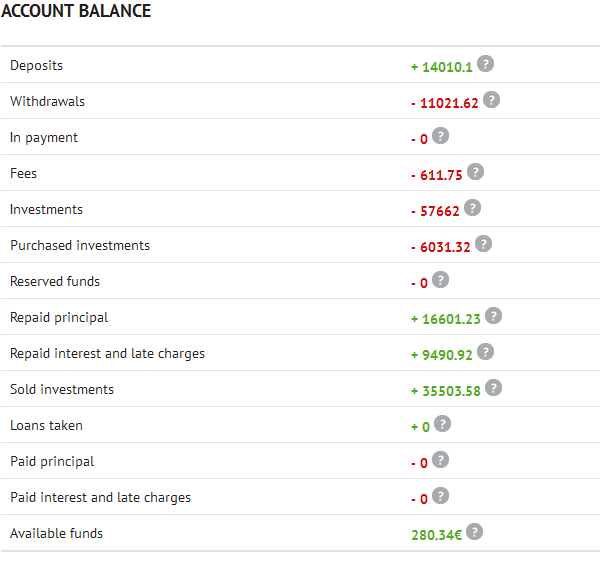
My Bondora Portfolio 12/2015
Chart 1: Screenshot of account balance

My interim conclusions after 3 years

I am very satisfied with my Bondora investment. Of the 14,000 Euro investment I already withdrew over 11,000 Euro, meaning my remaining risk (concerning the initial investment) is very limited and I still have a huge portfolio of loans. Currently Bondora shows my ROI to be 25.0%. In my own calculations, using XIRR in Excel, assuming that 30% of my 60+days overdue and 15% of my overdue loans will not be recovered, my ROI calculations result in 16.3%. Even in a very pessimistic scenario adding up only withdrawals (approx 11,000 Euro), current loans (about 8,200 Euro) and cash (280 Euro), the initial 14.000 Euro grew in three years to a value of 19,500 Euro. Continue reading


How Lendico Uses FinTecSystems to Streamline Borrower Application Process

In Germany p2p lending marketplace Lendico uses a solution offered by startup FintecSystems to simplify the borrower application process. Automatically accessing online banking data for the past 90 days of the applying borrower the service makes the postal submission of bank statements and certificates of salary via postal services redundant. This saves time and costs involved in the verification of the borrower’s loan application.

Co-Founder Christoph Samwer said: ‘The integration […] is an important step to offer our borrowers an application process rid of media discontinuity and to improve our risk assessment‘ (original quote in German, own translation).

Here is what FintecSystems says about their service:

…Our recently released new product called FintecSystems RISK enables lenders to obtain real time financial information about their customers using just their online banking account. This results in a more accurate and seamless loan application processes by enriching existing application processes or existing data.

With FinTecSystems RISK lenders can access up to 90 days of customer account activity. For lenders it is possible to derive certain information of interest from the account activity, e.g. using salary to carry out risk assessments. Also validating or completing financial information of the borrower to have a consistent data basis, while reducing the need for manual interaction efforts and costs for both parties.

With FinTecSystems RISK, we build a bridge between BigData and SmartData. Accurate information about a borrower enables the lender to be more effective with loan terms. Precise and quality data is more important than data quantity. Data quality is the crucial factor to establish an online financing process in Germany and Austria. Eliminating a manual finishing processing step for the lender…

Ratesetter Updates Legal Structure of the Provision Fund

RatesetterRatesetter informed its investors that it will update the legal structure of the provision fund by changing it from a trust to a limited company. Ratesetter was the first UK p2p lending marketplace to introduce a fund to protect investors against defaults (up to the amount available in the fund). So far no retail investor has lost a penny on Ratesetter since the launch in 2010.

Excerpt from the announcement: Continue reading

MoneyPlace and Auswide Bank Enter into Strategic Relationship

MoneyPlace, Australia’s second fully licenced peer-to-peer (P2P) lender and Auswide Bank have entered into a significant strategic relationship and equity deal.
The long term relationship, the first of its kind in Australia, includes a 5 year deal to fund up to 60 million AUD to assist MoneyPlace to grow its consumer lending and for the bank to grow and
diversify its financing activities nationally. Additionally Auswide Bank is taking a 20 per cent equity stake in MoneyPlace.

MoneyPlace launched in October after receiving its retail and wholesale Australian Financial Services licence and provides loans of 5000 to 35,000 AUD through its peer-to-peer lending platform.

MoneyPlace CEO Stuart Stoyan said the relationship is a critical milestone for P2P lending globally and demonstrates how banks can work with P2P lenders to provide fairer, better rates
for all customers. Continue reading

Interview with Sebastian Harung, Founder of Kameo

What is Kameo about?

Kameo is a Scandinavian marketplace for SME loans. It was established to meet two clear challenges in the Scandinavian markets: SMEs do not get loans; investors do not get good returns. By directly connecting them, we hope to make the situation better for both. Kameo’s vision is to include more people in the financial markets.

Note from editor: Kameo will launch around next week.

What are the three main advantages for investors?

  • Better expected returns
  • Support SMEs, the most important employer in Scandinavia
  • Possibility to create diversified portfolios

What are the three main advantages for borrowers?

  • Access to (more) funding
  • Quick and easy loan application
  • Flexible security & collateral structures

Sebastian Harung, KameoWhat ROI can investors expect?

Loans will be offered at 5 – 15 % per annum. At first, there will be no fees for investing through Kameo. We expect low default rates, based on historical data for Scandinavia and our thorough credit assessment. We can conservatively assume it to be around 1 – 3 % (naturally dependent on risk profile).

What is the background of the Kameo team? As some of you are Norwegian, why did you select the Swedish market for launch rather than Norway?

The team currently consists of five persons, of which only I am Norwegian. We have various backgrounds, but the same optimistic view of the future: alternative finance will transform Scandinavian banking, and it will become better for more people – it is the social democracy model, of which we Scandinavians are so proud.

We have a credit analyst with 20 years of SME analysis experience, a CTO that previously co-founded Avanza and developed its platform (Sweden’s largest net broker) as well as a marketing specialist and a business developer with backgrounds from digital marketing and corporate finance, respectively. My background is also from corporate finance at Norway’s largest bank, DNB.

And because we expect to grow, we will be looking to further strengthen the team next year.

While the largest owners are Norwegians, we chose to start in Sweden because the market is larger, it is a well-developed fintech-hub (#2 in Europe after London), and Kameo’s largest owner has a successful startup history in Sweden. In addition, the regulatory regime was easier when we started working with the idea (but this has since changed). We have, though, a clear ambition to cover Norway and Denmark next year, thus creating a Scandinavian marketplace (investors can create portfolios of Scandinavian loans.)

How is the company financed?

Two rounds of equity investments from co-founders, board members and angel investors. And I have sold my apartment and invested everything (except what I intend to lend through the platform in order to fund my daughter’s driver’s license in 16 years).

We will also be looking to raise more capital sometime next year, when we roll out in Norway and Denmark. Continue reading

Interview with Sergio Antón, Co-Founder of MytripleA

What is MytripleA about?

MytripleA is the first and only fully regulated platform operating in the Spanish market. MytripleA is a Spanish business finance platform meeting both short-term and medium-term financing needs of Spanish SMEs. MytripleA offers two different products: 1) insurance guaranteed loans -for more conservative investors- and non guaranteed loans -with higher risk and higher return- and 2) invoice financing.

What are the three main advantages for investors?

We offer an excellent risk-adjusted return to investors with a very robust underwriting process. Our investors receive monthly payments (except for invoice investments). In addition, we offer insurance loans (with close to zero risk) to more conservative investors. The abovementioned advantages and being the only fully regulated lending platform in Spain have allowed us to have a stable and growing investor base.

What are the three main advantages for borrowers?

Fast response to applicants. We are very flexible to adapt our financing to the borrower’ needs. In addition, our financing leaves no records in the Bank of Spain’s debt data base which makes it much more attractive than banking debt.

Sergio Anton, MytripleAWhat ROI can investors expect?

Our ROI in currently 8.30% with zero default rate.

How did you start MytripleA? Is the company funded with venture capital?

My cofounder and I noted that there are thousands of solvent SMEs ignored by the banks and decided to connect personal savings with solvent companies by using technology. We checked the regulatory issues and launched the company once we had obtained the necessary approvals. The company was initially funded by the founders and then we did our first round with GLI Finance and other private investors.

How valuable is it to have an experienced investor like GLI Finance? Can you please give examples how they help you in your business development?

GLI is the expert in the alternative finance sector for SMEs worldwide and is a key shareholder for MytripleA. They are supporting us in areas such us strategy, business development and the security of our platform. In addition, they also provide lending capacity for MytripleA. We are extremely happy to have them on-board. Continue reading