Lendico and PostFinance Launch Joint Venture in Switzerland

PostFinance one of the largest five retail banking institutions in Switzerland will partner with Lendico to launch joint venture Lendico Schweiz, which will facilitate loans to SMEs in Switzerland.

From the last quarter of 2016 onwards, the company will facilitate crowdfunding for small and medium-sized enterprises (SMEs) in Switzerland. It is entering the market in close collaboration with PostFinance, a subsidiary of postal carrier Schweizerische Post.

Together the partners would like to establish a new form of SME financing in Switzerland. The aim of the joint venture is to provide the numerous Swiss SMEs with a modern alternative to traditional bank financing. The two partners are contributing their complementary expertise in customer contact and the entire lending and repayment process to the joint venture.

Sources say PostFinance was barred by regulation to directly lend to SMEs and had to find a third party partner to enter this market.

‘With 110 years of experience in Swiss banking services and around three million customers, we can think of no better partner than PostFinance for our entry into the Swiss market. As part of the continued expansion of an international credit marketplace, this joint venture represents a significant step in our business development,’ says Dr Dominik Steinkühler, co-founder and managing director of Lendico.

Hansruedi Köng, CEO of PostFinance, is delighted to be able to join forces with Lendico, a partner which has established itself and enjoyed success internationally in a rapidly expanding industry. ‘Our vision for this cooperation is to take crowdlending in Switzerland from niche status to the mass market. The combination of Lendico’s innovative capacity and our structures in Switzerland offers the best conditions for Lendico Schweiz AG to become a market leader in the future.’

Spain: CNMV authorizes MytripleA & Lendix as crowdlending platforms

The Spanish Securities Exchange Commission (CNMV, Spain’s financial regulator) has authorized MytripleA as a Platform for Participatory Financing, the formal name for a p2p lending platform. This is one of the first actions to implement Law 5/2015 Promotion of Corporate Financing. MytripleA already benefits from a Payment Institution license (which can be passported within the EU) granted by the Bank of Spain, which authorizes MytripleA to make loan disbursements and receive loan instalments within the regulatory environment for banking payments. This is an additional regulatory requirement in Spain, which is not required by other European countries.

With this new authorization, MyTripleA becomes the first crowdlending platform to have both of the required authorizations in Spain. Competitors entering Spain, will not be able to use the the so-called passporting provisions from a financial regulator outside of Spain and will need to apply for a Platform for Participatory Financing license before being able to operate in compliance with Spanish regulations Law 5/2015 Promotion of Corporate Finance provided a unified legal framework for crowdlending platforms and securitized funds, and made CNMV responsible for their creation, authorization and supervision. Crowdlending has experienced rapid growth across Europe. The Spanish market last year grew 266% according to the website P2P-Banking.com. Within the new regulatory framework and with the supervision of CNMV, a greater degree of awareness of the alternative financial services market is expected.

French Lendix announced that it received its formal CNMV accreditation to operate as a P2P lending platform in Spain. The Spanish entity will be the first Lendix international market to open. It will target financing of credits to SME, for amounts ranging from 30,000 to 2,000,000 Euro, duration of 18 to 60 months and at interestrates comprises between 5.5% et 12%. Companies presented on the platform will be selected and analyzed by Lendix credit analysis team and will need to generate a turnover of at least €400’000. Non accredited private investors* will be able to lend up to 3,000 Euro per project with a total maximum yearly amount of 10,000 Euro, while no limit will apply to accredited private investors nor institutional investors. The launch of Lendix’s spanish platform is scheduled for Q4 2016.

Equity crowdfunding platform Crowdcube also received authorization.

Continue reading

Friday Fun: Bondora’s Personalized Investment Video

Just before the weekend Bondora sent me an email with a personalized investment overview video (click here to see mine; I was not able to embed it directly here in the blog). The video page encourages sharing via social media (Google, Linkedin, Facebook, Twitter), so obviously an aim is to aid in investor marketing. In future I might need to spend less effort on my personal portfolio reviews and post the video instead (just kidding). The highlighted return figure is higher than my own calculations, but I did achieve a high return on Bondora over the past years.

Have you seen other attempts on viral marketing via investors by p2p lending marketplaces? Let me know in the comments, please.

EDIT: Succeeded in embedding the video now:

In the Case of Death

‘What happens when I die’ is a concern occasionaly voiced by investors. Investments in p2p lending will be inherited like any other assets. The concern for the investor is how readily their beloved ones will be able to access the funds. I scanned the FAQs of several p2p lending marketplaces but this is not one of the topics addressed. I then reached out to the marketplaces asking for information.

Ratesetter, Assetz Capital and Estateguru pointed out that the procedures are very similar to those applied by other financial institutions.

Assetz Capital, after being notified about a death of an investor by the next of kin or a solicitor acting on behalf of the deceased estate will mark the account as deceased and suspend all marketing emails. The next step is requesting proof of death, most commonly provided in form of a death certificate and grant of probate. In the event that the decision taken is to liquidate the account then all account holdings are put up for sale. Any funds which can be released immediately are sent to the appropriate recipient and a monthly sweep of the account is carried out indefinitely until such time as all funds have been liquidated and released to the appropriate recipient.

Luke O’Mahoney of Ratesetter explained: ‘If an investor dies, we work with the next of kin to establish how they would like the account to be dealt with. Generally they would either use our Sellout function (effectively liquidating their investment) or they would allow the account to run down over time – of course we assist the next of kin or executor with this process’.

Funding Circle CE answered: ‘If the account is transferred the inheritance would need to be proven and the account would be manually transferred. The heir can then decide what to do with the portfolio.’

Martins Sulte, CEO of Mintos indicated that there are numerous different situations as the account is inherited according to the respective laws of the country where the investor resides.

In Estonia all matters of inheritence are usually dealt with by a notary office or a solicitor, says Aleksei Kurov of Estateguru. He describes ‘[the] notary or solicitor sends requests to different registers: Property Register, Companies House including all credit/finance institutions to clarify if the person in question had any obligations or deposit/investments accounts opened and what are obligations or funds are connected to these accounts. … When all heir/heirs are clearly identified and the amount of inheritance is also clarified then Notary Office is making a registry entry to an Inheritance Register. This entry will specify the list of heirs and their share of the inheritance. EstateGuru will have an information about the death and consequent inheritance procedures when we are contacted by Notary or Solicitors office. Then we will check with Inheritance Register (if the investor is from Estonia) or with according local institution to confirm this information. We will also seek independent confirmation from his Bank, which was used to transfer funds to our account. Any monetary pay-out or change the information of the account owner is possible only after we receive an official and apostilled confirmation from notary office, solicitors and/or double check this information with available local Inheritance Registry. If information we received is in local language, we will request that it is translated into English and apostilled. If we are satisfied with the identity confirmation and the legal rights heir/heirs then we will follow instructions from them, to make necessary changes on the account, close it or do the pay-out of available funds.Already invested funds will be repaid at the project maturity.’ Continue reading

International P2P Lending Services – Loan Volumes June 2016

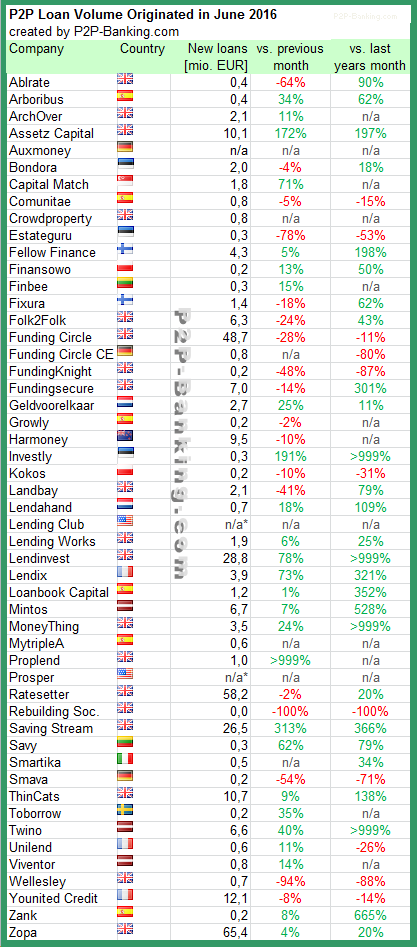
The following table lists the loan originations of p2p lending platforms in June. Zopa leads ahead of Ratesetter and Funding Circle. This month I added MytripleA. The total volume for the reported marketplaces adds up to 334 million Euro. I track the development of p2p lending volumes for many markets. Since I already have most of the data on file I can publish statistics on the monthly loan originations for selected p2p lending platforms.

Investors living in markets with no or limited choice of local p2p lending services can check this list of marketplaces open to international investors. Investors can also check how to make use of current p2p lending cashback offers available.

P2P Lending Statistic 06/2016

Table: P2P Lending Volumes in June 2016. Source: own research
Note that volumes have been converted from local currency to Euro for the sake of comparison. Some figures are estimates/approximations.
*Prosper and Lending Club no longer publish origination data for the most recent month.

Notice to p2p lending services not listed: Continue reading

German Investors Look Beyond Borders when Using P2P Lending

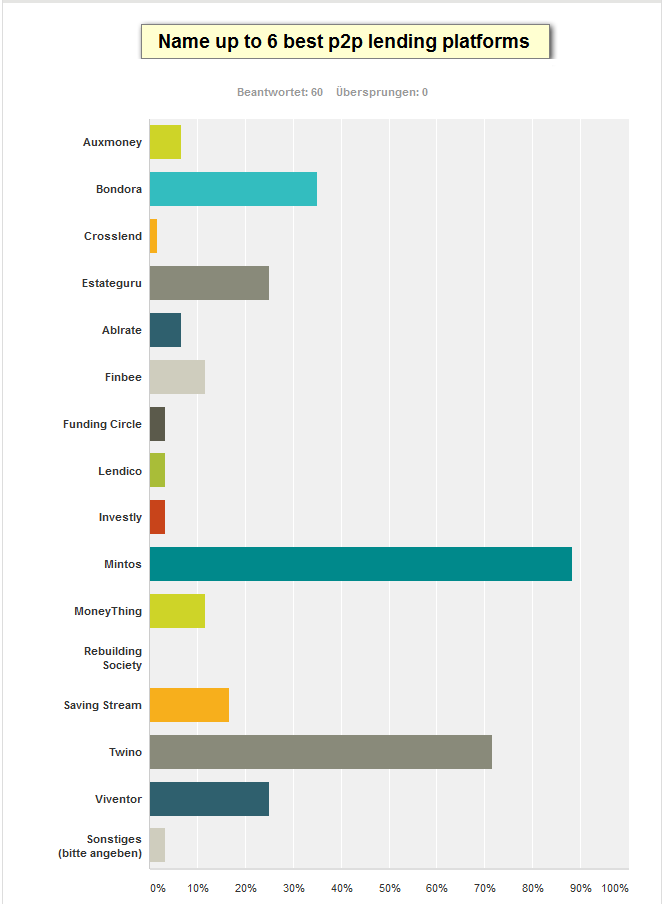
A poll conducted by P2P-Kredite.com among seasoned German speaking investors found, that many prefer p2p lending platforms outside the country they live in. After getting accustomed to the p2p lending concept and liking it, they are on a hunt for higher yields. Further supporting factors are the offered English language interface (a language most understand well), the easy transfer of funds within the Eurozone by SEPA payments and more features offered, e.g. most foreign platforms offer a secondary market, while currently none of the German marketplaces do.

German poll
Poll by P2P-Kredite.com, conducted in June 2016. 60 respondents. Each respondent could name up to 6 platforms. Note that Funding Circle refers to the German platform of Funding Circle, not Funding Circle UK.

Mintos (53 votes) and Twino (43 votes) lead by a wide margin in preference of the respondents, followed then by Bondora (21), Estateguru (15), Viventor (15), Saving Stream (10), Moneything (7) and Finbee (7).
Exclusively baltic and british platforms rank best among the respondents. The choice of british platforms for German investors is limited though as some like Zopa or Ratesetter are open only to UK residents or require a UK bank account to sign up.
Nearly all votes were cast before the Brexit decision. It remains to be seen how the UK platforms will rank in German investor preference in the future, given the more volatile GBP/EUR rates and the increased uncertainty for the UK economy.