Zopa is the first p2p lending marketplace to run a hackathon called Zopathon. Participants a challenged to code something ‘that makes interest rates more interesting’. I have seen several hackathons in the fintech space but usually they are organized by banks, service providers or accelerators and none were p2p lending specific. Zopa says they will introduce APIs, that can be used in the 24 hour event. Sign up for participants is here.
Today Lending Club has unveiled a new product offer. Borrowers in California will be able to refinance auto loans through Lending Club. Lending Club says that the opportunity is huge with currently more than 1 trillion US$ in auto debt outstanding, while just a fraction of that – 40 billion US$ – refinanced annually. The company states this represents huge potential for both Lending Club’s platform and the millions of Americans who could save by refinancing into a more affordable product. Lending Club estimates the average APR for borrowers on new loans through Lending Club will be about 1-3% lower than their current loan, translating into an average savings of up to 1,350 US$ over the life of the loan.
“Tens of millions of Americans borrow over half a trillion dollars every year to buy cars. The practices and processes of the auto lending industry offer consumers limited options and a lack of transparency. This has created a gap between the rates consumers pay and the rates they might otherwise qualify for, unnecessarily driving up debt burdens,” said Scott Sanborn, Lending Club’s President and Chief Executive Officer. “We are excited to leverage our technology and core capabilities to put thousands of dollars back in consumers’ pockets.”. “This is Lending Club’s first offering of access to a secured loan with an overall risk and return profile that’s complementary to the unsecured loans available through our platform. It’s a big step in the evolution of our platform, a win for consumers, and will give our investors access to another proven asset,” Sanborn said.
Loans will be for amounts from 5K to 50K US$ with terms of 24 to 72 months and APRs ranging from 2.49% to 19.99%.
Lending Club strives to offer a much simpler application process than competitors. While the loans are initially limited to borrowers in California it seems likely that Lending Club will expand that. An article with more details is on Lendacademy.
Estonian p2p lending marketplace Bondora will open a new European office in Germany, saying that post brexit London is no longer attractive as a Fintech hub. Bondora formerly planned to move to London but stopped the plan after the brexit vote. ‘There is too much uncertainty, the UK lost its attractiveness as a fintech hub’ explains Bondora CEO Pärtel Tomberg the decision. Now he has Berlin, Frankfurt and Munich on the short-list. The head office will stay in Tallinn
For the Bondora business model very good access to the European market is crucial says Tomberg. He sees uncertainty how long London might be able to provide this.
After informal tals with German regulator Bafin, Bondora CFO Rein Ojavere got a positive view on the perspective for fintechs in Germany: ‘German’s regulators open up more and more to innvations in the financial sector to attract fintechs and seminal start-ups.’. Continue reading →
French Banque Postale makes its first investment into a fintech and takes a 10% stake in Wesharebonds. Wesharebonds was launched in June 2016 after one year work to obtain approval by regulator AMF. The company previously raised 3.8M EUR from 50 business angels (0.6M for its own funding and 3.2M as supply to co-invest into the offerings on the marketplace). Wesharebonds allows indiviudals and companies to invest into bonds (and equity crowdfunding) to SMEs. The valuation was not disclosed.
The parties announced that the capital will be used to expand the product offering.
Cyril Tramon, WeShareBonds CEO expressed that they wanted a partner who shared their vision and could support development.
Banque Postale is a subsidary of La Poste Groupe, which claims ana ctive customer base of 10.8 million.
Lendico announced today that it will stop originating new consumer loans in the Dutch market and focus on loans to companies.
Lendico biedt vanaf 1 november tijdelijk geen consumentenkrediet meer aan. … Vanaf 1 november kunnen alleen bedrijven nog een lening aanvragen. … Product details zakelijke lening: Kredietbedrag: € 10.000 tot € 250.000 Rente vanaf 3,79% Looptijd 6-60 maanden Een aanvrager is gekwalificeerd als het bedrijf meer dan 2 jaar bestaat en in de afgelopen 2 jaar meer dan € 50.000 omzet had. Waarom stoppen we tijdelijk? Sinds we in september 2014 op de Nederlandse markt actief zijn hebben we een veelheid aan verschillende producten ontwikkeld die op de website of voor geselecteerde partners beschikbaar zijn. We willen ons productaanbod de komende maanden herijken en een beperkt aantal producten verder automatiseren en doorontwikkelen. Om dat in alle rust te doen, hebben we besloten om het consumentenkrediet volledig te pauzeren tot minstens januari 2017.
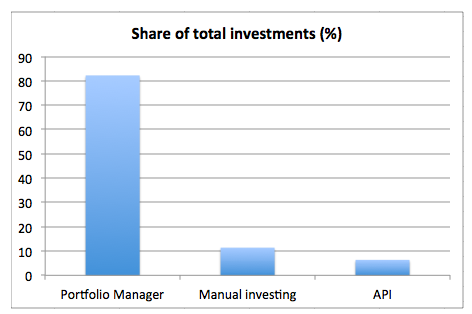
P2P lending marketplace Bondora announced that it will pull the primary marketplace from the user interface effective November 1st. This removes the chance for investors to manually invest on selected loans, leaving the options to either use the automated portfolio manager or to use the API.
Earlier this week Bondora provided this statistic showing that the majority of investments is done through the portfolio manager. This is another of the many changes the Bondora marketplace underwent in the past years.
The announcement email sent today, reads:
On November 1, 2016 we will remove the Primary Market view from the user interface.
What does this mean?
In recent months it has become clear that the Portfolio Manager offers greater efficiency through automation compared to manually investing. The increasing benefits of Portfolio Manager are the result of recent updates to the funding process, which optimize speed. Moving forward we will continue to focus efforts on further improving Portfolio Manager, Bondora API, Secondary Market and the reporting features available on the platform.
Why is Bondora removing the Primary Market from the user interface?
Bondora is removing the Primary Market from the UI because the speed of our popular automated option meets the investing and borrowing needs before manual investing can take effect. Our process improvements have created an environment where almost all loans are funded before they become visible in the UI. As a result, the Primary Market is most of the time empty.
This scarcity is due to the fact that when a loan enters the market it is open to bids for 10 minutes. After the 10 minutes expire the loan is closed. Our internal analysis and reporting shows that almost 100% of loans are funded within this brief window of time. Therefore, there is little reason to hold loans open any longer, as doing so would create unnecessary delays.
What should API users do?
Removing the primary market from the user interface does not change anything for Bondora API users. However, API users should review their settings for polling loans from primary market and reconfigure their settings to match the changes to the current funding process. We recommend that the polling of new loans be set to once a minute. Our API allows for speeds up to one query per second, however such rapid polling is also not recommended.