Funding Circle Raises 65M US$ Series D

British p2p lending service Funding Circle raised 65 million US$ series D in a round led by Index Ventures with participation from existing investors, Accel Partners, Union Square Ventures and Ribbit Capital. The new funding will be used to continue to fuel the company’s rapid global growth, expand product ranges and explore new international markets.

Today’s news follows Funding Circle’s record growth in both the US and UK markets over the past twelve months. The p2p lending marketplace is on track to lend 600 million US$ in 2014.

Samir Desai, CEO and co-founder of Funding Circle said: “We are thrilled to welcome Bob to our board. His expertise and experience is unparalleled. This latest round of funding will fuel our global ambitions and power the next phase of our evolution – catering for the increase in demand we expect to see over the next 12 months. Our vision is to build a better financial world, helping more small businesses access finance and offering attractive returns to investors.”

This news comes less than a year after the previous 37 million US$ round. In total, Funding Circle has now raised $123 million in equity funding.

(Source: press release)

International P2P Lending Services – Loan Volumes June 2014

June was another strong month for p2p lending services. Especially Prosper, Assetz Capital, Folk2Folk and Wellesley did grow their volume substantially. My estimate for the Lending Club number for June may be too high (I took the known figure of 1,006 million US$ loans issued in Q2 and subtracted my approximated numbers for April and May. But these April and May approximations may have been too low).  I do monitor development of p2p lending figures for many markets. Since I already have most of the data on file I can publish statistics on the monthly loan originations for selected p2p lending services.
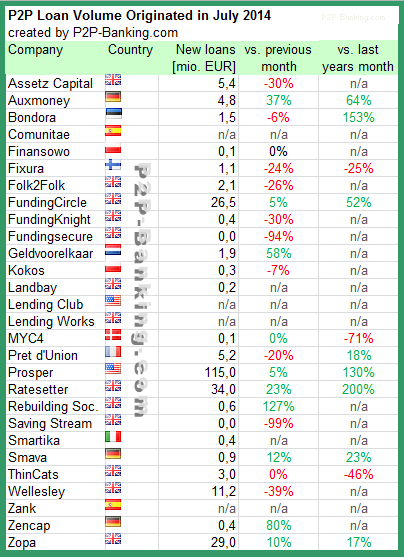
Table: P2P Lending Volumes in June 2014. Source: own research
Note that volumes have been converted from local currency to Euro for the sake of comparison. Some figures are estimates/approximations.

Notice to p2p lending services not listed:
If you want to be included in this chart in future, please email the following figures on the first working day of a month: total loan volume originated since inception, loan volume originated in previous month, number of loans originated in previous month, average nominal interest rate of loans originated in previous month.


Main UK P2P Lending Services Agree on Standard for Calculating Defaults

A long time downside of p2p lending was that each company used its own definition for defaults making it hard to impossible for all but experts to compare figures for different p2p lending companies. The Peer-to-Peer Finance Association (P2PFA), a trade organisation of British p2p lending companies, now addressed this issue with a new standard: ‘In future, all P2PFA members will calculate defaults on their loans in a standard way, helping consumers compare between platforms and to strengthen standards of industry disclosure. The new default rate calculation is currently being implemented and will be published on each individual P2PFA member’s website.’

P2PFA definitions of Non-Performing Loans and Defaults:

Definition of Non-Performing Loan:
A loan should be considered to be a ’Non-Performing Loan’, ‘Impaired’ or in ‘Arrears’, where the relevant borrower of the loan is:
(a) more than 45 days overdue in an interest payment; or
(b) more than 45 days
overdue with a principal repayment; or
(c) legal action for enforcement of the loan has commenced; or
(d) the loan is being or has been renegotiated with a borrower, or
(e) the loan has not otherwise been in full compliance.
The amount of arrears is the amount overdue for payment in a) and b) above. Continue reading

Zopa Changes Matching Algorithm

Zopa has announced changes to the sequence in which investor funds are matched in lending.

Over the next few weeks we will be making a number of changes we believe that will improve the overall lending experience.

Phase 1 – Maximum exposure change

Starting this week, we will be adjusting the maximum exposure for lenders. This will mean that the maximum you lend to any individual borrower will rise from 0.5% to 2% of your total funds. This means that you will lend in £10 chunks when lending up to £1000, £20 chunks when lending above £1000, £40 chunks above £2000 etc. This change will enable us to allocate more of a lender’s money to each loan and allow funds to be lent out more quickly. From a risk point of view, 2% provides a good level of initial diversification and over the course of time it will steadily increase so that lenders will have hundreds or even thousands of individual loans.

Phase 2 – First in first out lending (FIFO)

The second update which will also take place in the coming weeks will see us prioritise repayment money to allow existing funds to be matched more efficiently. We are calling this “First In First Out” (FIFO) and will separate out new funds from repayment funds, with repayments being matched first. New funds, or manual top ups are then placed in a FIFO queue and then dropped into the matching engine in a controlled way. This prevents spikes in new funding from slowing down lending of repayment money and allows us to give an accurate prediction of when new funds will be matched. It also allows us to lend as much repayment money on offer before allocating new funds for loans, therefore working your existing money harder.

Phase 3 – End of day matching

In the following weeks we will begin matching loans in one process at the end of each day. By allowing loans to be accumulated over the course of the day and including rapid returns, we can optimise the matching process to make it even more efficient. This will mean that all our lenders will receive a more consistent blended rate, regardless of lending size in any given day.

At Zopa our goal is to provide the best rates to our lenders and borrowers and ensure that we are as efficient as we can be in our lending. We believe that lenders will see an immediate effect on their money being matched. Meaning increased efficiency and more consistent rates from the changes detailed above.

A discussion around this change can be found in this thread.

Zopa is also changing the layout of the site. One change is that the visibility of the link to the Zopa community features, especially the discussion forum is reduced. Continue reading

International P2P Lending Services – Loan Volumes May 2014

Developments in May were mixed when compared to p2p lending volumes in April. I added one new service to the table. I do monitor development of p2p lending figures for many markets. Since I already have most of the data on file I can publish statistics on the monthly loan originations for selected p2p lending services.

Table: P2P Lending Volumes in May 2014. Source: own research
Note that volumes have been converted from local currency to Euro for the sake of comparison. Some figures are estimates/approximations.

Notice to p2p lending services not listed:
If you want to be included in this chart in future, please email the following figures on the first working day of a month: total loan volume originated since inception, loan volume originated in previous month, number of loans originated in previous month, average nominal interest rate of loans originated in previous month.

A Visit With Assetz Capital

On Wednesday I flew to Manchester on invitation of p2p lending service Assetz Capital and met with Managing Director Andrew Holgate and his team. I learned how they operate and we spent the day discussing various aspects of p2p lending.

Assetz Capital does p2p lending to businesses secured by assets – mostly property. While the loans are big (usually the minimum loan size is 100,000 GBP), investors can lend starting with amounts of just 20 GBP. But typical investments are higher. In fact their first loan, which was for the amount of 1.5M GBP was funded by just 150 investors. Andrew Holgate pointed out that since each loan is backed by a security there is not as much need for investors to diversify to spread risk as with other p2p lending platforms.

Assetz Capital went live in April 2012. The founders and the management have extensive experience in finance, especially SME funding. One of the founders, Stuart Law, is the CEO of Assetz Group which has a 15 years track record in property investments. Assetz Capital could utilise the huge existing database of over 65,000 customers of Assetz Group when it started marketing its loan offers to investors.

Initially the main task at hand was to build trust. Trust not only on the investor side, but also from brokers, the main source of loan requests. Brokers wanted to be able to rely on the referred, approved loan requested getting funded within reasonable time (e.g. 2 weeks). While this was challenging in the beginning, Holgate says Assetz Capital has no problem now of getting multiple large loans funded simultaneously. Some of the loans fill as fast as 4 to 5 hours.  To get there Assetz Capital integrated underwriters into the process.

After Assetz Capital has thoroughly vetted the applying business and the underlying security – in fact every business is visited in person by an employee of Assetz Capital, it is presented to large investors which will then check the offer themselves and underwrite it – effectively saying they are prepared to finance large chunks of the offer.

Once the loan is on the marketplace, investors bid on it. Investors do see all documentation available on the loan and Assetz Capital says investor scrutiny and feedback is very valuable. Each loan request has a Q&A section where investors can comment.  Between funding and drawdown it usually takes a few weeks, depending on circumstances. In this time all documentation required is completed (e.g. first or second charges).

Assetz Capital is 100% owned by the management. Even so the business is very young it already turned profitable.

Broader product range

Assetz Capital started p2p lending with loans backed by real estate. Gradually they are now moving in financing a broader range of loan purposes, but always backed by asset securities. Assetz Capital wants to become the single access point for SME finance needs, as banks are no longer fulfilling that role. A surprising point in the talks for me was, when Holgate said, that actually their interest rates are higher than those charged by the banks, which is possible since many SMEs don’t get the funding they need from the banks any more.

On the investor side Assetz Capital will take steps to reduce the average time-span between funding and drawdown for investors. The company also considers in the medium term to grade loans into risks classes. At the moment different risks perceived by the risk manager at Assetz Capital are priced into the interest rates of the loans. So far Assetz Capital has refrained from assigning risk grades as it might be seen as giving investment advice to investors, which Assetz Capital does not do. Assetz Capital might also make it easier for investors to automatically invest into loans of a given risk/interest range. So far this was not necessary as the majority of investors enjoyed the process of the individual selection of loans. Continue reading