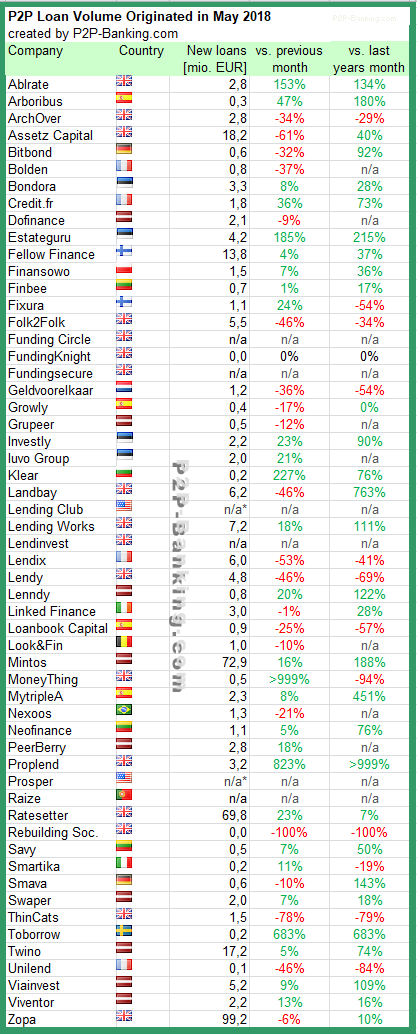
The table lists the loan originations of p2p lending marketplaces for last month. With the most recent Funding Circle figures not available at the moment, Zopa leads before Mintos. I track the development of p2p lending volumes for many markets. Since I already have most of the data on file, I can publish statistics on the monthly loan originations for selected p2p lending platforms. This month I added Grupeer.
Milestones achieved this month (overall volume since launch):
Table: P2P Lending Volumes in May 2018. Source: own research
Note that volumes have been converted from local currency to Euro for the purpose of comparison. Some figures are estimates/approximations. *Prosper and Lending Club no longer publish origination data for the most recent month.
The table lists the loan originations of p2p lending marketplaces for last month. With the most recent Funding Circle figures not availableat the moment, Zopa leads before Mintos. I track the development of p2p lending volumes for many markets. Since I already have most of the data on file, I can publish statistics on the monthly loan originations for selected p2p lending platforms.
Milestones achieved this month (overall volume since launch):
Table: P2P Lending Volumes in April 2018. Source: own research
Note that volumes have been converted from local currency to Euro for the purpose of comparison. Some figures are estimates/approximations. *Prosper and Lending Club no longer publish origination data for the most recent month.
Kuflink is a peer-to-peer property investment platform that brings borrowers and investors together. Our borrowers seek quick access to short-term finance that a high street bank would be unable to deliver, and our investors seek competitive interest that beats the typical rates offered with regular savings and current accounts.
Investing in property has previously been reserved for the very wealthy, with the money and means to put significant sums towards developments. The fintech revolution, however, has opened up a wide range of opportunities to retail investors who want to make meaningful returns on their cash, and in turn, opened up borrowing opportunities for a range of projects that would previously be denied such quick access to loans.
Kuflink has built a peer-to-peer platform in this emerging space to give retail investors the opportunities that were previously only available to high net worth individuals and institutional investors. In doing so, it also offers developers bridging loans to fund projects across the UK.
Since our launch of the p2p platform in 2016, Kuflink lenders have invested over 17 million GBP, with 0.00 GBP losses to date.
What are the three main advantages for investors?
Firstly, investors are offered high rates of return associated with property investments, which due to the nature of the property market are often very secure and predictable. In this age of mass-market retail investment, property opportunities have one of the longest track records, as people have been investing in property for hundreds of years, and long before technological advancements allowed us to build an accessible P2P platform.
A second main advantage for investors is that Kuflink has a highly effective due diligence procedure with an exceptional track record. We’re so confident in our vetting of loan requests that we cover the first 20% of losses in each individual opportunity on the platform. We really believe in each loan, and investors can be confident in all opportunities, as like them, we trust the platform with our own funds at risk.
Thirdly, investors are only offered access to the very best opportunities, as Kuflink only approves around 30% of loan applications. This gives lenders peace of mind that their investment is very likely to be successful.
What are the three main advantages for borrowers?
We have been providing bridging and development loans since 2011 of up to 1 million GBP, and our lenders have invested over 17 million GBP in just under 2 years, proving highly advantageous for our borrowers.
Firstly, Kuflink gives property professionals highly competitive rates on development loans. Many of these highly secure projects may not otherwise find funding, as Kuflink’s due diligence process filters highly promising opportunities that others may incorrectly deem inappropriate.
Secondly, borrowers can access a huge number of investors through the p2p platform, and are provided with a highly regulated means of crowdfunding their projects. This allows developers to work on projects that people really want, and can help to build strong community relationships between loan backers and project managers, leading to increased opportunities for future project funding.
Finally, Kuflink’s on hand customer service team is highly responsive to any queries or difficulties with loans, and can offer instant advice and support in the event of any difficulties.
What ROI can investors expect?
There are multiple ways for investors to lend their money with Kuflink, and each of these carries different estimated ROI.
Using the Auto-Invest feature, the platform will automatically diversify investors’ funds, and can offer up to 5.35% interest pa gross*. Investors can also choose to invest in certain opportunities to have more control over their portfolio. This is through Kuflink’s Select-Invest feature, which can offer up to 7.2% interest pa gross* over shorter periods of time. Finally, our IF-ISA offering also allows investors up to 5.35% interest pa*, with a £20,000 tax-free allowance for 2018/19.
You are advertising “investors never lost a pennyâ€. At a future point in time defaults will happen. What is the procedure for dealing with these and what overall unrecoverable rate of debts do you expect?
In the case of defaults, we instruct an insolvency practitioner to recover funds, however we expect our excellent track record to continue and hope we won’t need to act upon this in the future.
Is the technical platform self-developed?
The platform has been developed by our CTO, Hari Ramamurthy, alongside in-house front and back-end developers to ensure the technology seamlessly compliments our P2P offering. Since our launch in 2016, the platform has been operating smoothly, while undergoing continuous updates and improvements. Our in-house technical team can respond immediately to any borrower or lender issues with the software.
How is the company financed? Is it profitable?
The Kuflink platform as it stands today has evolved from alpha bridging, which provided the funds for the launch of Kuflink Bridging, which hosted the initial P2P offering. Kuflink’s model, as with many P2P platforms, is to take a small cut from each transaction, and currently runs at a profit.
What were the main challenges when launching your platform?
One of the main challenges we have had to face is inter-departmental integration. With so many moving parts across different disciplines, from property due diligence experts, to finance and tech experts, making sure there are good lines of communication and correct pathways in place have been essential to our successful operation.
You offer an Innovative Finance ISA with tax advantages. Can you please provide some absolute numbers on how many UK investors have invested into this? And are there more new subscriptions or more transfers in of existing ISAs?
We currently have many IF-ISA account holders who have so far made significant investments. There has been a large influx of transfers in from other ISA providers from both new and existing Kuflink account holders, however we cannot comment on the exact number of account holders or investment value as these figures are commercially sensitive.
Is Kuflink open to international investors?
Our platform is open and accessible to overseas investors with a UK residency and a UK bank account.
Which marketing channels do you use to attract investors and borrowers?
We use a variety of marketing channels, from online advertising, to PR and even major sponsorship deals such as our partnership with Ebbsfleet United Football Club and their Kuflink Stadium.
What factors do you see impacting the British property market in the near future?
Brexit is of course a big issue that could potentially impact property in the UK, with an air of uncertainty surrounding the future of the market. Although we expect this to have a somewhat adverse effect on the markets, we believe that UK property will continue to be an attractive area of growth and investment, and should be relatively robust to any larger market perturbations.
Where do you see Kuflink in 3 years?
We currently have [a] positive outlook for the next three years, even in the face of uncertainty in the marketplace. Our trends show that there is a steady increase in loan applications alongside growing demand from investors for lending opportunities.
We also have plans to continue the work reinvigorating local communities around Gravesend and across the UK through the Kuflink Foundation. We hope to expand our charity and community work, which currently includes sponsorship of Ebbsfleet United, work with Kent County Council, and charities such as Age UK.
You have one wish, that the regulator would fulfil. What is your wish?
We work very closely alongside the regulator and are satisfied by their requirements. Our platform is fully functional within the current rules, and we find that these are more than sufficient for our platform to run smoothly, fairly, and profitably.
P2P-Banking.com thanks Narinder Khattoare for the interview.
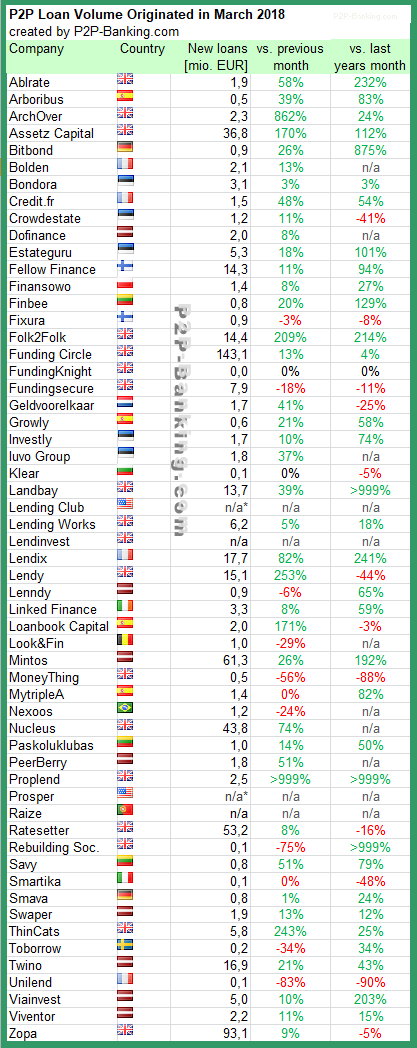
The table lists the loan originations of p2p lending marketplaces for last month. Funding Circle leads ahead of Zopa and Mintos, which is in the top 3 for the first time. The total volume for the reported marketplaces adds up to 599 million Euro. I track the development of p2p lending volumes for many markets. Since I already have most of the data on file, I can publish statistics on the monthly loan originations for selected p2p lending platforms.
Milestones achieved this month (overall volume since launch):
Table: P2P Lending Volumes in March 2018. Source: own research
Note that volumes have been converted from local currency to Euro for the purpose of comparison. Some figures are estimates/approximations. *Prosper and Lending Club no longer publish origination data for the most recent month.
LendingCrowd has secured an external funding round of 2 million GBP following a strong 2017 for the p2p lending company, with the proceeds earmarked for ramping up its sales and marketing activities.
The round was led by angel syndicate Equity Gap and included a number of private investors from Scotland’s entrepreneurial and finance scene, and the Scottish Investment Bank. The company says it is on track to scale significantly during 2018 and intends to seek Series A funding over the next 12 months.
As part of its drive to build market position, LendingCrowd this month launched its debut television advert, designed to bring the opportunities available through P2P lending to a wider audience. The advert features Geoff, who decided to “Think Outside The Bank†and invest with the platform after becoming disillusioned with the low rates of return on other investments.
LendingCrowd has originated loan deals totalling 16 million to SMEs across Britain in the past 12 months period. For 2018, CEO and co-founder Stuart Lunn has set a target to more than double loan deals to around 40 million GBP. New clients in 2017 included Summerhall Distillery, producer of award-winning spirits brand Pickering’s Gin, restaurant chain Tony Macaroni and property lettings agency Umega Lettings.
Investor funds on the platform have grown rapidly, with much of the expansion attributed to the launch of one of the first Innovative Finance ISA (IFISA) products in February 2017. After a full 12 months of opening the LendingCrowd Growth ISA, 82% of investors have beaten the advertised 6% target return.
LendingCrowd, which is fully authorised by the Financial Conduct Authority, has over 4,500 investors signed up to its platform and is on track to significantly increase investor numbers this year. It now offers three IFISA products – the passive Growth ISA and Income ISA, and the active Self-Select ISA.
Stuart Lunn, LendingCrowd CEO and co-founder, said: “Having laid solid foundations for the business over the last couple of years, we now have a position in the market that is starting to pay dividends. We have a strong pipeline of both investors and SME demand and with such a strong trajectory, we are now actively speaking to the venture capital and private equity communities about our next phase of growth.â€
Jock Millican from Equity Gap said: “We are extremely pleased that our syndicate members once again backed LendingCrowd, with this raise being the largest single investment by Equity Gap to date. Existing and new investors in LendingCrowd recognise the progress to date and the potential for the business to scale.â€
Kerry Sharp, Director of the Scottish Investment Bank, commented: “We are delighted to provide continued support to LendingCrowd who have demonstrated real market traction with their innovative peer-to-peer lending platform in Scotland.â€
Blend Network is an online property lending marketplace that focuses on lending to established property developers in high-growth areas across the UK but outside London. Since its official launch in January 2018, Blend Network has already lend £1.5 million GBP to 6 projects across Northern Ireland, Scotland and Norfolk with an average fixed return of 12.2% p.a. Lenders can join for free and manage their loans through a user-friendly dashboard. Borrowers are double-vetted by both Blend Network and a sponsor before being listed on the Blend Network platform. In addition, Blend Network loans are only made against security to help ensure the protection of lender money in the default scenario.
What are the three main advantages for investors?
Access to niche markets: While most P2P property lenders focus in the London market due to its convenience, we focus in less crowded markets outside London that are outperforming not only the London market but also the average UK market. We have done loans in Northern Ireland where according to the recent RICS UK Residential Market Survey Report the outlook is considerably more positive than in some other UK regions, with prices rising, a growing number of potential new buyers active in the market, robust demand and overall stronger sentiment. Similarly, according to the latest UK House Price Index data, Scotland was the only UK region where average year-on-year house prices in 2017 where higher than in 2016 (In England, Wales and Northern Ireland the pace of price growth moderated, although more significantly in England).
High returns: Our focus in high-growth, high-yield pockets of the UK property market outside London enables us to return up to 15% return p.a. – right at the top-end of the P2P lending marketplace. Our average return for the 6 loans since launch is 12.2%, significantly above the average of around 8% return across other P2P property platforms according to our own calculations.
Strong due diligence and credit risk assessment: We pride ourselves by the strength of our due diligence process. Borrowers are double-vetted by both Blend Network’s Credit Committee and a sponsor before being listed on the Blend Network platform. Our Credit Committee is chaired by senior banker Charles Lamplugh who has 35 years of experience successfully winning and running corporate relationships for Lloyds Banking Group. In addition, Blend Network loans are only made against first charge on the security as well as personal guarantee from the developer.
What are the three main advantages for borrowers?
Access to finance: Most property lenders pulled out in places such as Northern Ireland after the 2008 financial crisis and many haven’t gone back yet, but paradoxically Northern Ireland is one of the fastest growing UK property markets. For small developers in those markets, getting access to finance is simply not easy. Small and Medium Enterprise (SME) developers have the flexibility and the desire to build on brownfield sites, to redevelop derelict buildings and to maximise the potential of property which may no longer be viable for commercial use. Figures from the Federation of Master Builders (FMB) House Builders Survey 2017 suggest that a shortage of available small sites, combined with a lack of finance, top the list of barriers facing SME house builders.
We bring knowledge and understanding of developers’ true requirements: We operate in areas where the constrained nature of most mainstream lenders has led to many opportunities for small developers being delayed, frustrated or lost. In contrast, we pride ourselves for our understanding of the true requirements in the development process. As one borrower put it ‘It was very refreshing to work with a company that understood the process well so could recognise the opportunities available and thus able to finance accordingly.’
No exit fee for early repayments: If our borrowers are able to complete their project before the maturity, great! They can repay the loan with no exit fee. It’s a win-win.
What ROI can investors expect?
Between 8% and 15% fixed return p.a. Our average since launch is 12.2% fixed return p.a.
Is the technical platform self-developed?
The platform was developed for us, we own it.
How is the company financed? Is it profitable?
The company has been self-financed so far. It is profitable but we have just decided to take the whole team on an offsite to Miami, so we spent all our profit! J J
What were the main challenges when launching your platform?
Frankly, our main challenge so far has been trying to explain why the returns are so good! In today’s markets, there are not many investments that offer an average of 12% return p.a. with no volatility. One might think it is too good to be true. It is not. The simple answer is that the UK housing crisis and lack of available homes is at its worst since the 1970s, and small developers with tight access to funding are willing to pay a premium to get funding for redevelopment projects and bridge loans. This is why we can pay up to 15% return p.a.
Do you plan to offer an IFISA?
We will assess this later in the year and decide whether we want to implement an IFISA for the next financial year.
Is Blend Network open to international investors?
Yes, it is. Our current lenders on the platform include a range of nationalities across Western Europe, the Middle East and Far East Asia.
Which marketing channels do you use to attract investors and borrowers?
The platform has already attracted a string of high-profile lenders among the high net worth bankers and hedge fund managers of Yann’s circle of personal connections. These have lent nearly 1.5M GBP since the platform launched and the proposal is attracting significant ‘word of the mouth’ attention among current lenders. In addition, we have prepared a 2-year strategic marketing plan highlighting the relevance of branding, social media, PR but most importantly word of the mouth by current lenders who are more than happy to recommend the product.
What factors do you see impacting the British property market in the near future?
We see Brexit as a key challenge (or in our case opportunity) for the UK property market in the next 2-5 years. The UK property market is a 2-speed market, with on the one hand the London market and on the other hand the rest of the UK market. We believe the London market is set to undergo a further correction due to being directly exposed to a number of sectors hit with Brexit: the financial sector and the global elite’s appetite towards prime London property ownership after Brexit. On the other hand, the rest of the UK suffers from an endemic housing crisis and lack of available homes: after decades of failure to build the homes the country needs, public concern about housing is the highest it has been for 40 years according to several heavyweight reports into Britain’s housing crisis.
Where do you see Blend Network in 3 years?
At Blend Network we are not trying to reinvent the wheel; we are simply offering an improved product for both lenders and borrowers. While we don’t want to be the only P2P property platform in the market, in 3 years we certainly want to be the best in terms of:
Returns – keeping our current position at the top-end of the P2P lending marketplace
Customer experience – continuing to enhance the functionalities on our platform to keep delivering top navigational and interface tools that our lenders love using
Access to deals – Continuing to source top deals for our lenders
P2P-Banking thanks Yann Murciano for the interview.