Spain: CNMV authorizes MytripleA & Lendix as crowdlending platforms

The Spanish Securities Exchange Commission (CNMV, Spain’s financial regulator) has authorized MytripleA as a Platform for Participatory Financing, the formal name for a p2p lending platform. This is one of the first actions to implement Law 5/2015 Promotion of Corporate Financing. MytripleA already benefits from a Payment Institution license (which can be passported within the EU) granted by the Bank of Spain, which authorizes MytripleA to make loan disbursements and receive loan instalments within the regulatory environment for banking payments. This is an additional regulatory requirement in Spain, which is not required by other European countries.

With this new authorization, MyTripleA becomes the first crowdlending platform to have both of the required authorizations in Spain. Competitors entering Spain, will not be able to use the the so-called passporting provisions from a financial regulator outside of Spain and will need to apply for a Platform for Participatory Financing license before being able to operate in compliance with Spanish regulations Law 5/2015 Promotion of Corporate Finance provided a unified legal framework for crowdlending platforms and securitized funds, and made CNMV responsible for their creation, authorization and supervision. Crowdlending has experienced rapid growth across Europe. The Spanish market last year grew 266% according to the website P2P-Banking.com. Within the new regulatory framework and with the supervision of CNMV, a greater degree of awareness of the alternative financial services market is expected.

French Lendix announced that it received its formal CNMV accreditation to operate as a P2P lending platform in Spain. The Spanish entity will be the first Lendix international market to open. It will target financing of credits to SME, for amounts ranging from 30,000 to 2,000,000 Euro, duration of 18 to 60 months and at interestrates comprises between 5.5% et 12%. Companies presented on the platform will be selected and analyzed by Lendix credit analysis team and will need to generate a turnover of at least €400’000. Non accredited private investors* will be able to lend up to 3,000 Euro per project with a total maximum yearly amount of 10,000 Euro, while no limit will apply to accredited private investors nor institutional investors. The launch of Lendix’s spanish platform is scheduled for Q4 2016.

Equity crowdfunding platform Crowdcube also received authorization.
Continue reading →

Friday Fun: Bondora’s Personalized Investment Video

Just before the weekend Bondora sent me an email with a personalized investment overview video (click here to see mine; I was not able to embed it directly here in the blog). The video page encourages sharing via social media (Google, Linkedin, Facebook, Twitter), so obviously an aim is to aid in investor marketing. In future I might need to spend less effort on my personal portfolio reviews and post the video instead (just kidding). The highlighted return figure is higher than my own calculations, but I did achieve a high return on Bondora over the past years.

Have you seen other attempts on viral marketing via investors by p2p lending marketplaces? Let me know in the comments, please.

EDIT: Succeeded in embedding the video now:

International P2P Lending Services – Loan Volumes June 2016

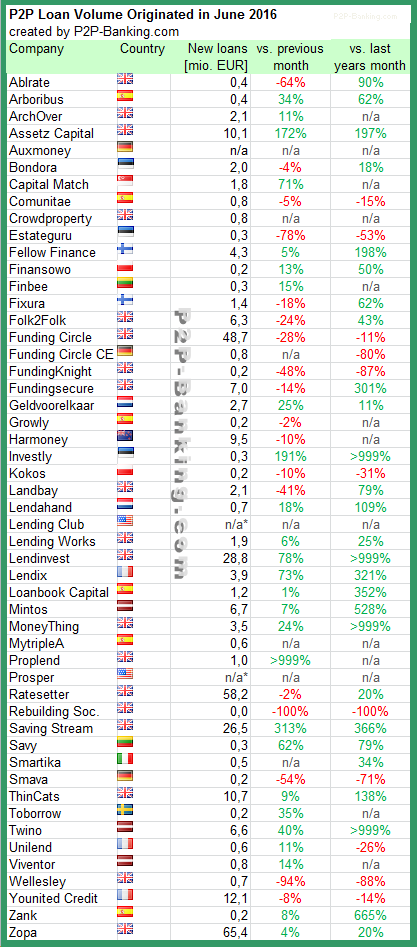
The following table lists the loan originations of p2p lending platforms in June. Zopa leads ahead of Ratesetter and Funding Circle. This month I added MytripleA. The total volume for the reported marketplaces adds up to 334 million Euro. I track the development of p2p lending volumes for many markets. Since I already have most of the data on file I can publish statistics on the monthly loan originations for selected p2p lending platforms.

Investors living in markets with no or limited choice of local p2p lending services can check this list of marketplaces open to international investors. Investors can also check how to make use of current p2p lending cashback offers available.

P2P Lending Statistic 06/2016

Table: P2P Lending Volumes in June 2016. Source: own research
Note that volumes have been converted from local currency to Euro for the sake of comparison. Some figures are estimates/approximations.
*Prosper and Lending Club no longer publish origination data for the most recent month.

Notice to p2p lending services not listed: Continue reading →

German Investors Look Beyond Borders when Using P2P Lending

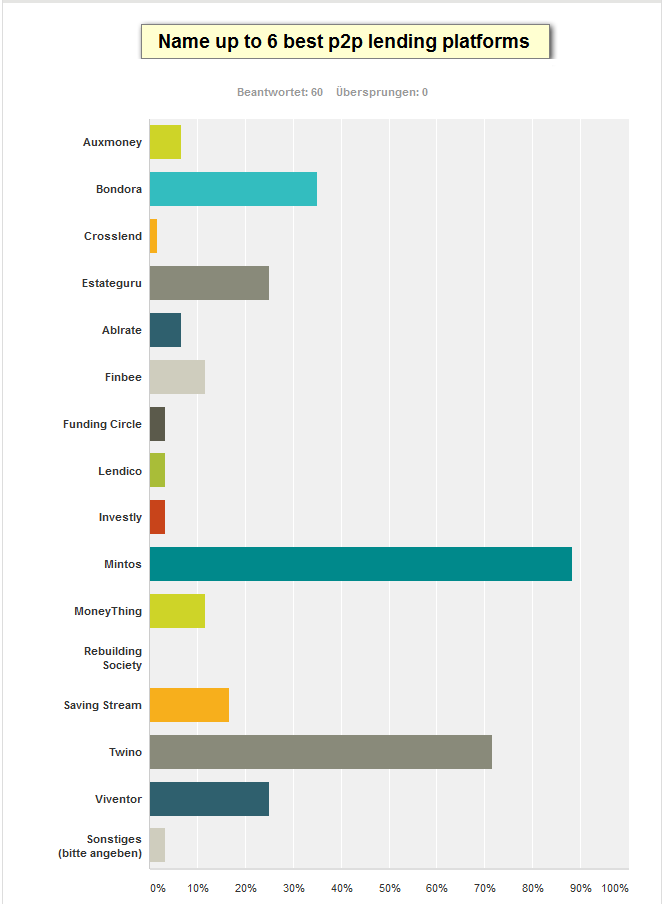
A poll conducted by P2P-Kredite.com among seasoned German speaking investors found, that many prefer p2p lending platforms outside the country they live in. After getting accustomed to the p2p lending concept and liking it, they are on a hunt for higher yields. Further supporting factors are the offered English language interface (a language most understand well), the easy transfer of funds within the Eurozone by SEPA payments and more features offered, e.g. most foreign platforms offer a secondary market, while currently none of the German marketplaces do.

German poll
Poll by P2P-Kredite.com, conducted in June 2016. 60 respondents. Each respondent could name up to 6 platforms. Note that Funding Circle refers to the German platform of Funding Circle, not Funding Circle UK.

Mintos (53 votes) and Twino (43 votes) lead by a wide margin in preference of the respondents, followed then by Bondora (21), Estateguru (15), Viventor (15), Saving Stream (10), Moneything (7) and Finbee (7).
Exclusively baltic and british platforms rank best among the respondents. The choice of british platforms for German investors is limited though as some like Zopa or Ratesetter are open only to UK residents or require a UK bank account to sign up.
Nearly all votes were cast before the Brexit decision. It remains to be seen how the UK platforms will rank in German investor preference in the future, given the more volatile GBP/EUR rates and the increased uncertainty for the UK economy.

How the Brexit Influences My Personal P2P Investment Strategy

Well that was a surprise. When I went to bed last midnight the news reported more indications for a remain vote than for a leave. Even with psephologists cautioning that the referendum is very hard to predict due to the lack of comparision data from earlier votes, it seemed to me that the outcome was likely pro EU.

While I had personally wished the Brits to stay in the Union they took a democratic decision and now the politicans have to act upon it to execute divorce.

Awakening to the new reality I now have to assess what this means for my personal p2p investment strategy – as a foreign investor. Only a small portion of my p2p investment portfolio is invested in UK platforms (a substantial amount at Saving Stream, small amounts with Ablrate, MoneyThing and Rebuilding Society). The markets are in turmoil, and I have already taken the hit by the pound dropping sharply compared to the Euro this night.

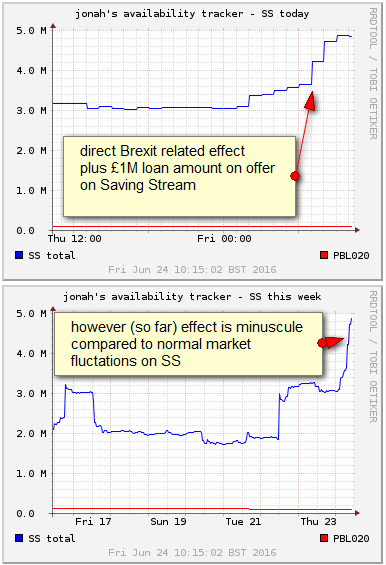
Another effect is that the uncertainty is causing more investors to put up loan parts for sale – the effect is measureable on Saving Stream and currently accounts for a plus of approx. 1M GBP loans on offer there. Still this amount is very small compared to fluctations of liquidity levels due to other factors. For most loans this now means that there is a considerable delay in selling loans, due to queue size. However this could be cleared up quickly by one or two large loans repaying and the interest payout on July 1st.

Saving Stream loan tracker
(Source: jonah; own edits)

With Saving Stream and Moneything loans will depend highly on the development of the property prices. Some expect a drop in property prices. I think it is to early to tell if that will happen, but I think it is very likely that there will be slow down in new development activity while everbody waits to see what the outcome will be. This will affect the demand for bridging loans and thereby Saving Stream and Moneything to a cetain degree.

And then totally unpredictable there is the question how this new direction will effect the European economy as a whole and whether it might trigger a recession. While I am optimistic that it will not, there is an extreme amount of uncertainty and I have to consider that this might impact my p2p investments on continental European platforms.

For now I have decided that I will not deposit new funds on UK platforms (which I was planning to do) but will not withdraw funds either at the moment and will just keep reinvesting the proceeds. I see little point in selling off loans (would be hard right now anyhow as liquidity seems to dry off temporarily), and exchange the amounts back to Euro. That would guard me from further drops of the pound exchange rate, but I think it is not sure that the pound will fall into a continuing decline (even so that seems more likely than any rise in the pound rate vs the Euro).

For the continental platforms my strategy remains unchanged by the event, even though I think that the risks on some platforms have risen somewhat too in the mid-term outlook.


Commerzbank will Launch P2P Lending Platform Main Funders Next Week

At a press conference this morning in Frankfurt, Michael Kotzbauer of Germany’s second largest bank Commerzbank and Birgit Storz of Main Incubator announced that the new platform Main Funders will launch next week. Main Funders is part of a broader digitalisation strategy of Commerzbank and the first project Commerzbank and Main Incubator built together. Main Incubator previously invested in several Fintech startups.

The aim of the new platform is to bring together SMEs seeking loans in the range of 200K to 10M Euro for up to 5 years and professional investors (institutional and large companies). Both will be already customers of Commerzbank and Commerzbank will make use of its regional sales force to bring borrowers onto the marketplace.

Kotzbauer explains strateg of Commerzbank with context Main FundersBorrowers will list their project n the platform, visible only to logged in investors, which in can browse the listings and select those that match their interests. Main Funders will assign credit grades to the loan requests and set the interest rate, taking into account that all loans will be unsecured. Since borrowers already have a credit history with Commerzbank, Storz says that the process, including the handling of the contracts, will take only a short time frame.

Main funders charges borrowers 0.45% of the loan amount multiplied with the duration and  investors 0.2%.

Unlike on other platforms investors won’t have to ‘park’ cash to be able to invest but rather will be able to pay for funded loans after all contracts have been signed, an advantage to avoid cash drag.

Once the loan is fully funded, the loan will be serviced by a third company (not Commerzbank or Main Funders).

Main Funders says it is uniquely positioned compared to other p2p lending marketplaces in that it is able to facilitate very large loans and benefits from the relationship and trust Commerbank already has to target customers.

With Main Funders Commerzbank aimes to:

  • increase customer satisfaction
  • strengthen its competitive position
  • react to rgulatory requirements
  • create a basis that will allow it to build further innovative loan products upon

Storz declined to give a figure on the expected loan volume in the first year, saying it is important to be able to react and adapt quickly in such an innovative product offering.

Some questions in the press conference targeted whether Commerzbank is cannibalizing the own products and if there is no conflict of interest in the decision of whether to finance a loan itself or put it on the platform.

Kotzbauer said that Commerzbank is reacting to the wish of some of their customer to diversify financing options. The decision of whether to finance the loan request themselves or put it on the platform is made after consulting with the borrower on his financing needs and wishes and not discriminating by credit grades or other parameters.

Main FundersCommerzbank is one of the first large banks in the world to have developed its own platform (together with its incubator). Other banks have taken the route to acquire lending startups (e.g. Barclay Africa Rainfin, Westpac with SocietyOne, or Banca Sella at Smava and Prestiamoci). Several banks are investing into consumer and SME loans on p2p lending marketplaces, especially in the US and the UK.

The initiative of Commerzbank is likely going to give a boost to awareness and credibility of p2p lending in Germany, even though it remains close to the conventional process with the restriction to existing customers and institutional investors. Continue reading →