British p2p lending service Zopa.com announced in an email, that it now plans to launch nationwide in the US changing older plans for a US launch limited to California. No date was given but sources say the launch is not immanent, but could rather take place mid-year.
Countries
Booberwatch offers statistics on boober.nl p2p lending
The new website booberwatch.nl offers p2p lending stats for the Dutch p2p lending service boober.nl (as wiseclerk.com does for prosper.com stats). While the site is in Dutch language, it has many charts and tables that can be understood without speaking Dutch. The main page shows the fluctation of average interest for each credit grade over time. According to booberwatch 536207 Euros have been loaned so far.
P2P Lending in Denmark offered by Fairrates.dk
Today I received an email from Arkadiusz Hadjuk of Fairrates.dk informing me, that his company started to offer p2p lending in Denmark. Most of the following information was supplied by him.
At Fairrates.dk:
- There are individual listings, both lending and borrowing
- There are no groups
- There is auction bidding down interest rates, both lending and borrowing
- In case of non-payment (for over 1 month) a lender is assisted with
a collection procedure - Minimum loan is 1000 DKK (approx. 135 Euro; approx $100)
- There is no maximum a lender can lend
- Maximum per loan is 50.000 DKK (approx. 6700 Euro; approx. $5100)
- Borrower can request minimum 1000 DKK
- Borrower can request maximum 50000 DKK until his income information
is verified – then the limit is lifted up - Minimum bid is 1000 DKK
- Only people over 18 years old with Danish CPR number and Danish bank
account can lend/borrow - No interest on unlend deposits
- Simple fee structure (borrower pays 1% of loan amount)
- Risk assessment is based on information and documentation provided
by borrowers.
I did technorati and Google searches for additional information. Since I don't speak Danish I could not find much additional information, only a profile of Arkadiusz Hadjuk and a CV of Robert Pawel Bialek (CEO).
Judging by forum activity at Fairrates.dk there is not much traffic yet.

Boober to expand p2p lending into Germany and Belgium?
Springwise reports that Boober.nl has plans to expand its p2p lending service into the German and Belgian markets. In job ads Boober recently searched country directors for Germany, France and Spain and said it is already working on roll out in Belgium.
Smava.de – the business case
Following the previous post on Smava.de here is a look on the business case of the smava startup and the chances for profit.
Currently Smava earns only when a loan funds. Smava charges the borrower a 1% fee of the loan amount. Only other fee are 10 Euros per dunning letter (which is covers the costs of the dunning letters but is otherwise neglectable).
Possible reason for the low fee (in comparison to Prosper and Zopa) are the low interest rates in Germany which might not allow for higher fees. Loans range from 500 to 10.000 Euro. Assuming an average loan amount of 3000 Euro Smava would earn 30 Euro.
Looking at transaction costs, we have:
- Identity check of borrowers and lenders via PostIdent (approx 5 Euros each)
- Creditgrade check (estimate 1 Euro)
- Validation of documentation for borrowers (estimate 5 Euro, based on typical call center cost, actual inhouse costs could be higher or lower)
- Validation of documentation for lenders (estimate 3 Euro, based on typical call center cost, actual inhouse costs could be higher or lower)
Even looking at this transaction costs without taking into regard marketing, overhead, legal and setup costs it seems that Smava faces quite a challenge and will have to focus on automation of processes.
A critical factor in my view is the fact, that costs for lender and borrower identification are incurred before anything happens and regardless if borrowers and lenders become active. Learnings form Prosper.com are that 103.000 listings created only 9000 loans, which means 90% of listings gounfunded. Of the 230000 Prosper.com members about 23000 have the role lender. Only 12000 of these were active in the last 30 days.
Prosper does some verification only when a listing will fund.
An interesting factor of Smava is the high minimum fee of 500 Euro (which Colin Henderson was quick to point out).
In a call founder Eckart Vierkant reasoned that a lower minimum was not necessary due to the automatic risk spreading through the Anleger-Pool (see previous post).
The 500 Euro minimum has 2 interesting effects:
- since the lowest unit is 500 Euro, deposits from 0 to 499 Euro will accumulate on the lender accounts. Lenders collect non interest on these unloaned amount. Assuming an average 'parked' amount is 200 Euro and that the bank partner of Smava invests this money earning a return of 5 % that would mean 10 Euro profit per year and active lender
- the 500 Euro minimum keeps small lenders out (at least in theory since anybody can register for free)
It will be interesting to see how Smava deals with that challenge in future.
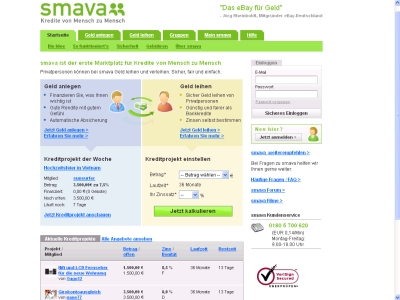
Smava starts p2p lending in Germany
Startup Smava.de starts offering p2p lending in Germany. Anybody can lend or request a loan online. Borrowers, after registering will by checked for identity and credit grade by smava. Smava uses PostIdent (a service offered by German postal service Deutsche Post) to verify the identity of the borrower and relies on credit report information from Schufa, a leading German credit bureau. Smava is only open to borrowers with credit grades A to F (which smava says leads to expected default rates between 1.4% and 7.2%).
After validation the borrower can post his request which can range from 500 to 10000 Euro and state the interest rate he is willing to pay. Lenders can bid in intervals of 500 (minimum) Euros.
If the loan request is fully funded the loan is payed to the borrower which will repay it in monthly rates for a period of 36 months. The borrower has the right to payoff early anytime (without any additional fees).
Smava does not take fees from the lenders. Smava charges 1% fee of the loan amount from the borrower.
An interesting though complicated instrument are the so-called Anleger-Pools (engl. lender pools). The purpose of these is risk spreading over all loans of a given creditgrade. Say a specific B loan is not payed back. In this case this would lower the repayment on all B loans (not just this specific one). Does this mean the lender can invest in any loan regardless of description. No because this instrument applies only to repayments not to interest due.
Due to German regulation smava, which is a startup founded as limited company, had to partner with a bank. While there are different views on whether under German laws a banking licence is required to run a p2p lending platform or not, Smava chose the safe route by partnering with the ‘Bank für Investments und Wertpapiere AG (BiW)’. This way deposits are secured by the German Einlagensicherungsfonds. Deposits which are not lend out, do not earn interest.
Some interesting feature, when viewed in comparison to Zopa, Prosper and Boober:
- There are individual listings (like Prosper)
- There are groups (like Prosper), but seemingly no group rewards
- There is no auction bidding down interest rates (or I missed it)
- In case of non-payment (for over 40 days) smava has the right to sell the loan to the collection agency Intrum Justita for a percentage of the value
- maximum a lender can loan is 25000 Euro
- maximum per loan is 10000 Euro
- minimum bid is 500 Euro
- only German residents can borrow or lend
- no interest on unlend deposits
- simple fee structure (borrower pays 1% of loan amount), no late or other fees
- new Anleger-Pool (lender pool) concept for risk spreading on defaults within same credit grade
The management team behind Smava has a lot of ecommerce experience. I could not determine when smava launched publicly, according to forum and loan activity it can have been no more then a few days ago.
Smava already received press coverage by a large regional newspaper.
P.S.: If you blog about this a link back here would be appreciated. Thank you!
Permalink:https://www.p2p-banking.com/uncategorized-smava-starts-p2p-lending-in-germany/
Trackback:https://www.p2p-banking.com/uncategorized-smava-starts-p2p-lending-in-germany/trackback/