In January 2012 I wrote down my predictions for p2p lending developments in 2012. The black text is my original prediction, with the review added in green and yellow.
Deeper integration of mobile (probability <25%) Can you use a p2p lending service from a Smartphone? Sure. Some even have special apps for that purpose. But that’s not what we are talking about here. We are at the advent of a couple years timespan where several players (compare this infographic) will be fighting over market shares in the developing mobile payment market. If there is a role for p2p lending services, it is yet undiscovered (aside from the use p2p microfinance makes of it in underdeveloped countries). No action so far.Continue reading →
Roughly a year ago I came across an idea that sounded extreme. There was a crowdfunding pitch for a startup that had no team and no idea. What? Well the idea was that the startup once founded would use the ‘Design Thinking’ method to develop the idea and the business model in the first months after funding and company foundation. The pitch was for 100,000 CHF. It had a strange appeal to me, so I invested a small amount. The pitch did fully fun and 4 applicants – students of the university of St. Gallen, Switzerland – were recruited as founders and off they went. The founders are not paid a salary but compensated in shares for their work.
Soon the appropriately named ‘ Design Thinking Startup AG’ was incorporated.
One year of development
As investor I received nearly weekly updates newsletter-style on what the team was currently up to. Through 38 of these reports I was fascinated by successes, drawbacks, ideas and lots of work done. Initially the team sought idea and coaching, used the Design Thinking method to identify problems (needfinding) and did market research. Finally around week 11 one of the ideas substantiated into the idea that was developed.
In between there were events for investors and shareholder meetings approving the decisions proposed by the team.
Then a prototype was built, a development company contracted, the team moved office to Zurich and a second funding round was raised (again through crowdinvesting). During the last weeks the product was presented, tested and finalized in a closed beta.
Rothschild, through its RIT Capital Ltd investment trust, invested into p2p lending service Zopa. Their VC fund Augmentum Capital has led a “multi-million pound” round which for Zopa is the series D round. Forward Venture Partners as well as previous backers Bessemer Venture Partners and Wellington Partners participated in the investment. Details of the transaction were not disclosed.
Two month ago, when p2p lending service Isepankur opened up to investors from all EU countries, I started lending there. In this post I look at the status of the portfolio I have built so far.
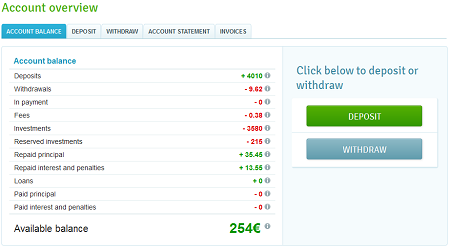
I have deposited 4,000 Euro (approx. 5,200 US$) over the past weeks. The account currently has 254 Euro in cash, 215 Euro waiting in bids on loans to close and the majority of 3,580 Euro is invested in loans. I invested usually between 10 and 35 Euro per loan. The average interest rate of the loans is 25% and loan terms are between 1 and 36 months with most loans running for 24 months or longer. Most of the investments were done using the automatic bidding feature: About two thirds of the loans are fully funded by automatic bids the minute they appear on the marketplace. It is therefore necessary to use the automatic bidding, or these loans will be missed investment opportunities.
Screenshot of Account Overview
Repayments
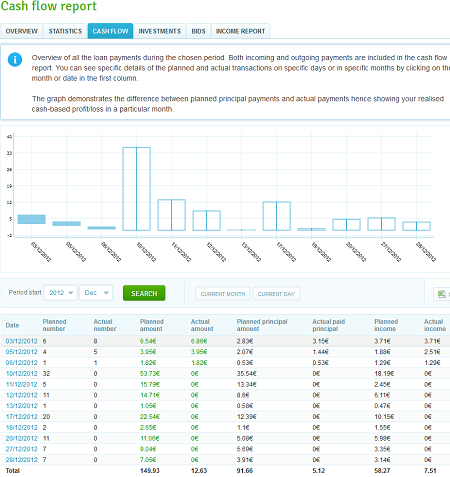
So far nearly all repayments came on time. Of the few who missed a payment date, all but two repaid the next day. Currently only one loan (10 Euro) of my portfolio is a few days overdue. One loan was fully repaid early after only one month. In December I have scheduled repayments of 149 Euro which consist of 91 Euro principal and 58 Euro interest. In January – with more loans reaching first repayment date – repayments will rise to over 250 Euro. Isepankur offers monthly and daily charts forecasting cash flow.
Screenshot of Isepankur cashflow view for my portfolio showing payment dates and amounts in December
Statistics
The portfolio management has a statistics section that daily calculates the return on investment. Continue reading →
Starting April 2014 p2p lending in the UK shall become a regulated activity. There are no further details yet, the Treasury said the aim of the coming consultations was to get the details right. The leading British p2p lending marketplaces Zopa, Ratesetter and Fundingcircle welcome the prospect of regulation.
British p2c lending Fundingknight, a service facilitating p2p loans to British companies, yesterday launched auction bidding. Basic requirements for companies to be eligible to submit a loan application are:
The business must have at least two years trading history
They must be limited companies registered at companies house
And finally, they must be UK based businesses with a UK bank account
Fundingknight then uses the following criteria to decide if the application will be listed on the marketplace
Is the business well managed?
Is the company realistic about risk?
Will the business generate enough cash to repay the lenders?
Fundingknight launched in September 2012. There is no data publicly available on the loan volume to date.