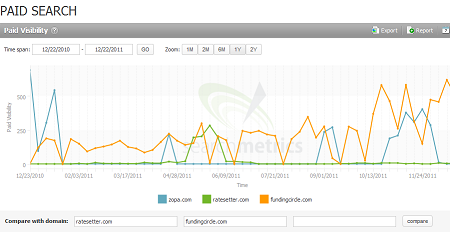
I did some research on use of Google Adwords in the online marketing strategy of Zopa, Funding Circle and Ratesetter.
Who is most active in search engine advertising?
I was surprised to see that Funding Circle is the most active in advertising on Google Adwords.
The chart shows that Fundingcircle had active ads nearly the whole year, while Zopa ran the ads only for certain intervals and Ratesetter only gave it a small try. Continue reading →
Yesterday I invested a small amount and will become a shareholder of Crowdcube Ltd., which runs the British p2p equity marketplace Crowdcube.com (see earlier articles about Crowdcube). Crowdcube is currently using it’s own platform to raise 300,000 GBP (approx. 470K US$) for a stake of 9% in the company.
If you decide quick, you can become a shareholder of Crowdcub too (minimum investment is 10 GBP). For UK residents investments of over 500 GBP mean they are eligible for a 30% income tax rebate under the EIS scheme. At the time of this writing the pitch is 54% funded and it looks like it will fully fund within the next days.
Crowdcube provides a slide presentation and a forecast. The forecast is a bit sketchy with some figures being debatable in my view but overall I think Crowdcube is a promising venture for the following reasons:
The founders achieved quite a lot in the short time since launch
Good marketing angle. New pitches might allow them to uphold high PR resonance (at least locally and industry sector specific). With luck and craftsmanship they might achieve equal marketing spin in p2p equity as Kickstarter has achieved in crowdfunding
I expect p2p equity in UK to get a boost by rising tax reliefs (50% !) under new SEIS scheme (see yesterday’s post)
Crowdcube, if growing fast, might reach a level where (for UK) it profits from network effect. However the pitch is missing competitor analysis and strategies to deal with them.
Good revenue/cost ratio. With less (technical) complexity than say Zopa or Ratesetter (but much higher risk for investors in pitches)
Should they succeed in creating a secondary market that is not awkward/clumsy in the future, then that will heighten the attractiveness for investors as it offers liquidity for the investments
I am fairly optimistic that the influx of pitches won’t be a problem. It is hard to gauge how the funding success percentage of these will be as that depends on the quality of pitches. The single biggest threat to Crowdcube’s business model in my view is the prossibility of one of the companies funded at the market place failing big time and leaving very unsatisfied investors.
I plan to post further reviews of the progress (naturally I won’t share any confidential data made available to shareholders).
German laws require a banking license to hand out loans. To comply with regulation the two active German p2p lending services partner with a transaction bank, which originates funded loans and then sells the debt claim to the individuals (‘lenders’) that did bid on the loan request on the p2p lending marketplace. Smava now switched it’s bank partner. Since Smava’s launch in 2007 the bank partner was the biw Bank für Investments und Wertpapiere AG. For all new loans after Dec. 1st, Smava cooperates with the Fidor Bank AG (see earlier coverage on Fidor). Smava feels that Fidor is a great match and praises the integration advantage Fidor offers with its web APIs. The change does not bring any immediate benefits for lenders other than a) unlend money will now earn 0.5% interest p.a. and b) the e-money license of Fidor allows lenders to start lending without verifying identity first – but that’s rather symbolic as it applies only to amounts of up to 500 Euro (and the minimum bid on Smava is 250 Euro) meaning that new lenders could test Smava with up to 2 bids before going through postal identification process.
P2P Equity
Smarchive, the fourth startup pitching at German marketplace Seedmatch (see earlier coverage on Seedmatch) raised 100,000 Euro in less than 3 days. The pitch originally was for 50K, but was oversubscribed to the maximum possible amount (100K).
Seed Enterprise Investment Scheme (SEIS)
In the UK the market the surrounding conditions for the emerging p2p equity market get better and better. From April 2012 investors in eligible startups will be able to claim 50 percent income tax relief (on a maximum investment of 100,000 GBP per year). The minimum required investment is just 500 GBP per startup. The new law will replace the Enterprise Investment Scheme (EIS) which currently already offers a generous 30% tax break. The British government will also ease some of the restrictions of the current EIS scheme. The SEIS will bring a huge boost to p2p equity marketplaces in the UK. Maybe an idea to be copied in other legislations to foster startup foundation?
ThisisMoney on P2P Lending Risiks and Quakle
ThisisMoney has two (1,2) long articles on the failure of Quakle and risks associated for lenders with p2p lending in general. While not wrong, the articles oversimplify some things. And actually there are more risks for lenders then the two mentioned (compare my old article ‘For Debate: A Flaw in Current P2P Lending Models?‘). The author is a strong advocate of the P2P Finance Association: ‘Checking for the association membership is crucial. It’s a self-governing industry body, so does not carry the same weight as regulation by the Financial Services Authority – something the industry wants but lacks as yet – and is currently the best benchmark for those considering lending.‘. Not a bad advice, but with the association and the market so young, I see that as a bit of limiting, possibly excluding any new entrants that might launch.
I love unusual marketing ideas. Therefore I contracted Ross and Ed, 2 british students, to ‘advertise’ P2P-Banking and to support them in their quest out of college debt. You can read about their idea at BuyMyFace.com.
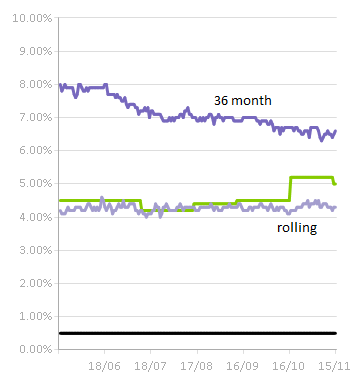
Borrowers needing a small loan can turn to p2p lending marketplace Ratesetter, which matches borrower requests with funding supplied by private lenders. Borrowers can choose a variable rate loan (rolling loan) or a 36 months fixed rate loan. Nominal rates for the 36 months loan have fallen considerably in the past six months from approx. 9% to now under 7% (that translates to a representative APR of slightly under 9%).
Ratesetter has facilitated over 10 million GBP in loans since its inception.
Last week Ratesetter completed raising series C round of funding, raising 1.5 million GBP (approx. 2.35 million US$). The total amount raised so far is 3 million GBP.
RateSetter CEO Rhydian Lewis said: ‘…RateSetter is continually working to narrow the spread between what Savers can earn on their money and what creditworthy Borrowers can pay. This investment will ensure that customers will continue to get great value and a great service‘.
UK startup Civilised Money has raised 100,000 GBP from 121 individual investors using the p2p equity platform Crowdcube. The investors will own 10% of the funding after the legal process of the funding is completed. The funding was completed in just 9 days, showing the potential p2p equity has in the UK.
Civilised Money plans to offer crowdfunding first and p2p lending in a second step. Katherine Byles of Civilised Money told P2P-Banking.com earlier this week that this is actually the second funding round for the company: ‘We have a first round of crowdfunded investment from ‘The Pillars’ 20 key supporters.‘.
Asked whether the technology is self-developed or licensed, she told P2P-Banking.com: ‘The technology is licensed. We have a one-off revenue share based licence for one of the most powerful and flexible P2P platforms available.  Through the core technology platform we will be able to roll-out a number of products, enabling us to cut the cost of using these – once funds are on the platform moving them between the different products is a simple and fast process.‘
Asked about the USP as compared with Zopa, RateSetter or Fundingcircle Byles said: ‘Civilisedmoney will offer all the people-to-people financial services products in one integrated service.  It has launched with crowdfunding. People-to-people loans are coming next. It is developing new products too. Civilisedmoney is becoming a one-stop-shop for all your people-to-people financial products that create a viable alternative to banks. …‘
The company has ambitious goals as a quote from information provided in the pitch shows: ‘While its service is not yet available in the U.S., CivilisedMoney’s plans are to expand from the U.K. to greater Europe, and then eventually to Africa and the U.S. (CivilisedMoney’s services offered will depend on region, since, for example, crowdfunding equity stakes for startups isn’t yet legal in the U.S.)‘.