The following table lists the loan originations of p2p lending marketplaces in May. Funding Circle leads ahead of Zopa and Ratesetter. I track the development of p2p lending volumes for many markets. Since I already have most of the data on file I can publish statistics on the monthly loan originations for selected p2p lending platforms.
Table: P2P Lending Volumes in May 2016. Source: own research Note that volumes have been converted from local currency to Euro for the sake of comparison. Some figures are estimates/approximations. *Prosper and Lending Club no longer publish origination data for the most recent month.
P2P lending platform Zopa will finance loans for customers of newly launched online mobiler retailer Unshackled.
Customers can fund the purchase of handsets by taking out a finance deal with Zopa. The APRs on launch will range from 9.7 per cent to 24.9 per cent. Customers will also be able to pay off early at no extra cost or make additional payments.
The partnership is Zopa’s first online retail agreement, with its service integrated in to Unshackled.com sales platform using the Zopa API.
Jaidev Janardana, Zopa CEO added: ‘With the majority of consumers getting a bad deal on their mobile phone, partnering with Unshackled means we can offer consumers better, fairer and more transparent deal in financing their phone.’
Today UK p2p lending service Zopa announced it will extend its product range to offer ‘Zopa Car ReFi‘, a refinancing product for car loans. It is positioned to allow consumers to refinance existing car loans at a better rate. Zopa’s credit risk algorithms, combined with in-depth vehicle information, act together to provide customers with a free and instant personalised savings estimate, prior to those customers taking out the product.
Ownership of the vehicle remains with Zopa’s Lenders until the final payment, when it will be transferred to the borrower.
Jaidev Janardana, Zopa CEO said, ‘We are thrilled to launch the UK’s first seamless car refinancing service, helping thousands of consumers drive down the cost of car ownership. This is a market worth £12bn per year with plenty of space for customer-first innovation – something we have specialised in at Zopa for over 11 years. Buying a car is by far the most common reason for a customer to take a personal loan from Zopa, so we are proud to now also offer a product that can help customers that already have a car on a finance agreement. …’
With everybody focussing on the larger p2p lending merketplaces, I think another current development in the space in the UK is happening without much attention. Looking at the numbers each months while the larger players go from strength to strength, some of the smaller marketplaces are in stagnation or even in decline in terms of volume.
Even with numbers fluctating monthly, it can’t be healthly to originate a few 100K each month over years whereas the total sector is doubling each year. Marketplaces have to pay employees, infrastructure and maintain and improve their technology. Add hefty marketing costs on top of that.
The struggeling ones are failing to attract enough new borrowers.
From an investor’s viewpoint there is little incentive to add funds on platforms that are not delivering much dealflow. Selection is superior on other marketplaces and even considering the advantages of diversification across platforms there are now so many choices that investors dedicate their largest amounts on probably not more than 3 to 6 different marketplaces. So every platform needs to compete to at least stay in the top 10 of attractiveness in its sub-category (e.g. consumer, property, SME, …).
So what happens to these platforms? Outright announced closures are rare (remember Squirrl?). With a lot of capital, time and effort spent, the management often hopes for a turn to the better, may it come in form of a new investor, opening up of a new sales channel or an exit/trade sale. Furthermore with an existing loanbook running, there isn’t any easy time to close down operations as the platform will usually have to continue to service the loans for the full remaining loan term. Continue reading →
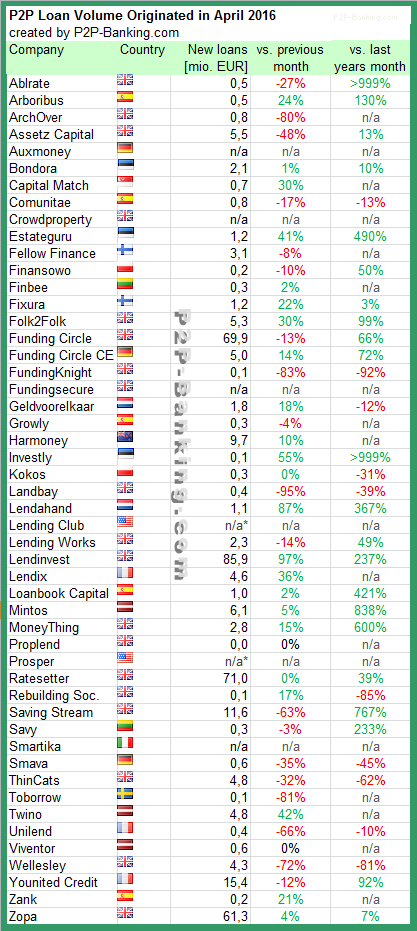
The following table lists the loan originations of p2p lending marketplaces in April. Lendinvest leads ahead of Ratesetter and Funding Circle UK. I track the development of p2p lending volumes for many markets. Since I already have most of the data on file I can publish statistics on the monthly loan originations for selected p2p lending platforms.
Last month Younited Credit (formerly Prêt d’Union) originated first loans in Italy. Geoffroy Guigou told P2P-Banking.com, Younited Credit had a great start, with 416,500 Euro loans originated.
Table: P2P Lending Volumes in April 2016. Source: own research Note that volumes have been converted from local currency to Euro for the sake of comparison. Some figures are estimates/approximations. *Prosper and Lending Club no longer publish origination data for the most recent month.
Earlier this week, I was at the FintechNorth event in Leeds, UK. A very well organized, small conference with about 150-200 attendants. After a welcome from Adam Beaumont, founder of aql and a chairman address by Dan Rajkumar, CEO of p2p lending marketplace Rebuildingsociety, who co-organized the event, Chris Sier, director of FiNexus gave a very interesting presentation on the current state of the fintech market and the economic context.
Very interesting event venue in former Salem church. Beneath the glass, that Chris Sier is standing on there is the server farm of Aql’s datacentre.
Chris Sier put forward the provocative thought that we are at a cusp of a new banking crisis [in the UK] because of the rise of peer to peer lending. His argument is that the rising market share of p2p lending marketplaces will take away that much working capital from the banks that it will critically diminish the ability of the banks to create credit.
Applied futurist Tom Cheesewright than gave his assessment of the current state of digital innovation, saying he is still optimistic but not as bullish as he was a few years ago on the prospects of fintech and digital transformation.
Another very interesting presentation was ‘The future of lending’ by Richard Carter, the CEO of Nostrum Group, which provides digital lending technology to banks, finance companies and brands (one of their clients is Lendable). He thinks that the biggest gamechanger could actually be that a company like Paypal, Facebook or Amazon starts to make lending offers to their customer and thereby makes use of the size of their existing customer base, the trust these customers have into the brand and the vast amount of data these companies have collected on their customers which will benefit them in the assessment of the credit risk. He showed a chart with portfolio balances of unsecured loans in the UK (Lloyds 9.6bn GBP, RBS 8.9bn GBP, HSBC 8.9bn GBP, Santander 5.5bn GBP, Barclays 4.9bn GBP, Zopa 1bn GBP). He expects to see totally different names on that chart in the future.
After the lunch break James Sherwin Smith presented Growth Street, a company that offers overdrafts to SMEs. One aspect he mentioned was that all talks with banks about collaboration opportunities so far led nowhere. The banks are unable/unwilling to understand that they need to regain the trust of their SME customers (‘only 13% of SMEs trust their bank to act in their best interest’).
Markus Simson of Ziraff and Tiit Pekk of Codeborne gave some fascinating examples of the efforts to digitize a whole country: Estonia. I was aware of the great progress before, but I find it striking over and over when I hear tidbits about what it means for everyday life. E.g. 99% of state services are online. Tax declaration takes 3 minutes now, but that is considered too long, therefore the next step is to make it ‘zero click’. 98% of medical prescriptions are handled online, no paperwork. Only marriages and divorces are still conducted offline. Wonder about the latter – too messy? Tiit claims to be able to setup a new mobile bank (including all regulatory compliance, KYC, AML, card services) within months. Continue reading →