CommunityLend to offer p2p lending in Canada

CommunityLend.com has announced the start of p2p lending in Canada on the site in fall 2007 enabling person to person lending without a bank as the middlemen, thereby eliminating banking fees. It promises lenders higher returns and borrowers lower interest rates and flexible payment options on loans. It aims to 'revolutionize the way lending works in Canada'. 

Earlier it will launch a working pre-view which allow users to test drive the site without using real money. CommunityLend expects useful user feedback during this work preview which it plans to use to enhance the site until the launch date.

CommunityLend is driven by an impressive team which includes Michael Garrity (Founder and President), ex-Bank of Montreal exec and BankWatch blogger Colin Henderson and John Philip Green, currently Director of Engineering at Affinity Labs and Co-Founder of of Savvica and Rapleaf.

CommunityLend profits as it can pick the best form the existing models (Prosper, Zopa). It will not just replicate one site. Few is known about the plans, but the announcement states that Community Lend will include auctions and groups (as does Prosper) as well as selectable paypack periods (as does Zopa).

Sources: p2p-kredite.com and others

P.S.: If you blog about this a link back here would be appreciated. Thank you!

Permalink:https://www.p2p-banking.com/uncategorized-communitylend-to-offer-p2p-lending-in-canada/
Trackback:https://www.p2p-banking.com/uncategorized-communitylend-to-offer-p2p-lending-in-canada/trackback/
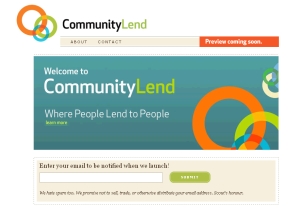
Communitylend preview

Zopa to branch out into additional markets

Zopa, a competitor of Prosper.com, is on it's way to enter two additional markets (aside from UK and the long planned launch in California), informed sources say.

This source stating Zopa will launch in Germany as next country, is a false report however. It is based on a misleading interpretation of a German newspaper interview.

A summary of the situation for p2p lending in Germany is published at p2p-kredite.com. It states that there are tough regulatory issues to be solved and that it is expected that a first service might launch in late 2007 or early 2008.

Boober.nl offers P2P lending in the Netherlands

I just became aware of Boober.nl a new service that brings the concept of peer-to-peer lending to the Netherlands. As far as I am aware of this is the third market (after Zopa in UK and Prosper in US) where p2p credits over the internet are possible.

Since you probably do not read Dutch (the boober website does not have an english translation) – here is a short summary of the service:

  • Boober takes a fee of 1% (0.5% from lender, 0.5% from borrower) plus 19.95 Euro fee from borrower for creditrating plus annual fee of 9.95 Euro from lender
  • Loans are possible for amounts from 1500 to 10000 Euros (approx 13000 US$)
  • Lenders can invest from as little as 5 Euro to a maximum of 250 Euro in an individual listing
  • Available terms are 6, 12, 18, 24, 30, 36, 48 and 60 months
  • Interest rates go up to 15%
  • As of today, there are 2 dozen open listings

Boober has more similiarities with Prosper than with Zopa since lenders can pick individual loans.The information available on borrowers listings is very limited but it has to be taken into account that boober launched only 2 weeks ago.

It will be interesting to see how Boober develops.

In case you are wondering what ‘Boober’ means. The website says that ‘Boober’ is the name of the dog of the founders, which they say is stubborn, creative and loyal.

Update: It is only possible to invest for lenders that are located in the Netherlands

Does FYGO have the better p2p-lending concept?

In a recent blogpost James Gardner argues that FYGO  may have an advantage over Prosper in P2P lending because with FYGO, you are either borrowing from someone you know directly, or who they know directly.

While it might be true that at FYGO the defaults will be lower than at Prosper, I do not think you can compare both approaches directly. They have different target audiences and are essentially different markets with very different conditions