MyC4 with new look – currency risk now to be covered by lender

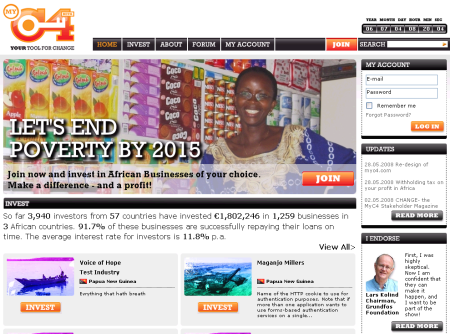
Today MyC4 presents itself in an all new shiny layout. On MyC4 lenders can give loans to small businesses in Africa. Unlike at Kiva, lenders at MyC4 earn interest. So far 1.8 million Euros (approx. 1.2 million US$) have been invested in loans and there are no defaults yet – only several late payments. With the new release …

… three key elements have been prioritized on the new website; usability, design and communication. We have made it easier to understand what MyC4 is all about, how to join, how to upload money, how to find a Business, which fits your criteria and lastly how you invest and re-invest.

According to MyC4 the changes in today's release are:

  • The look of MyC4.com has been updated
  • Improved navigation making it easier to find your way around via a top menu and a left hand menu with sub-levels
  • “Opportunity” changed to “Business” – to access the overview of Businesses, click on “INVEST” in the top menu
  • MyCredits is now changed to EURO (€)
  • The Investor now carries the Currency Risk
  • Withholding tax

I also noticed that MyC4 is no longer marked as "beta".
The handling of currency risk is a major change. The announcement email says:

At MyC4 we want to offer a sustainable and easy to understand solution for the African Businesses. The currency Risk has until now been carried by the African Business, but this has uncertainty for their loan conditions.

To ensure that MyC4 and the African Businesses are sustainable in the long run a new model for the Currency Risk has been developed. We now transfer the Currency Risk to the Investor, which has to be covered by the size of the interest rate you demand.

As a consequence please be aware that going forward there is a Currency Risk on your new investment when investing in some African countries. MyC4 cannot advise on the daily currency development, but based on the last 3 years currency fluctuation we suggest as a guideline that your add the following percentages to your normal wanted interest rate to cover for the potential Currency Risk;

Uganda 6%
Kenya 2%
Côte d’Ivoire 0%

This means that if you where planning to Bid on a Business in Kenya with an interest of 8% in mind you now add the 2% – so you Bid 10%, but will properly get 8% depending on the currency fluctuation over the period of the loan.

 Screenshot of MyC4 in new design
 MyC4 new release

Demand at Boober NL slows

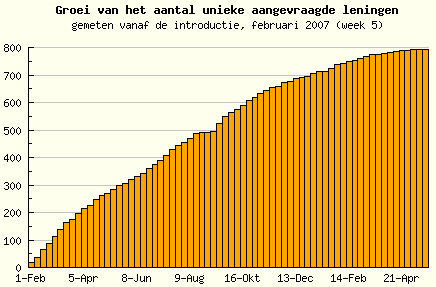
Demand at Boober.nl is slowing. When I checked today only two loan listings were open. The following curve showing unique loan requests definitly shapes in the wrong direction. Boober lenders discus this development in this forum thread.


(Source Booberwatch.nl)

Since the launch 15 months ago, about 2.4 million Euro (about 3.8M US$) loan volume has been funded through Boober.

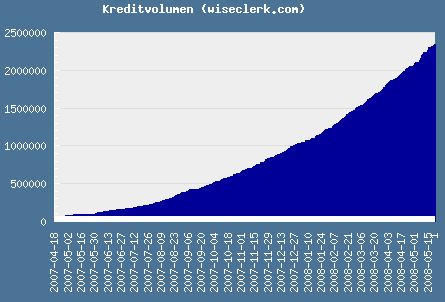
German Smava.de has funded about the same volume (2.3 million Euro) but after a slower start 14 months ago, lately the volume growth accelerated moderately.

Smava loan volume
(Smava loan volume, Source: Smava loan stats at Wiseclerk.com).

On Smava as well as on Boober average borrower interest rates have risen considerably since the start. This reduces the attractiveness for borrowers.

New p2p lending report

A new research report on peer to peer lending was published at VRL KnowledgeBank. The 200 pages PDF-report (table of contents), written by Ray Cain, can be purchased online. It covers the following issues:

  • What is P2P lending? Who are the main players?
  • What is their operating model and crucially their profitability projections?
  • What are the practical issues involved in building a large virtual community of lenders and borrowers, such as compliance, identity verification, credit screening, IT infrastructure, customer service and marketing? Can borrowers and lenders really be peers?
  • What short term lessons can financial services providers draw from P2P?
  • The future for P2P lending… is it an opportunity or a threat for the lending industry? How to blend P2P with other financial services? Can it be rolled out across the full range of mass market retail financial services?


Advanta doubles funds to Kiva loans

Credit card issuer Advanta entered into a partnership with Kiva. The initiative is called KivaB4BProject and Advanta will match the loans made by business card holders with up to 200 US$ per card. Card holders simply select a business owner to sponsor through Kiva and make a grant using their Advanta Business Card. Advanta matches that grant, dollar for dollar, and Kiva distributes the total resulting funds.

The loans funded by this project can be seen on this Kiva lender page. Already contributed to more than 500 loans.

When the project was announced at Advanta's headquarters, Advanta flew in Kiva borrower Senerita Lilli a dressmaker from Samoa to share her story.