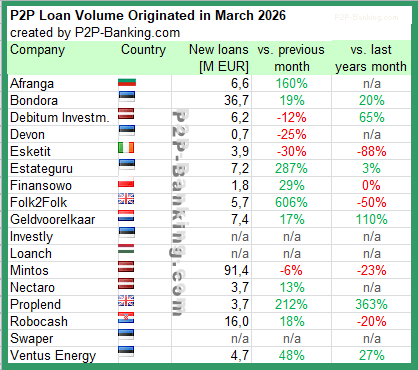
The table lists the loan originations of p2p lending marketplaces for last month. Mintos* leads ahead of Bondora* and Robocash*. The total volume for the reported companies in the table adds up to 196 million Euro. I track the development of p2p lending volumes for many markets. Since I already have most of the data on file, I can publish statistics on the monthly loan originations for selected p2p lending platforms.
Table: P2P Lending Volumes in March 2026. Source: own research Note that volumes have been converted from local currency to Euro for the purpose of comparison. Some figures are estimates/approximations.
The table lists the loan originations of p2p lending marketplaces for last month. Mintos* leads ahead of Bondora* and Robocash*. The total volume for the reported companies in the table adds up to 176 million Euro. I track the development of p2p lending volumes for many markets. Since I already have most of the data on file, I can publish statistics on the monthly loan originations for selected p2p lending platforms.
Table: P2P Lending Volumes in February 2026. Source: own research Note that volumes have been converted from local currency to Euro for the purpose of comparison. Some figures are estimates/approximations.
The table lists the loan originations of p2p lending marketplaces for last month. Mintos* leads ahead of Bondora* and Loanch* The total volume for the reported companies in the table adds up to 235 million Euro. I track the development of p2p lending volumes for many markets. Since I already have most of the data on file, I can publish statistics on the monthly loan originations for selected p2p lending platforms.
Table: P2P Lending Volumes in January 2026. Source: own research Note that volumes have been converted from local currency to Euro for the purpose of comparison. Some figures are estimates/approximations.
Two years ago I started investing on Inrento*. On the Inrento* platform investors select property loans secured by a first rank mortgage. Typical interest rates are around 9-10% with loan terms between 12 and 36 months. Inrento has a strong track record with zero late projects, 78 million EUR lent and around 4200 active investors. The home market of Inrento* is Lithuania, where it is fully regulated and most projects are located – the platform also featured projects in Poland, Latvia and occasionally other countries.
Sample Inrento project photo – click to enlarge
There are detailled project descriptions and regular updates. The minimum investment per project is 500 EUR.
good service (recently something did not go according to plan and a project I invested in was cancelled because the mortgage wasnot signed within the projected 20 days maximum. Inrento* paid all affected investors 0.35% cashback as compensation)
interest is paid monthly
fully regulated
On the downside there is
few new projects (about 1-3 per month), resulting in cash drag
new projects are often filled within hours after coming online
15% withholding tax applied; can be reduced and possibly offseted in tax declarations depending on the rules of the home country of the investor
no auto invest
Profit graph from my Inrento dashboard
Yield calculation from third party tool p2pdash – click to enlarge; shown figures are a little too low as the do not count secondary sales correctly
After roughly two years my yield is a little under 10% per annum. I can say only good things about Inrento*. The main gripe is the cash drag which is the result of the growing popularity of Inrento* among investors.
Other property platforms
Asterra Estate* is a property platform dedicated for a development project of a Latvian village. Loans are high interest around 15%. Minimum investment is 1000 EUR per loan. Interest is credited daily. Early exit feature available. Currently 4-7% cashback if you sign up via this Asterra Estate* link.
Devon* is a property platform with loans backed on Latvian property. Loan rates are around 10-15%. Minimum investment is 1000 EUR per loan. Interest is credited daily. Early exit feature available. 1% cashback (plus 4%-5.5% cashback during current spring campaign, depending on your investment level), if you sign up via this Devon* link
Estateguru* is a fully regulated Estonian platform, featuring loans secured by properties mainly across the Baltics and Finland. Minimum investment is 50 EUR per loan. Secondary market available.
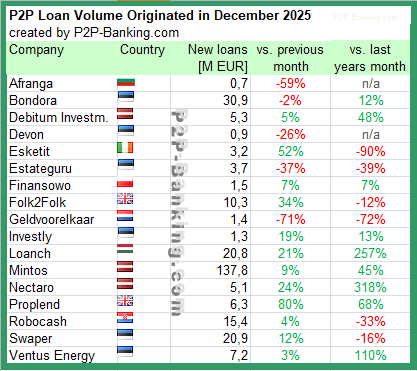
The table lists the loan originations of p2p lending marketplaces for last month. Mintos* leads ahead of Bondora* and Swaper*. The total volume for the reported companies in the table adds up to 274 million Euro. I track the development of p2p lending volumes for many markets. Since I already have most of the data on file, I can publish statistics on the monthly loan originations for selected p2p lending platforms.
Table: P2P Lending Volumes in December 2025. Source: own research Note that volumes have been converted from local currency to Euro for the purpose of comparison. Some figures are estimates/approximations.
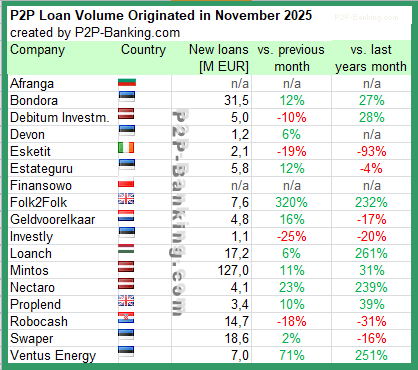
The table lists the loan originations of p2p lending marketplaces for last month. Mintos* leads ahead of Bondora* and Swaper*. The total volume for the reported companies in the table adds up to 253 million Euro. I track the development of p2p lending volumes for many markets. Since I already have most of the data on file, I can publish statistics on the monthly loan originations for selected p2p lending platforms.
Table: P2P Lending Volumes in November 2025. Source: own research Note that volumes have been converted from local currency to Euro for the purpose of comparison. Some figures are estimates/approximations.